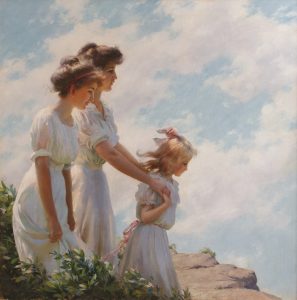
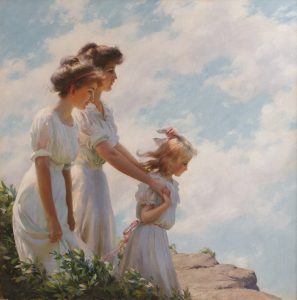
 On the Cliff (1910), by Charles Courtney Curran. (Photo courtesy Albany Institute of History and Art)
Known for his American Impressionist style and Gilded Age sensibility, American artist Charles Courtney Curran’s (1861–1942) works are quite at home in the Music Room at the Flagler Museum. a room designed for concerts, reflection and harmony.
Titled Golden Hour: Charles Courtney Curran and the Romance of American Impressionism, the exhibit runs through Sunday, May 24, and traces his career from his birthplace in Ohio to New York, Paris, and the mountaintop artists’ colony of Cragsmoor, N.Y., in the Hudson Valley. Curran spent four decades there capturing a leisurely lifestyle outdoors in nature filled with sunlight, flowers, trees and idealized images of women.
“In our present moment, defined by speed, distraction and constant visual noise, Curran’s work feels unexpectedly urgent,” says curator Campbell Mobley. “These paintings require us to slow down. They reward close looking. They model attentiveness.”
“There is something radical about quiet beauty today,” she says.
Mobley says the exhibit is significant in a number of ways.
It reintroduces Curran not simply as a painter of charming outdoor scenes and beautiful girls in dresses, but as an artist deeply committed to atmosphere and to the emotional power of light. She says that at a moment when American art history often privileges rupture and modernism, this exhibition reminds us that another current was equally powerful: the desire to preserve beauty, calm and intimacy in a rapidly changing world.
The show also situates Curran within a broader cultural conversation, that of American Impressionism, as an expression of optimism, refinement and leisure at the turn of the 20th century. His paintings reflect a society negotiating progress while longing for stillness.
In addition to a selection of his paintings, the exhibit includes rarely seen works, early portraits, and period women’s lingerie-style dresses, similar to ones in his paintings. There are black-and-white photographs of the artist along with family and friends from his time in Cragsmoor and copies of old magazines with his work featured on the covers of the 1929 Literary Digest, Arts and Decoration from 1920 and a cover of Truth magazine from 1899.
There is also memorabilia from his paintings — watercolors, oils and a pastel — which were shown at the World’s Columbian Exposition of 1893 (the Chicago World’s Fair) and for which he earned a bronze medal.
The “Golden Hour” title of the show, according to the Flagler description, comes from “the most seductive moment in painting: the instant when light softens, edges blur and the world seems almost too beautiful to be true.”
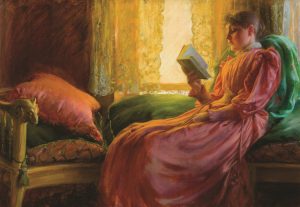 Girl in Window Seat (1892), by Charles Courtney Curran. (Photo courtesy Albany Institute of History and Art)
Curran highlights this golden hour in many of his paintings, which belong to the same Gilded Age cultural moment that shaped the construction of Whitehall in 1902 — a time when leisure was curated, beauty was a form of capital and the modern world of the early 1900s valued refinement.
Known for his ability to conjure luminosity in his paintings and for his romantic subject matter filled with sun-drenched, optimistic scenes of young women outdoors, often with flowers or trees in bucolic settings, Curran’s reputation has increased over time. His tonal harmonies and colors that change with the light reveal an artist attuned to atmosphere — a sensitivity evident in the works featured in the exhibition.
A portrait of the artist from 1931, painted by his friend and colleague, Alphaeus Cole, depicts Curran after 30 years at Cragsmoor, looking at the viewer, dressed in a suit and tie with wire-rimmed glasses, sitting in front of one of his own paintings of a group of women on a rocky ledge, silhouetted against a blue summer sky and a view of the valley beyond.
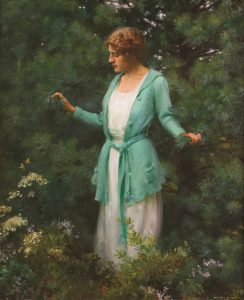 The Green Jacket and White Pines (1922), by Charles Courtney Curran. (Photo courtesy Albany Institute of HIstory and Art)
In his 1922 oil on canvas The Green Jacket and White Pines, a woman wearing a loosely tied light green jacket over a white blouse stands in front of a background of darker green pine trees, each hand holding a spray of pine needles. The painting, in essence, is a color study of greens and of textures — the detail and texture of the needles providing a contrast to the subtle simplicity of the woman’s figure. The scene is punctuated by small bursts of white flowers, adding contrast to the harmonious mood of the painting.
In a deviation from his outdoor naturescapes, Curran explored other genres of art, including Symbolism, which he was exposed to during his studies in Paris between 1888 and 1891.
The Sirens, based on a scene from Homer’s The Odyssey, is an example of this style as is his 1898 painting, The Peris. In it, Curran explores mythology, fantasy and dreams. The Peris, according to Persian folklore, are supernatural creatures that thrive on the fragrance of roses. He depicts five romantic nymph-like figures floating in white gossamer gowns outside in a garden of soft pink roses.
The otherworldly ambiance and ethereal nature of the Peris are reflected by his use of pale, iridescent colors, creating the effect of an imaginary, enchanted, dream-like world.
Illustrating his signature style of care-free summers and women in flowing summer frocks, On the Cliff, his 1910 masterwork from his years at Cragsmoor, depicts two young women and a young blonde girl (the artist’s daughter, Emily), dressed in white, standing on a large rock, gazing into the valley below. A vast blue sky covered with white linen clouds forms the backdrop for the painting. The effect is again, romantic, soft, muted and idealized — offering “a luminous vision of summer at its most poetic.”
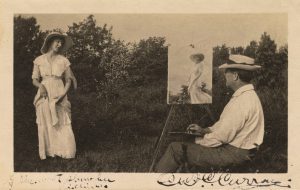 Charles Curran and model Dorothea Storey at Cragsmoor, c. 1914-16. (Photo courtesy Albaniy Institute of History and Art)
Mobley says the show invites guests to linger, to experience art, not as spectacle, but as atmosphere.
“If someone walks out and notices the late afternoon sun differently, or feels a little calmer than when they entered, then the exhibition has succeeded,” she says. “Curran and the golden hour remind us that sometimes the most profound experiences are quiet ones.”
As a whole, the works in the Golden Hour showcase an artist devoted to capturing beauty and its ephemeral nature — the sunlight on a dress, the flowers in the garden, the blue sky, the quiet of a summer afternoon, or the dreamlike nature of spirits. Far from being dated, Curran’s vision and artistry still feel fresh, reminding viewers of a simpler time and a world where leisure, nature and light were worthy of study — the very essence of Curran’s own golden hour.
If you go
What: Golden Hour: Charles Courtney Curran and the Romance of American Impressionism
Where: Flagler Museum, 1 Whitehall Way, Palm Beach
Tickets: $28, $14 for children ages 6-12. Hours: Tuesday through Saturday, 10 am to 5 pm; Sunday, noon to 5 pm. Call 561-655-2833 or visit flaglermuseum.us.