image:
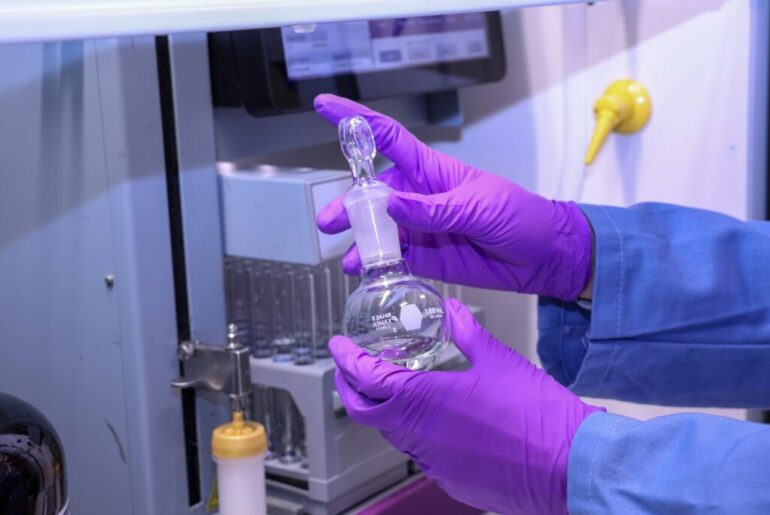
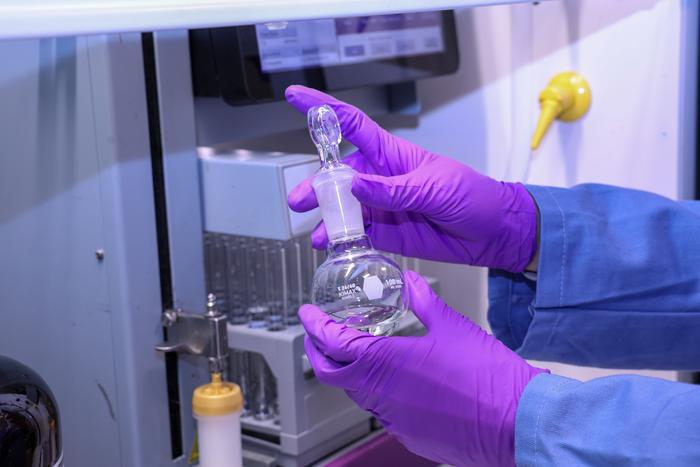
Postdoctoral fellow and co-first author Dongyoon Kim demonstrates some of the equipment used to craft the new ionizable lipids.
Credit: Bella Ciervo, Penn Engineering
The most common side effects of mRNA vaccines like the COVID-19 shot are well known: soreness, mild fever and general malaise. Those symptoms, which typically resolve within days, are the natural result of the immune system activating. But what if they could be avoided?
In Nature Materials, researchers at the University of Pennsylvania describe how they modified lipid nanoparticles (LNPs) — the delivery vehicle for the mRNA-based COVID-19 vaccines — to outperform leading, commercially available formulations while reducing common vaccine side effects in pre-clinical tests of human cells and mouse models.
By changing the structure of the ionizable lipid, a core part of LNPs, the researchers boosted the metabolism of key immune cells, providing the energy necessary to gird the body’s defenses while dialing down the inflammatory signals that often cause fever and fatigue. The chemical tweak also enhanced on-target delivery of the nanoparticles to immune organs like the lymph nodes.
“This is an early step, but it opens the door to a new generation of mRNA vaccines that are more potent and better tolerated,” says Michael J. Mitchell, Associate Professor in Bioengineering (BE) and the study’s senior author. “Instead of accepting a trade-off between efficacy and side effects, we’re beginning to see that chemistry can help us improve both.”
More Than a Delivery Vehicle
Historically, LNPs have been viewed primarily as delivery vehicles, ferrying genetic instructions and other therapeutic cargo into cells. But, as the Penn researchers demonstrated for the first time, LNPs can also modify the metabolism of immune cells to enhance the efficacy of mRNA vaccines.
“We tweaked the standard lipid recipe by adding a new ingredient,” says Dongyoon Kim, a postdoctoral fellow in BE and the study’s co-first author, referring to imidoester cross-linkers, chemical groups whose connective ability expanded the possible range of ionizable lipid structures.
The best-performing lipid, dubbed C12-2aN, in reference to its chemical structure, boosted the metabolism of dendritic cells, which play a crucial role in teaching the immune system what viruses or pathogens to attack after receiving a vaccine. “These immune cells function a bit like engines,” adds Kim. “When they detect a threat or virus and need to shift gears into ‘defense’ mode, they shift their fuel source, meaning that they change what kind of energy they use.”
In both human dendritic cells and mouse models, LNPs built with C12-2aN increased the expression of genes involved in glycolysis — a rapid form of energy production that metabolizes the sugar glucose. The treated cells also showed increased production of lactate, the same compound that builds up in muscles during intense exercise.
Crucially, the metabolic boost came without a loss in vaccine performance: in a mouse model of mRNA-based COVID-19 vaccination, the redesigned lipid performed on par with FDA-approved formulations. “This shows that we can make LNPs with more than one function,” says Kim. “With the right ingredients, these particles can deliver mRNA cargo and regulate immune cell metabolism at the same time.”
Reducing Inflammatory Symptoms
Normally, stronger immune activation within a vaccine comes with a cost. As immune cells teach themselves to identify a pathogen or ramp up to fight an active infection, they release inflammatory molecules that help coordinate the body’s response, but that can also cause fever and fatigue. The new lipid appears to break that pattern.
“These lipids activate the immune system in a way that appears more controlled and confined to the immune cells,” says Amanda Murray, a doctoral student in the Mitchell Lab and co-author of the study. “The dendritic cells are getting the energy they need to mount a protective vaccine response without triggering the same level of widespread inflammation that we normally experience after a vaccination, which causes common symptoms such as fever and muscle aches.”
Compared to an FDA-approved ionizable lipid, LNPs built with C12-2aN lowered the expression of genes associated with systemic inflammation in human cells and mice, and reduced levels of inflammatory markers in the mice’s bloodstreams. Mice that received the redesigned lipid also experienced smaller increases in body temperature than those treated with a standard lipid.
“Activating the immune system is essential for an effective vaccine,” adds Murray. “But thanks to the new lipid’s metabolic boost, that activation may be attainable without the usual side effects that make people complain about getting their vaccines.”
Improved Targeting and Delivery
One challenge for LNPs is off-target delivery. Like delivery trucks taking the wrong exit off the highway, nanoparticles often end up accumulating preferentially in the liver instead of in lymphoid organs, where immune cells coordinate the body’s response to a vaccine. But with the C12-2aN lipid, the same chemical changes that boosted dendritic cell metabolism and decreased systemic inflammation also enhanced on-target delivery of LNPs.
Compared to an FDA-approved formulation, the redesigned LNPs delivered more than three times as much mRNA to the lymph nodes relative to the liver. “The new ingredients imparted a positive charge,” notes Kim. “That seems to have affected how the particles interact with tissues and proteins, helping steer them more often toward the right destination.”
Future Directions
While this study focused on dendritic cells, the researchers also found that changes in lipid chemistry promoted glycolysis in other types of immune cells, suggesting that engineered ionizable lipids could help regulate immune cell metabolism in other diseases, including cancer, autoimmunity and other immune-mediated disorders.
“This study shows that rationally designing lipid chemistry allows us to do more than improve delivery,” says Mitchell. “We can begin to intentionally shape immune cell metabolism, opening new avenues for immune engineering beyond vaccines.”
This study was conducted at the University of Pennsylvania School of Engineering and Applied Science and supported by an American Cancer Society Research Scholar Grant (RSG-22-122-01-ET) and an NSF Graduate Research Fellowship (Award 1845298).
Data for this project was generated in the University of Pennsylvania’s CDB Microscopy Core and Small Animal Imaging Core Facility (RRID:SCR_022385). Data was also generated in the Penn Cytomics and Cell Sorting Shared Resource Laboratory at the University of Pennsylvania (RRID:SCR_022376) and the Pancreatic Islet Cell Biology Core supported by the University of Pennsylvania Diabetes Research Center (DRC).
Additional co-authors include co-first author Ningqiang Gong of the University of Science and Technology of China; Emily L. Han, Jinjin Wang, Ellie Feng, Qiangqiang Shi and Kaitlin Mrksich of Penn Engineering; Mohamad-Gabriel Alameh and Drew Weissman of Penn Medicine; Il-Chul Yoon of Penn Arts & Sciences; Hanxun Wang of Shenyang Pharmaceutical University; and So-Jeong Moon of Hanyang University.
Method of Research
Experimental study
Subject of Research
Cells
Article Title
Crosslinked ionizable lipids reprogram dendritic cell metabolism for potent mRNA vaccination
Article Publication Date
17-Mar-2026
COI Statement
Dongyoon Kim, Ninqiang Gong and Michael J. Mitchell have filed a patent on the lipid nanoparticle technology disclosed in this manuscript. The other authors declare no competing interests.