Editor’s Note: Join Lexipol, Police1 and our partners for First Responder Wellness Week from March 23-27, 2026. Each day, we’ll provide webinars, articles, videos and more, all within the overarching theme of being “Total Wellness. True Readiness.” Register for five wellness webinars now.
By Lt. Randall L. Combs
Police wellness programs today look nothing like they did a decade ago. Peer support teams are active and trusted. Clinicians are embedded inside departments instead of waiting off-site. Employee Assistance Program (EAP) staff understand police humor, police stress and police culture. For all the progress, though, officers across the country continue carrying a specific kind of pain that rarely gets named — and hardly ever gets treated.
Moral injury.
It isn’t the jump-scares of traumatic memory or the adrenaline storms associated with fear. Moral injury hits somewhere deeper. It settles into the places where officers store their identity, values, loyalty and sense of who they are when the uniform comes off. It takes root when an officer feels their actions or decisions broke faith with their own internal moral compass — or when the system they serve fails to live up to its promises. For some officers, it feels like guilt; for others, like betrayal. For many, it feels like something they can’t explain at all.
| REGISTER: Access five wellness webinars built for real-world readiness
And while clinicians play a vital role in wellness programs, there are moments in policing when the real wound isn’t a psychological one. It’s moral. It’s spiritual. It’s about meaning.
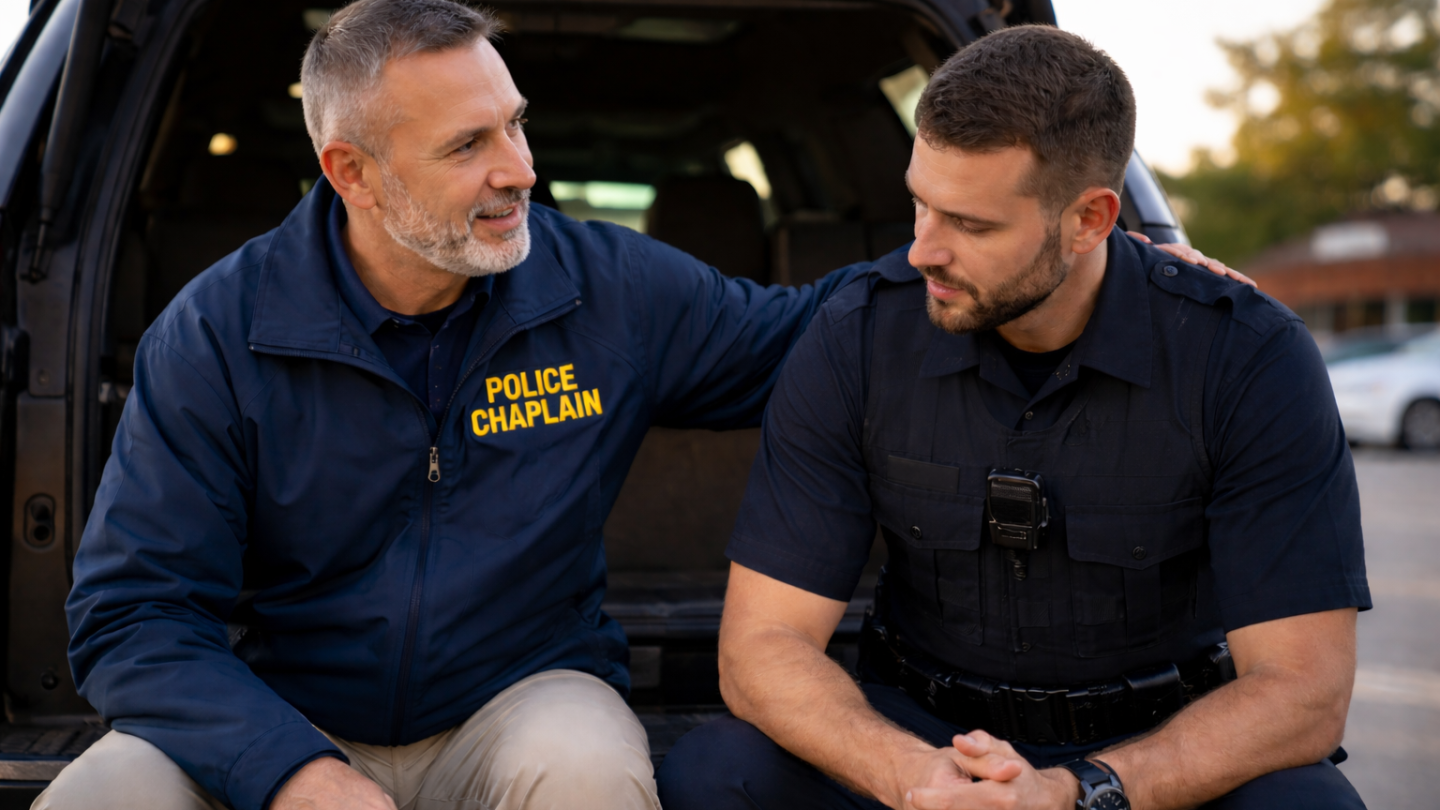
This is the space where trauma-informed chaplaincy belongs — not as an afterthought, but as a fully integrated part of wellness.
What moral injury looks like in day-to-day police work
Moral injury doesn’t show up in one predictable form. It sneaks in through different edges of the job:
The shooting you replay long after the investigation clears youThe child you couldn’t reach in timeThe victim whose story haunts you because you knew it would end the same way next monthThe leadership decision that contradicted everything you thought you believed about fairness and loyalty
| RELATED: Moral injury: What is it and how does it impact first responders?
These experiences don’t just raise clinical symptoms.
They raise moral questions:Did I do the right thing?Why does a justified action still feel wrong?What kind of person am I becoming?Why is this job changing me in ways I don’t want?
Those are not the kinds of questions an officer brings to a supervisor or a therapist in the first five minutes of a session. But they will bring them to someone who can safely explore the moral and existential fallout of the work.
That’s where a trained chaplain belongs.
| PODCAST: How peer support and police chaplains build wellness in law enforcement
What spiritual care actually is (and isn’t)
In policing, “spiritual” conversations often get misunderstood. This isn’t about converting anyone, quoting scripture or asking officers to embrace a belief system.
Spiritual care in a wellness context simply means dealing with the parts of trauma that touch:
MeaningPurposeIdentityMoral coherenceThe sense of being a “good person”
The military has spent years studying this dimension of trauma. They found that when chaplains work alongside clinicians, service members recover more fully. Officers are no different. They frequently approach chaplains with questions they don’t know how to articulate anywhere else:
“If I did everything right, why does this still feel wrong?”“How do I look my family in the eye after what I saw today?”“What do I do with this guilt that doesn’t go away?”
A chaplain’s role is to help untangle these deeper moral knots while complementing — not competing with — traditional counseling.
| RELATED: 5 things to know about police chaplains
The underuse problem
Although most agencies have chaplains, their potential is usually untapped.
In many departments, chaplains are:
Seen only at ceremoniesCalled mostly for notifications or hospital visitsRarely included in wellness planningSiloed away from clinicians and peer supportInvisible in the day-to-day rhythm of the department
The result: one of the most cost-effective, culturally resonant wellness resources is sitting underused while officers struggle with the exact type of distress chaplains are trained to help with.
In the video below, Dr. Jaime Brower discusses why peer support matters at every level of an agency — from line officers to command staff — and how small, proactive gestures can strengthen resilience and reinforce a culture of care.
Chaplains: The wellness resource officers turn to first
Research across multiple departments and chaplaincy organizations has consistently shown that officers are often more willing to approach a chaplain than a clinical counselor during times of personal or professional crisis.
In surveys conducted by law enforcement chaplaincy associations and police wellness programs, officers reported several reasons for this preference: greater trust, lower stigma, cultural familiarity, and the perception of chaplains as “safe” and non-judgmental listeners.
Officers also describe chaplains as uniquely approachable because they are not part of disciplinary systems, do not write reports on officers, and understand the moral and human dimensions of the work without relying on clinical terminology.
In some departments, wellness assessments have shown that officers were two to three times more likely to initiate support conversations with a chaplain than with a mental health professional, especially in the first hours after a difficult call. This doesn’t diminish the role of clinicians — it highlights how chaplains can act as a bridge, helping officers take the first step toward deeper care when needed.
| RELATED: When is the right time for therapy for first responders?
What trauma-informed chaplaincy actually looks like
A modern chaplaincy model — especially one guided by lessons from the military — moves far beyond tradition. It includes:
Full integration into the wellness team: Chaplains should participate in the same conversations and strategy sessions as clinicians, peer support members, EAP staff and command staff.Specialized, mission-aware training: Chaplains need preparation in trauma-informed pastoral care, moral injury, grief work, crisis spiritual care and police culture.A defined role in post-critical-incident response: Their job is meaning-making — helping officers interpret events in a way that doesn’t destroy their identity.Clear and familiar access pathways: Officers should know how to reach a chaplain and what’s confidential.A consistent presence before the storm: Chaplains earn credibility through ridealongs, roll call visits, family support and simple everyday presence.Supervisor literacy in moral injury: Supervisors can catch early signs — withdrawal, resentment, identity fatigue, cynicism — and facilitate early support.
| RELATED: 5 steps officers can take to process emotions after a traumatic event
What departments can gain & what leaders can do
When chaplains are woven into the wellness system instead of floating around the edges, departments see tangible improvements:
Officers engage more willingly in wellness servicesRecovery after difficult calls improvesTrust between line officers and leadership strengthensSuicide risk tied to moral despair decreasesDepartments retain officers who might otherwise burn out
This happens because trauma-informed chaplaincy doesn’t replace other wellness practices — it fills the gap they cannot.
And, it’s important to note that a department doesn’t need a massive overhaul. Leaders can start by:
Appointing a chaplain who understands policingSupporting professional chaplaincy trainingCreating a policy defining chaplain roles at critical incidentsPiloting chaplain integration in a high-stress unitIntroducing chaplains clearly during roll callUsing officer feedback to refine the programThe leadership takeaway
Officers aren’t just carrying traumatic memories — they’re carrying moral burdens. And when those burdens go unaddressed, they slowly undermine identity, purpose and trust.
A trauma-informed chaplain offers a safe place to process the wounds that cut closest to the soul of the profession. Departments that recognize this reality — and act on it — strengthen not only their officers but the fabric of the organization itself.
Trauma-informed chaplaincy isn’t an add-on. It’s the missing piece that helps officers stay whole.
NEXT: In the video below, learn why normalizing emotional processing after critical incidents is essential — and what officers can do in the hours and days that follow a traumatic call.
About the author
Randall L. Combs is a police lieutenant and graduate of the Southern Police Institute’s Administrative Officers Course. He holds a Master of Arts from Liberty University’s School of Divinity and is the owner of Fearless Resilience LLC, specializing in officer wellness and resilience training.

Because if we can’t laugh about it, we’ll never deal with it; and if we don’t deal with it, it’ll keep dealing with us — on patrol, at the console or in the middle of a 10-hour shift
March 18, 2026 12:17 AM
·
As agencies confront stress, trauma and retention challenges, equine-assisted therapy addresses policing’s invisible burdens while expanding the officer wellness toolkit
March 18, 2026 12:15 AM
·
From hypervigilance to emotional flattening, new officers may show early stress responses that are easy to overlook
March 17, 2026 10:47 PM
·
Agencies that wait until after critical incidents to address stress miss a key opportunity — academy training can prepare officers to perform and recover from day one
March 17, 2026 09:13 PM
·
Leadership behavior, workload and organizational conditions — not just resilience training — determine whether officers can stay well on the job
March 17, 2026 08:40 PM
·

The final years of a law enforcement career are the last opportunity to address cardiovascular risk, metabolic health, joint issues and mental wellness before retirement begins
March 17, 2026 02:43 PM
·