FACT CHECKED
WEBINARS
Learn about your medications and treatment options straight from independent experts.
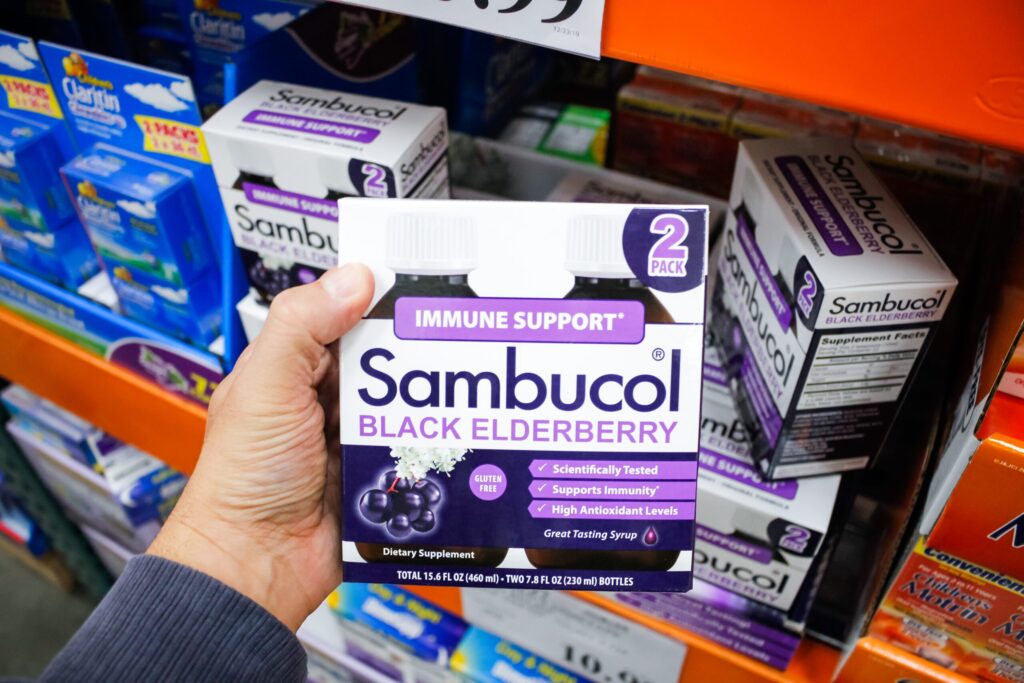
Walk down any drugstore aisle during the winter months, and you’ll find elderberry products everywhere, with labels promising “daily immune support.” As a mom with young kids in preschool, I get the appeal. Illness is basically a constant for me. But as a pharmacist, I’ll tell you that the research behind elderberry is more complicated, and less compelling, than most labels let on.
This doesn’t mean that elderberry is a complete scam. But the truth is nuanced. So I asked a physician and a nutritional scientist to help me weigh in. Here’s what the research actually shows, including where it falls short.
What is Elderberry?
Elderberries are dark purple berries that grow on certain trees in Europe, North America, North Africa, and Western Asia. Most elderberry supplements contain the Sambucus nigra species.
These berries are rich in polyphenols, a large family of plant compounds that may have antiviral and anti-inflammatory effects. In in-vitro studies, which test substances on cells rather than people, polyphenols appear to block viruses from entering cells, meaning they may help the immune system respond to infections.
But what happens in the lab doesn’t always translate to what happens in the human body. And we don’t know how much of a specific compound actually gets absorbed from a processed gummy or syrup, as it may vary widely from product to product and person to person.
What the Research Shows About Elderberry for Cold and Flu
In elderberry research, the gap between “promising lab findings” and “clear benefits in people” isn’t yet closed. When we look at the available human research, results vary across studies and the specific products being tested.
The best overview we have is a 2021 systematic review that analyzed the results of five randomized control trials (RCTs), which is the strongest type of clinical study design.
But even so, the authors of that review determined the overall quality of evidence for elderberry isn’t great. The studies were extremely small (three had fewer than 65 participants), short (follow-up periods of 16 days or less), and four out of five were funded by the manufacturer of the product being tested. Additionally, the largest study in this review didn’t test elderberry alone. Rather, it tested a product that contained a mix of ingredients, including echinacea. Several studies also had problems with selective reporting of outcomes and unreliable research methods, like relying on patient-reported symptom scores as an outcome rather than objective measures like lab results.
With those limitations in mind, here’s what the review found:
Elderberry doesn’t appear to reduce your risk of getting a cold or the flu.
Among people who get sick, elderberry may shorten the length of time an illness lasts and reduce symptom severity, but the evidence isn’t completely convincing.
Zhaoping Li, M.D., Ph.D., professor of medicine and chief of the Division of Clinical Nutrition at UCLA Health, puts it plainly. While “a few small studies suggest that elderberry may help shorten the duration and lessen the severity of cold and flu symptoms,” the benefits remain “marginal and not confirmed with large studies.” She adds that positive results seen in some studies can’t be considered “clinically meaningful yet.”
“A few small studies suggest that elderberry may help shorten the duration and lessen the severity of cold and flu symptoms, [but the benefits remain] marginal and not confirmed with large studies.”
If you’re looking to prevent respiratory illness, you’ll get more protection for yourself and others by following the boring, conventional advice: get vaccinated for flu, RSV, and Covid-19 if you’re eligible, wash your hands well and often, prioritize sleep, and stay home when you’re contagious.
Elderberry for Flu
No published RCT has specifically tested elderberry for flu prevention. The strongest flu trial we have, a 2020 RCT of 87 adults and children who came to a Cleveland Clinic emergency room with a confirmed flu infection, looked at elderberry for flu treatment.
Participants were randomly assigned to receive elderberry extract or a placebo (a fake liquid with no active ingredient). Though small, the study was adequately powered, meaning it included enough participants to detect a real difference in elderberry versus placebo, if one existed.
Stay Informed. Sign up for our newsletters.
Independent, science-based journalism delivered directly to your inbox.
The study didn’t find a difference. Elderberry didn’t shorten flu symptoms or reduce their severity compared to a placebo. In fact, people who took a placebo recovered about two days faster than those who took elderberry alone.
Participants could also choose to take oseltamivir (Tamiflu), the Centers for Disease Control (CDC) recommended flu treatment for individuals who are hospitalized or have severe illness.
Tamiflu has been shown to shorten flu symptoms by about 1 day (and possibly by 3 days for older, sicker patients). In a follow-up analysis, people who took elderberry and Tamiflu recovered faster than those taking Tamiflu alone (about four days compared to seven). However, this comparison wasn’t part of the original study plan, so it doesn’t confirm anything on its own. Though it points out something worth studying, the combination of Tamiflu and elderberry needs to be validated with more research before we can draw solid conclusions about its effectiveness.
While earlier studies painted a more promising picture, finding that elderberry alone relieved flu symptoms more quickly than placebo, Marily Oppezzo, Ph.D., instructor of medicine at the Stanford Prevention Research Center and head of the nutrition pillar at Stanford Lifestyle Medicine in Palo Alto, CA, points out problems with those studies: “The three human studies that reported shorter duration of flu illness with elderberry are also considered unreliable due to a high risk of bias. They’re industry-funded, tested proprietary blends, and had selective reporting of outcomes (meaning they didn’t report all the outcomes in their write-up).” And only the summaries of those studies are publicly available (not the full data), making it more difficult to evaluate how they were run or whether the results can be trusted.
“The three human studies that reported shorter duration of flu illness with elderberry are also considered unreliable due to a high risk of bias. They’re industry-funded, tested proprietary blends, and had selective reporting of outcomes (meaning they didn’t report all the outcomes in their write-up).”
Elderberry for Colds
No RCT has been specifically conducted to test elderberry as a cold treatment. The best evidence we have comes from the largest individual elderberry study to date, a 2016 RCT designed to evaluate elderberry’s ability to prevent colds.
Over 300 adult airline passengers received either elderberry extract for 10 days before traveling and for 4 to 5 days after flying, or a placebo. The results showed no difference in how many people got sick. However, among the 29 people who did develop colds, those taking elderberry had about half as many sick days (which the authors worked out to be about two fewer days of illness per person). The elderberry group also had less severe symptoms. But a few things make these results difficult to interpret:
29 people is a very small number to draw firm conclusions from.
Participants were allowed to use other medications.
The outcomes were also based on self-reported symptoms, not lab results.
The elderberry supplement manufacturer also supplied the elderberry capsules and helped design the study. While industry funding doesn’t automatically make results unusable, it’s a well-documented source of bias in supplement research. Photo: Shutterstock
Dr. Oppezzo describes what a truly rigorous elderberry trial would need: randomly assigning participants to elderberry or placebo and then deliberately exposing them to a cold virus — controlling for exposure itself, not just treatment. “Although randomization handles a lot of the variability of life,” she says, “I would also take other measurements that affect the immune system as well and randomize people ahead of time on these markers.”
No published elderberry trial has come close to this standard.
Elderberry for Other Health Conditions
Elderberry has also been studied for cholesterol reduction, heart disease risk reduction, gut health, and blood glucose (sugar) regulation in adults living with extra weight or obesity. But these studies are small, and results are inconsistent or modest at best.
Most of the remaining research — in conditions like diabetes, cancer, weight loss, Covid-19, and dementia — has been conducted in test tubes or animals, not people.
Is Elderberry Safe? Side Effects, Interactions, and Red Flags
For most healthy adults, short-term use of a commercially available elderberry product is likely safe. While side effects like nausea and abdominal pain are possible, they are more likely with high doses of raw or improperly prepared elderberry. As Dr. Li notes, “raw elderberry may contain toxins.” So don’t prepare elderberry at home from raw plant materials.
“Raw elderberry may contain toxins,” so don’t prepare elderberry at home from raw plant materials.
Importantly, dietary supplements aren’t regulated or approved by the FDA the way prescription drugs are. Manufacturers don’t need to prove that a supplement is safe or effective before it’s sold. Because of this, choosing reputable products matters.
One of the best ways to evaluate supplement quality is to look for third-party certification when choosing a product, such as seals from independent organizations like the National Sanitation Foundation (NSF), the United States Pharmacopeia (USP), and ConsumerLab.com. As Dr. Oppezzo explains, these organizations “ensure that supplements are not contaminated, that they’ll be absorbed, and that each dose has the ingredients it claims on the label. But this doesn’t mean the supplement works. Just that you’re getting what you think you’re getting.”
A few other things worth noting:
A small number of case reports have linked elderberry to more serious problems like acute liver and pancreatic inflammation. While case reports can’t confirm elderberry caused these issues, they’re worth knowing about if you have existing liver or digestive conditions.
During the COVID-19 pandemic, concern spread that elderberry could trigger the immune system to overreact, sometimes called a cytokine storm. But the 2021 systematic review mentioned earlier specifically examined this question and didn’t find evidence to support it. In fact, some data suggests elderberry can reduce inflammation.
Due to limited data on long-term daily use of elderberry, Dr. Oppezzo says she wouldn’t recommend long-term supplementation with elderberry. We’re also lacking studies in children, pregnant and lactating women, and older adults.
Elderberry in Kids: Evidence is Limited
Many elderberry products are marketed for children. But most research on elderberry was conducted on adults, meaning there is no established recommended dose for children.
Though the Cleveland Clinic flu study included children, it found no benefit (except when combined with Tamiflu). So while giving your kid a commercially prepared elderberry product short-term is probably low-risk, we don’t have data to support this type of use or confirmation that the benefits outweigh the risk.
Dr. Oppezzo is direct when it comes to elderberry use in children: “I’m a hard no for use in kids.” Dr. Li agrees: “I would not recommend elderberry for a child.”
If You Choose to Use Elderberry: What to Know Before You Buy
If you decide to try elderberry, a few practical tips can help you use it wisely:
Keep it short-term. No studies have looked at elderberry for more than a few weeks, so using it daily for long stretches isn’t supported by current evidence.
More isn’t better. Higher doses are associated with more nausea and other gastrointestinal side effects. Stick to the dose on the product label.
Know what you’re buying. Look for products that list the amount of elderberry extract in milligrams. Avoid vague terms like “proprietary blend.”
Look for third-party testing. Elderberry supplements aren’t approved by the FDA, so there’s no confirmation that what’s written on the label is actually what’s in the bottle. That’s why you should look for products carrying a seal from independent testing organizations like the NSF, the USP, and ConsumerLab.com.
Don’t skip the basics. Get adequate sleep, wash your hands often, and keep your distance from others when you’re sick. And when it comes to the flu, getting vaccinated is the most effective way to reduce your risk. If you’re already sick, Dr. Li recommends increasing fruit and veggie intake, getting enough protein and water, and resting well.
The Bottom Line: When Elderberry Might Help, and When It Probably Won’t
Elderberry isn’t magic. But it has some promising lab data and a small amount of human research that indicate it may improve symptoms of respiratory illnesses like cold and flu. Still, marketing claims have far exceeded what the science actually says.
My takeaway after examining the research? If you want to try elderberry, go in with realistic expectations and start taking it soon after symptom onset. Choose a product that’s been independently tested. But don’t let the plant’s beautiful purple hue convince you that elderberry is the nature-derived solution to all your cold-season problems. The basics, like vaccination, hand-washing, and adequate sleep, are more likely to protect you.
0 Comments
Elderberry: Usefulness and safety. (n.d.). NCCIH.
Häßler, M., Wetzel, K., Warnecke, L., Niedenthal, T., Montero, L., Ayala-Cabrera, J. F., & Schmitz, O. J. (2025). Assessment of the differentiation of Sambucus nigra plant parts using a multi-target and suspect screening by LC-HRMS and ICP-OES. Analytical and Bioanalytical Chemistry, 417(27), 6209–6220.
Wieland, L. S., Piechotta, V., Feinberg, T., Ludeman, E., Hutton, B., Kanji, S., Seely, D., & Garritty, C. (2021). Elderberry for prevention and treatment of viral respiratory illnesses: a systematic review. BMC Complementary Medicine and Therapies, 21(1), 112.
Mahboubi, M. (2020). Sambucus nigra (black elder) as alternative treatment for cold and flu. Advances in Traditional Medicine, 21(3), 405–414.
Wieland, L. S., Piechotta, V., Feinberg, T., Ludeman, E., Hutton, B., Kanji, S., Seely, D., & Garritty, C. (2021). Elderberry for prevention and treatment of viral respiratory illnesses: a systematic review. BMC Complementary Medicine and Therapies, 21(1), 112.
Hariton, E., & Locascio, J. J. (2018). Randomised controlled trials – the gold standard for effectiveness research. BJOG an International Journal of Obstetrics & Gynaecology, 125(13), 1716.
Macknin, M., Wolski, K., Negrey, J., & Mace, S. (2020). Elderberry Extract Outpatient Influenza Treatment for Emergency Room Patients Ages 5 and Above: a Randomized, Double-Blind, Placebo-Controlled Trial. Journal of General Internal Medicine, 35(11), 3271–3277.
Influenza Antiviral Medications: Summary for Clinicians. (2026, March 10). Influenza (Flu).
Butler, C. C., Van Der Velden, A. W., Bongard, E., Saville, B. R., Holmes, J., Coenen, S., Cook, J., Francis, N. A., Lewis, R. J., Godycki-Cwirko, M., Llor, C., Chlabicz, S., Lionis, C., Seifert, B., Sundvall, P., Colliers, A., Aabenhus, R., Bjerrum, L., Harbin, N. J., . . . Verheij, T. J. (2019). Oseltamivir plus usual care versus usual care for influenza-like illness in primary care: an open-label, pragmatic, randomised controlled trial. The Lancet, 395(10217), 42–52.
Heinsberg, L. W., & Weeks, D. E. (2022). Post hoc power is not informative. Genetic Epidemiology, 46(7), 390–394.
Zakay-Rones, Z., Varsano, N., Zlotnik, M., Manor, O., Regev, L., Schlesinger, M., & Mumcuoglu, M. (1995). Inhibition of Several Strains of Influenza Virus in Vitro and Reduction of Symptoms by an Elderberry Extract ( Sambucus nigra L.) during an Outbreak of Influenza B Panama. The Journal of Alternative and Complementary Medicine, 1(4), 361–369.
Zakay-Rones, Z., Thom, E., Wollan, T., & Wadstein, J. (2004). Randomized study of the efficacy and safety of oral elderberry extract in the treatment of influenza A and B virus infections. Journal of International Medical Research, 32(2), 132–140.
Tiralongo, E., Wee, S., & Lea, R. (2016). Elderberry supplementation reduces cold duration and symptoms in Air-Travellers: a randomized, Double-Blind Placebo-Controlled clinical trial. Nutrients, 8(4), 182.
Lima, J. P., Agarwal, A., & Guyatt, G. H. (2024). Industry Funding by Itself is Not a Reason for Rating Down Studies for Risk of Bias. The Journal of Law Medicine & Ethics, 52(3), 701–703.
Murkovic, M., Abuja, P. M., Bergmann, A. R., Zirngast, A., Adam, U., Winklhofer-Roob, B. M., & Toplak, H. (2004). Effects of elderberry juice on fasting and postprandial serum lipids and low-density lipoprotein oxidation in healthy volunteers: a randomized, double-blind, placebo-controlled study. European Journal of Clinical Nutrition, 58(2), 244–249.
Curtis, P. J., Kroon, P. A., Hollands, W. J., Walls, R., Jenkins, G., Kay, C. D., & Cassidy, A. (2009). Cardiovascular Disease Risk Biomarkers and Liver and Kidney Function Are Not Altered in Postmenopausal Women after Ingesting an Elderberry Extract Rich in Anthocyanins for 12 Weeks ,. Journal of Nutrition, 139(12), 2266–2271.
Teets, C., Ghanem, N., Ma, G., Minj, J., Perkins-Veazie, P., Johnson, S. A., Etter, A. J., Carbonero, F. G., & Solverson, P. M. (2024). A One-Week elderberry juice intervention augments the fecal microbiota and suggests improvement in glucose tolerance and fat oxidation in a randomized controlled trial. Nutrients, 16(20), 3555.
Elderberry | Memorial Sloan Kettering Cancer Center. (2023, March 27).
Asgary, S., & Pouramini, A. (2022). The Pros and Cons of Using Elderberry (Sambucus nigra) for Prevention and Treatment of COVID-19. Advanced Biomedical Research, 11(1), 96.
Healthy habits to prevent flu. (2025, September 3). Influenza (Flu).
DISCLAIMER: MedShadow provides information and resources related to medications, their effects, and potential side effects. However, it is important to note that we are not a substitute for professional medical advice, diagnosis, or treatment. The content on our site is intended for educational and informational purposes only. Individuals dealing with medical conditions or symptoms should seek guidance from a licensed healthcare professional, such as a physician or pharmacist, who can provide personalized medical advice tailored to their specific circumstances.
While we strive to ensure the accuracy and reliability of the information presented on MedShadow, we cannot guarantee its completeness or suitability for any particular individual’s medical needs. Therefore, we strongly encourage users to consult with qualified healthcare professionals regarding any health-related concerns or decisions. By accessing and using MedShadow, you acknowledge and agree that the information provided on the site is not a substitute for professional medical advice and that you should always consult with a qualified healthcare provider for any medical concerns.