Kiara’ Bowling’s legs extend to touch the ground as her hair bounces off her back. With each step she takes, the encouraging voices in her head get louder.
Bowling is the executive assistant of Lady Echelon Project, Inc., and currently holds the appointed title of Miss Greater Bay Area, which she will represent in the Miss California pageant.
Approximately 2.5 million women participate in thousands of beauty pageants each year, according to a study by Julia Van Steenberghe and Sandra L. Caron.
The words “beauty pageant” are often associated with glitz and glamour. Contestants strive to outshine competitors by emphasizing individual characteristics. Over time, pageants have begun to judge candidates on qualities beyond beauty, such as unique talents, advocacy causes, and intelligence, according to the Public Broadcasting Service.
In a study by Laurel R. Stiekes, 11 former pageant queens were followed to gain insight into the effects of beauty pageants and how people around contestants, such as family, coaches, and friends, influenced them. Ninety-one percent said the opinion of others affected how they viewed themselves. However, 45% reported that they felt more empowered and gained confidence after obtaining their title.
Ultimately, beauty pageants can either help or harm contestants, but the contestants themselves largely determine how they are affected.
“Now, when I walk into a room full of people that I don’t know, I carry myself with more confidence, and I know I can act more boldly. When people see the crown and sash, they immediately think that I have some sort of importance,” Bowling said.
Background of beauty pageants
The development of modern pageants
Beauty pageants began in 1854. Renowned circus owner P.T. Barnum introduced the idea as a way to attract larger audiences and showcase a new act. Since then, they have undergone immense evolution.
The first official modern beauty pageant was held in Atlantic City, New Jersey, in 1921. By 1954, the Miss America Pageant was telecast by ABC.
From the moment beauty pageants started, specific stereotypes and valued ideals rose above others.
Generally, specific beauty characteristics are more desirable than others. According to the National Library of Medicine, facial symmetry is preferred over facial asymmetry. Additionally, tan skin is more likely to be perceived as healthy, which can make the person more attractive to others.
These general ideals are not new to society, but originate from old myths and legends.
In the Greek myth of the Judgment of Paris, Paris, a Trojan prince, had to choose between the three most beautiful goddesses- Hera, Athena, and Aphrodite. Ultimately, he chooses Aphrodite because she promised him the most beautiful woman in the world, herself, to love him.
Adding jewels to the crown: The pageant experience
Behind the makeup, fancy clothes, and crown lies a journey that requires passion and determination.
Dr. Patricia Celan has many titles. She has been known as Dr. Universe, Dr. Canada, and Miss Canada. Celan started competing in pageants when she was a teenager. Recently, she retired from the pageant world.
When she started competing, pageants were advertised as a means of personal development. After completing medical school, she returned to the stage and went on to represent Canada internationally.
“I started doing teenage pageants as an experience with community service, emphasizing leadership and personal growth,” Celan said.
Each pageant has its own schedule, but all involve being judged by a panel. Additionally, each pageant carries the same level of stress and intensity.
“With every pageant, it’s kind of the same thing. What’s two or three hours for the audience is go, go, go for the girls backstage. You go on stage, have your moment, and then run backstage to get into your next outfit,” Celan said.
Regardless of the competition, each creates “pageant sisters” with an unwavering amount of support among the contestants.
“There’s always something last-minute that goes wrong for someone, and there’s always some kind of anxiety, but by collectively supporting each other and learning to manage stress individually, it turns out okay,” Celan said. “You have to smile, and the show must go on.”
“
You have to smile, and the show must go on.
— Patricia Celan
Pageantry can find people in all stages of life, ranging from childhood to adult pageants.
Just last year, Bowling’s creativity and interest in fashion led her to discover pageantry. Initially, being on a stage in front of people interested her, but she didn’t just want to be a model. Pageantry was the obvious choice.
“When I first started exploring fashion and beauty, I thought about modeling or doing something like that. I decided to enter myself into a pageant for Miss California, because why not?” Bowling said.
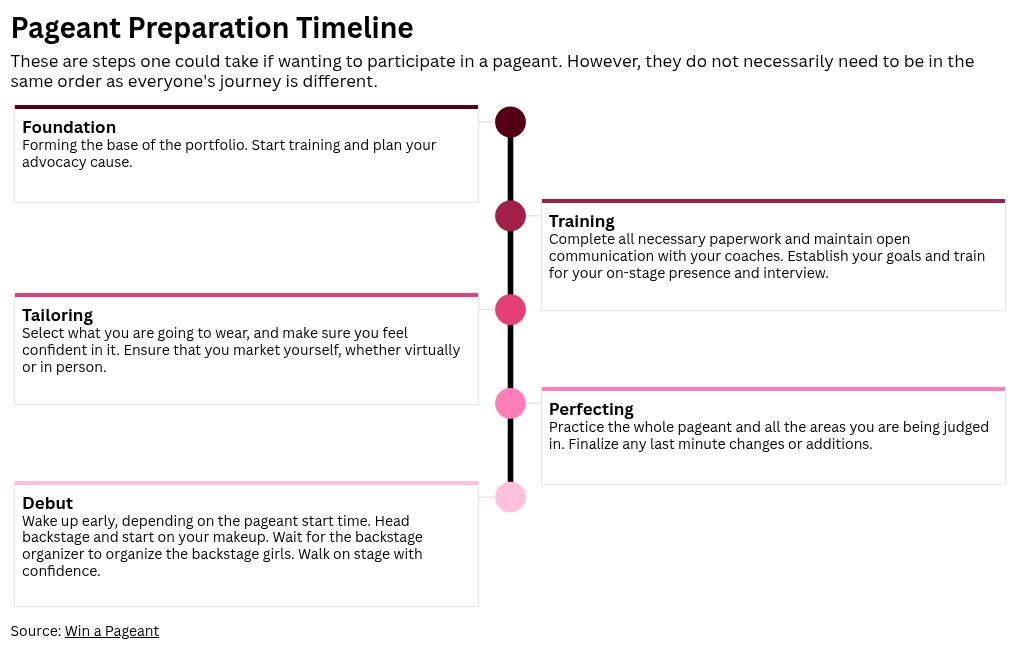
Pageants not only represent the individual work but also the collective work of their entire team. While some contestants train for months, some pageants are spur-of-the-moment decisions. Bowling only had five weeks, but with the help of her pageant directors, coach, and community, she was able to prepare adequately.
“I had to prepare by getting a pageant coach and directors,” Bowling said. “I did the tailoring and embellishments on my own dress. When it came time to find my ‘Why’, I knew what I wanted to focus on. I’m already involved in my community and help foster youth.”
To be herself, Bowling had to be vulnerable. Being open about her recent losses allowed her to be authentic, which encouraged and empowered her.
“I shared that I lost my mom and brother recently, and I was even surprised that I shared that. I was able to show that I’m a real person, and I was motivated knowing that if someone could relate, maybe they could be inspired by me,” Bowling said.
Tarnishing the crown: The effects of pageants
Beauty pageant contestants face a series of challenges during and after competing. These challenges have the potential to empower or break them, but it all depends on each individual.
Dr. Hilary Levey Friedman is the author of “Here She Is: The Complicated Reign of the Beauty Pageant in America” and a former professor of sociology at Brown University.
Beauty pageants impact physical and mental traits in many ways.
“Even if you win, there are both positive and negative effects. Obviously, for some people, the scholarship money can be quite life-changing, along with the skills they develop and the increased exposure they receive. But for other people, sometimes even the same people, there are lasting consequences of body image,” Levey Friedman said.
Still, many contestants can build their self-confidence while also learning about themselves and others.
“During the competition, I didn’t expect to be so supported by other people, like my coach or community. Their support made me continue to feel positive about competing and sharing my story,” Bowling said.
Additionally, pageants can raise awareness of social issues through each contestant’s chosen social cause and add meaning to what each contestant is competing for.
“I advocate for abuse victims, animal rights, and problematic systems that have limited people’s rights,” Celan said. “If I’ve experienced these things, it gives me a purpose and reason to find meaning in them. I can be a voice for others who are struggling or don’t have a voice to defend themselves.”
“
I can be a voice for others who are struggling or don’t have a voice to defend themselves.
— Patricia Celan
Behind the layers of concealer and foundation, beauty pageants also carry adverse effects.
Beauty pageants typically conclude with one winner and two runners-up. Due to this, they often create an idealized image of a person, the winner, who represents the essence of beauty within a culture and society.
According to Alexandria Vasquez, an adjunct professor of sociology at the University of San Francisco, idealizing one person creates a power dynamic between them and someone who is perceived as lesser and not ideal or good enough, even if unintentional. Contestants strive to do everything they can to be that one person, creating harmful effects they may not even recognize.
“Inherently, they’re being told that if this is the idealized version of a woman, then I should be doing more,” Vasquez said. “Overachieving by comparison can lead to developing eating disorders, and personalities focused on being the best, even if it means getting sick trying to do it. They feel like nothing they do is good enough, which ultimately leads to low self-esteem and a lack of confidence.”
Feeling unfulfilled is another impact of beauty pageants, which, when blended with society’s beauty standards, can have a long-term effect.
“Sometimes it takes them their whole lifetime, or sometimes people never realize that they are born beautiful and there’s nothing they have to do to become more beautiful. However, because society dictates that one must buy more products, dress a certain way, and emulate the appearance of beauty influencers, they never get to be their authentic selves. It’ll make them feel like they live half a life,” Vasquez said.
Beauty pageants reflect society’s standards of women, suggesting that they cannot be just one thing, but must be all or nothing. From a young age, the idea that women could either be pretty or smart, but never both, was instilled in Levey Friedman.
“My mom was Miss America 1970, so beauty pageants were always something I understood. When I was growing up, I believed that beauty and brains were mutually exclusive; she was the beauty, and I was the brains. I thought these things couldn’t coexist together in one person,” Levey Friedman said.
The adverse effects of beauty pageants are not always visible to the audience or the public, but that does not mean they are not still there.
Behind all the crowns on the shelves and sashes on the wall, at the end of the day, beauty pageant contestants face human challenges. After the awards show, as their makeup is being removed, they reveal that they aren’t just someone on a stage, but a person in society too.
“It’s heartwarming and inspiring to see people sharing their struggles and seeing the human side to someone who we may think is a perfect Barbie. It doesn’t matter what someone looks like on the outside; everybody’s got struggles,” Celan said.