SINGAPORE – Into an increasingly dense local bathhouse scene, a new leviathan enters.
House+ Bubble is the $45 million, 24-hour Chinese spa complex at Perennial Business City in Jurong East that soft-launched in end-February with a cinema, meditation room and e-sports lounge to go with its hot pools and saunas – the first of its kind here.
It is now in phase one of its roll-out, and phase two will double its floor space to some 100,000 sq ft, roughly the size of 7½ Olympic swimming pools.
The mega bathhouse debuted to mixed reviews online and some tongue-wagging when it temporarily shut its hot pools in early March, citing facility adjustments. But it is betting on a soft landing after those strained first weeks.
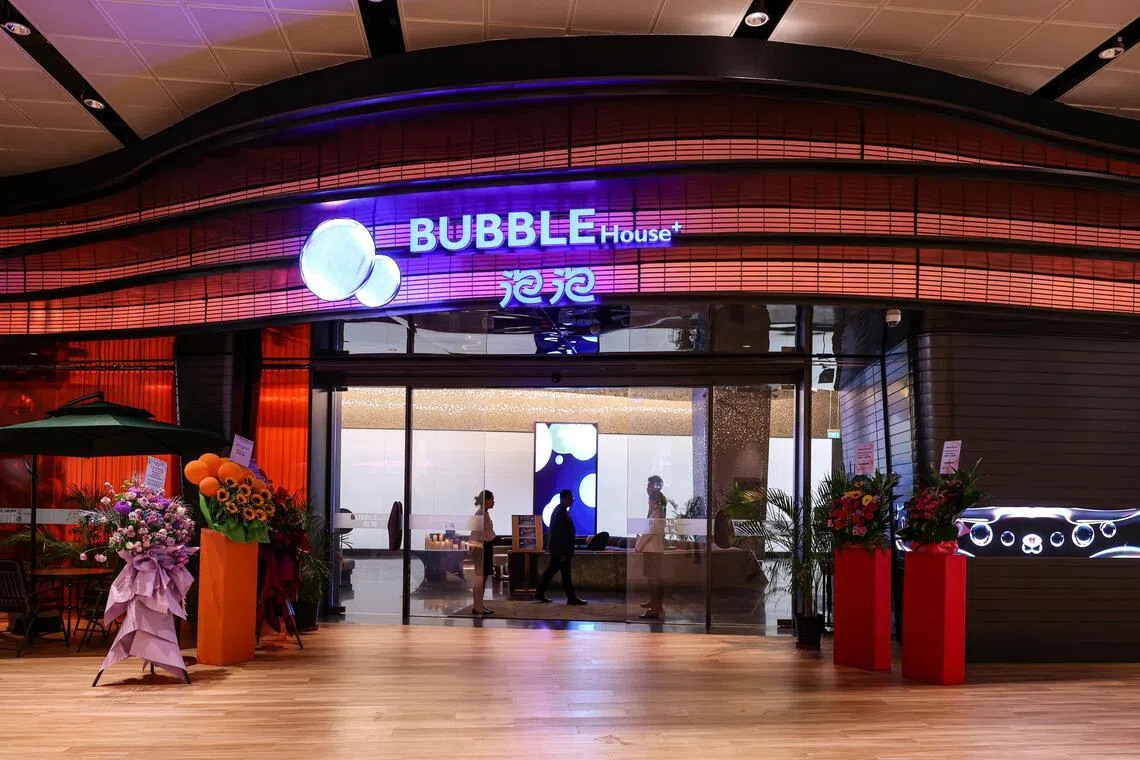
House+ Bubble is a $45 million Chinese bathhouse complex at Perennial Business City.
ST PHOTO: BRIAN TEO
Chief executive Hou Zelong tells The Straits Times in Mandarin: “I am still confident. Though we have received criticism, we humbly accept it and will improve. We still have many supporters; we just have to sort ourselves out.”
Even as House+ Bubble’s official opening has been pushed from mid-March to an unconfirmed date before May, the operator is already scoping out new locations, certain of demand that can carry one or two more outposts.
This high-profile entrant is the surest sign of C-wellness’ growing presence here.
Where preceding traditional Chinese medicine (TCM) massage joints leant fusty and functional in image, the clutch of entrants post-Covid-19 have arrived primed for Instagram, with business models pre-tested and already certifiably viral in China.
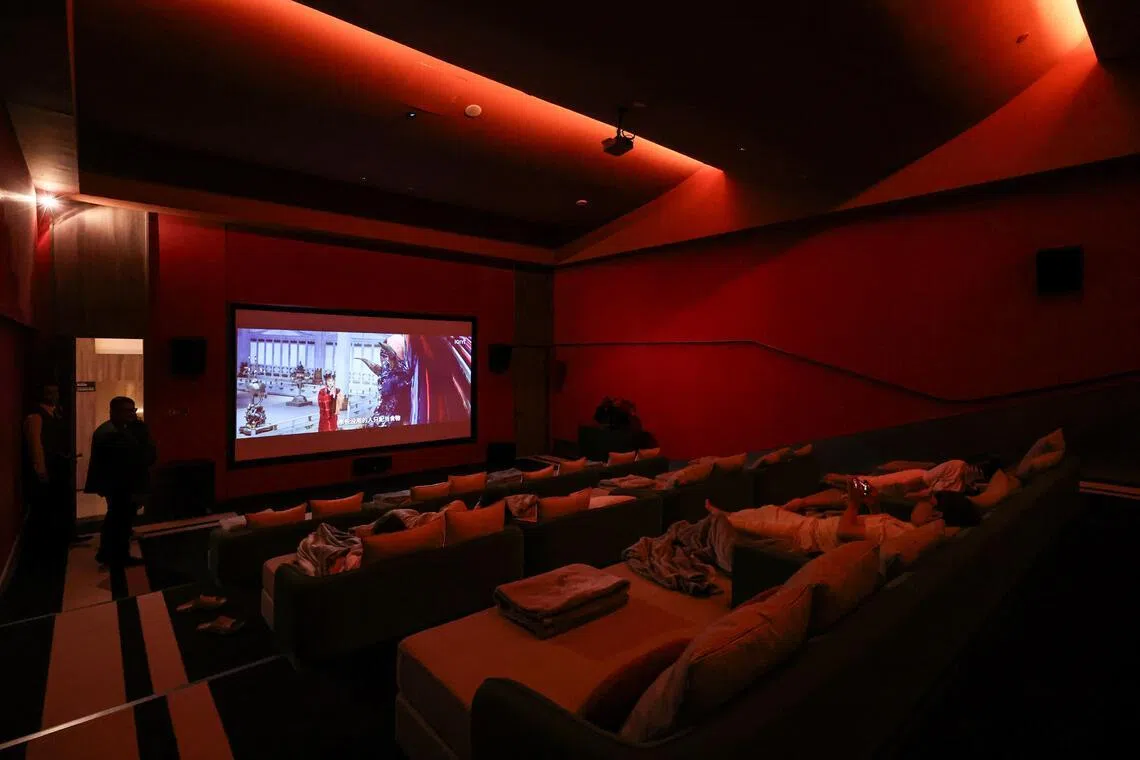
The cinema at House+ Bubble.
ST PHOTO: BRIAN TEO
House+ Bubble has for its blueprint the ubiquitous round-the-clock spas that function as adult daycare centres in big Chinese cities like Shenzhen, Shanghai and Xi’an. These entertainment multiplexes have been trending in China for more than a year and, since they were discovered by TikTok, have become fixtures on tourist itineraries.
Dionysian buffet spreads – lobster, sashimi, all-you-can-eat fruit bars – nap pods and cosy pyjama sets for guests are the genre’s fixed beats, dutifully approximated here, if not fully replicated.
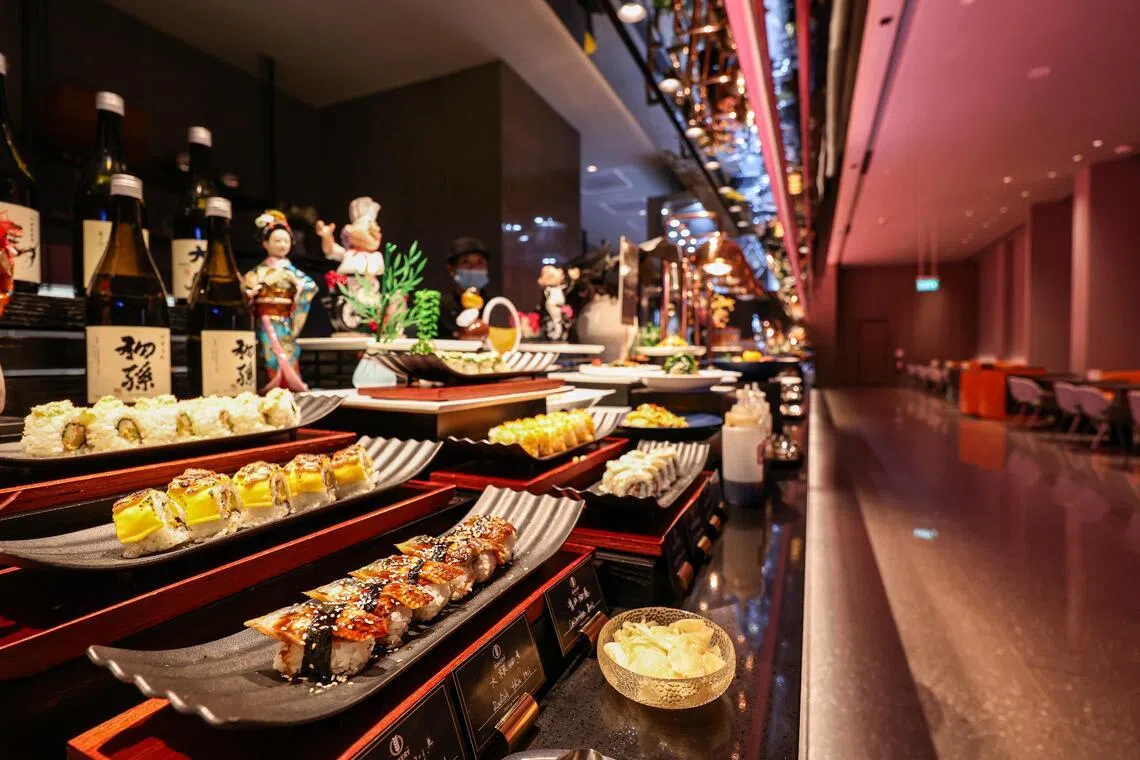
A buffet spread offered at House+ Bubble.
ST PHOTO: BRIAN TEO
Still, Mr Hou is at pains to emphasise that the place is not complete.
A VIP KTV room the size of a small apartment and a teppanyaki grill to go with an expanded buffet menu are forthcoming. Kid-friendly spots, ice baths, mixed-gender pools and a storm bath simulating squall and lightning are in the offing for phase two, he adds.
This last ingenuity of weather catharsis is a new fad in China, inspired by viral Milanese originator spa QC Termemilano.
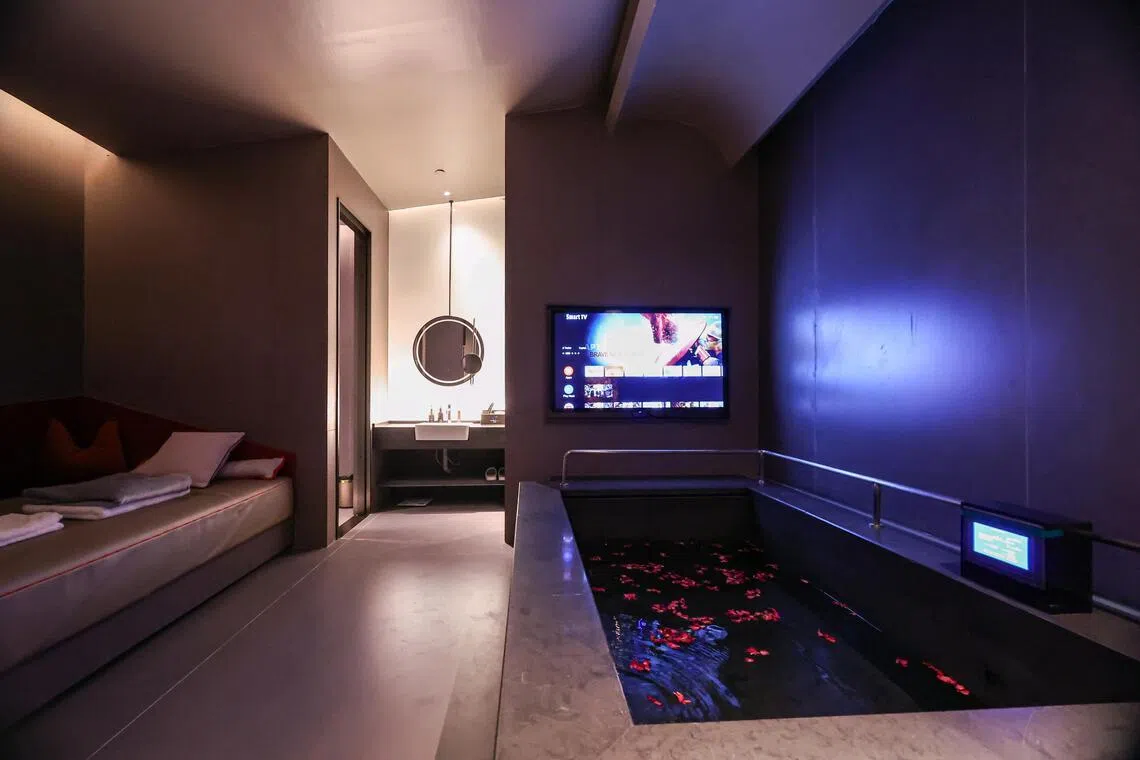
Private soaking rooms at House+ Bubble.
ST PHOTO: BRIAN TEO
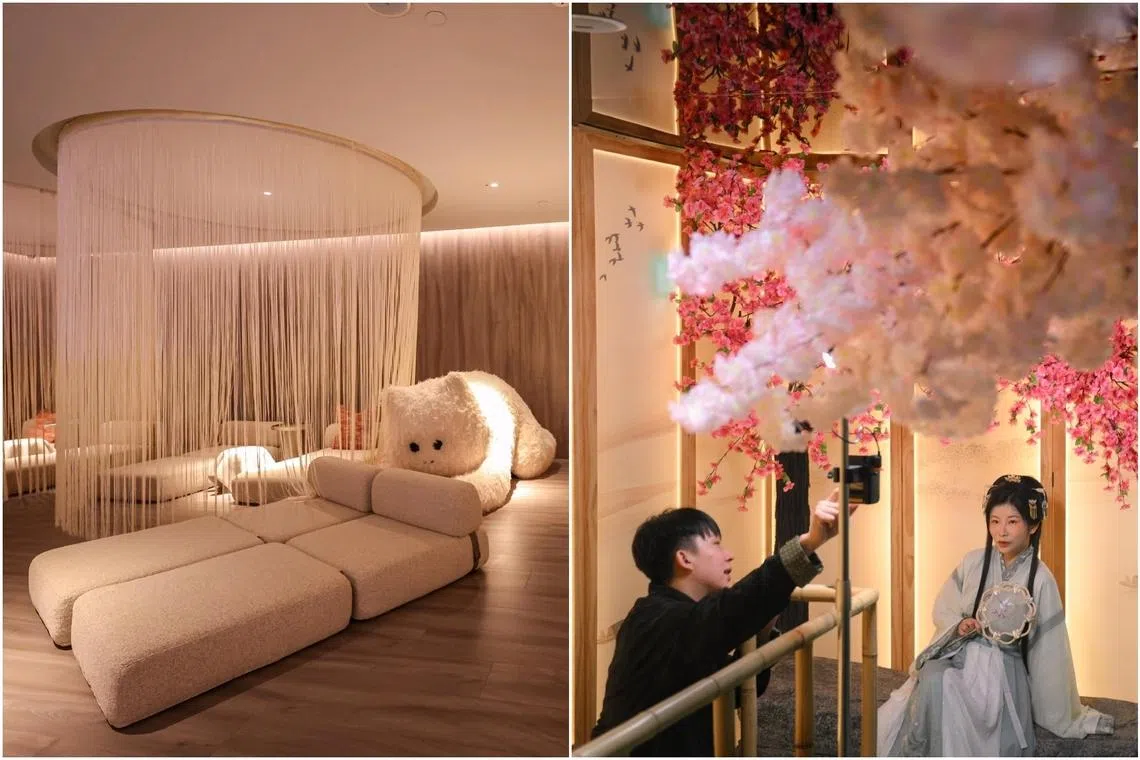
Meanwhile, TCM-based spa Yagyo Haven has seized on the vogue for hanfu, or traditional Chinese clothing, offering those patterned wide-sleeved robes for dress-up and photography. Make-up services are included too.
It opened on Jan 23 as the first South-east Asian branch of the Nanjing-based brand with over 200 outlets in China, where it is catnip on Chinese social media platform Xiaohongshu for those born after 1990, says co-founder of the Singapore franchise Kelly Zhu.
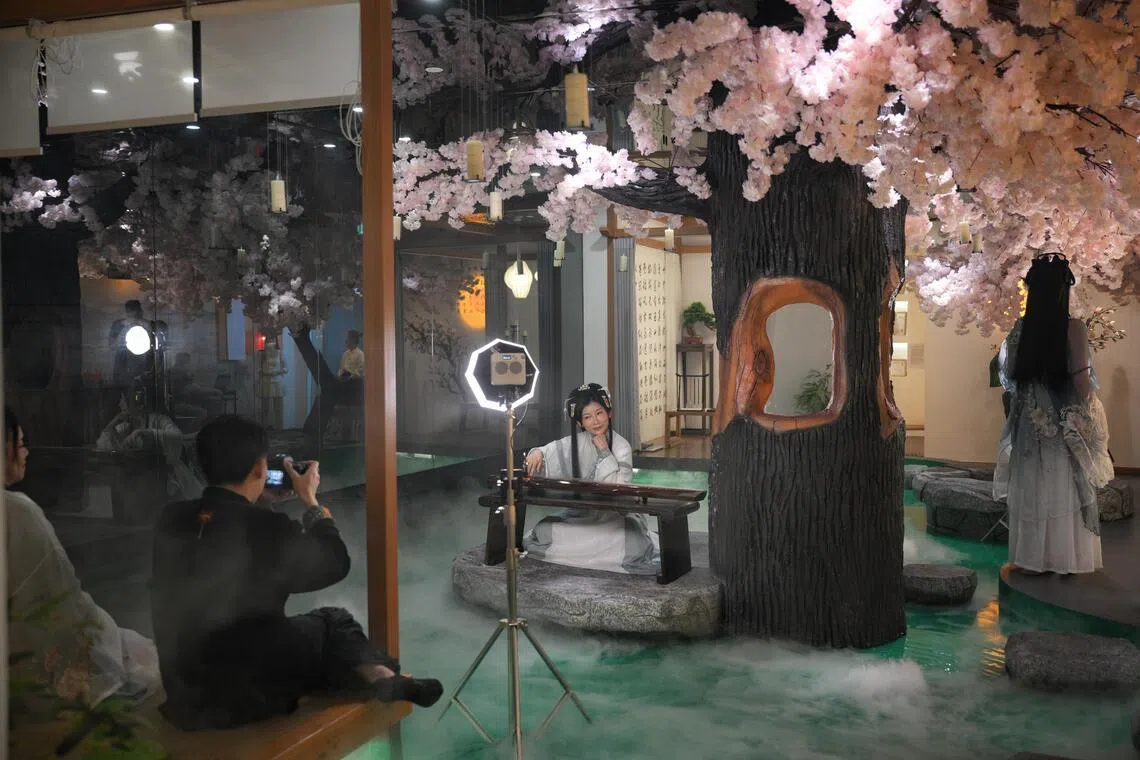
Patrons dress up in hanfu, a traditional Chinese dress, during a photo shoot at Yagyo Haven.
ST PHOTO: MARK CHEONG
The 2,600 sq ft Fu Lu Shou Complex unit in Bugis is run in the atmosphere of a Tang court, more precisely, the noblewoman quarters of ancient Chinese beauty Yang Guifei, the beloved consort of Emperor Xuanzong.
Guests are greeted as “xiao zhu” (little princess) and can sit on raised flooring above a central “lake” of swirling mist to indulge in the old ladylike arts of “qin qi shu hua” (music, chess, calligraphy, painting). Yagyo Haven’s spin on these are tea brewing, incense-making and calligraphy.
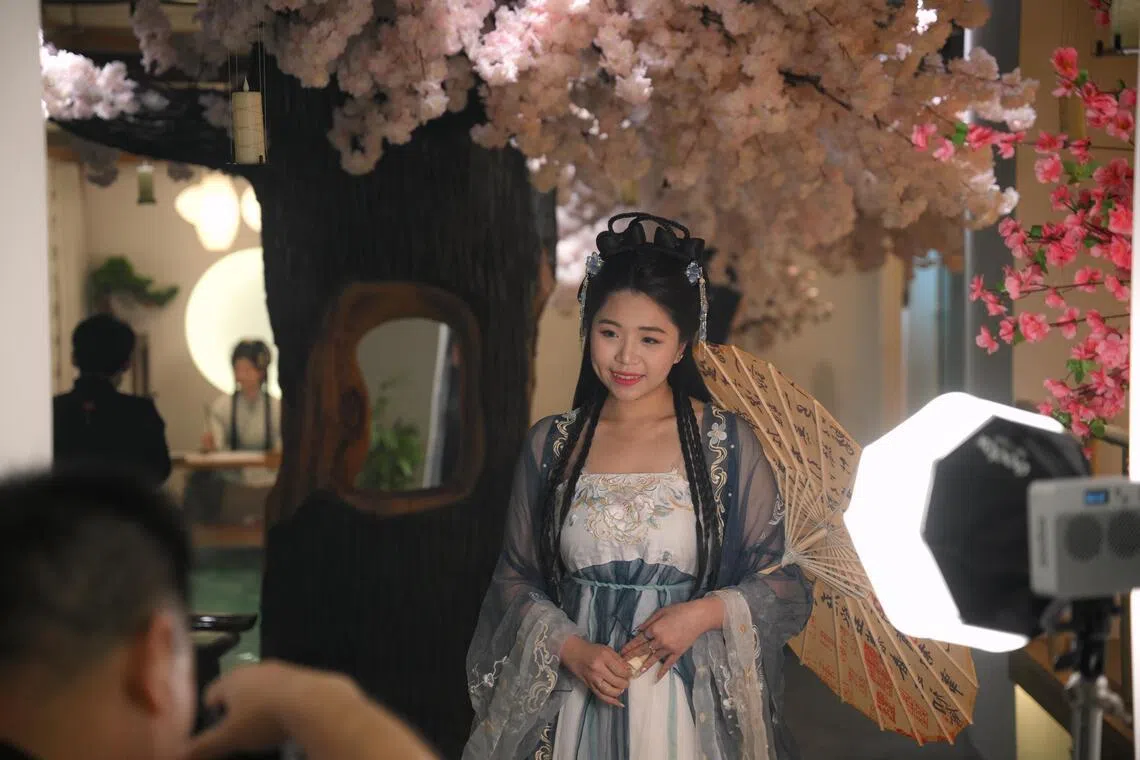
Yagyo Haven is run in the atmosphere of a Tang court.
ST PHOTO: MARK CHEONG
It is a near geeky level of cultural immersion, but the concept has translated swimmingly.
Says Ms Zhu in Mandarin: “We have not encountered any resistance. There’s no need to coax people to try us out; the acceptance rate is very high.”
Its most popular offering pairs hanfu cosplay with a head spa ($280), another viral Chinese treatment that at Yagyo Haven comes with hearty scraping of the meridian points with forked implements (bojin), cupping of the scalp with a spindly whisk-like tool and a hair soak in over 50 herbs.
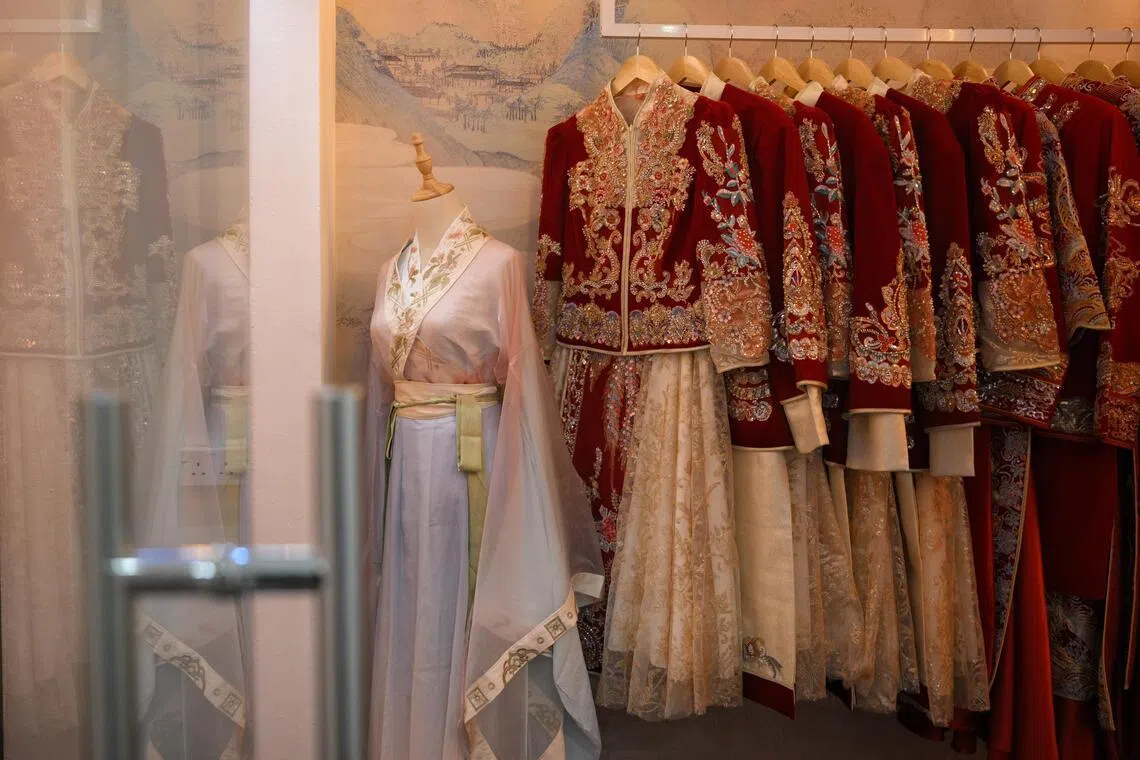
Traditional Chinese dresses at Yagyo Haven.
ST PHOTO: MARK CHEONG
Like the 24-hour spas that inform House+ Bubble’s model, the hanfu and head spa trends are of a certain critical mass, popular with those outside China too, and a mark of the country’s rising cultural cachet. Little wonder then that they are finding favour here.
More than 80 per cent of Yagyo Haven’s 1,000 visitors as at early March were local, including non-Chinese guests, while the half-open House+ Bubble averages about 300 customers a day, at least 60 per cent of whom are Singaporean. Mr Hou expects to break even within four years.
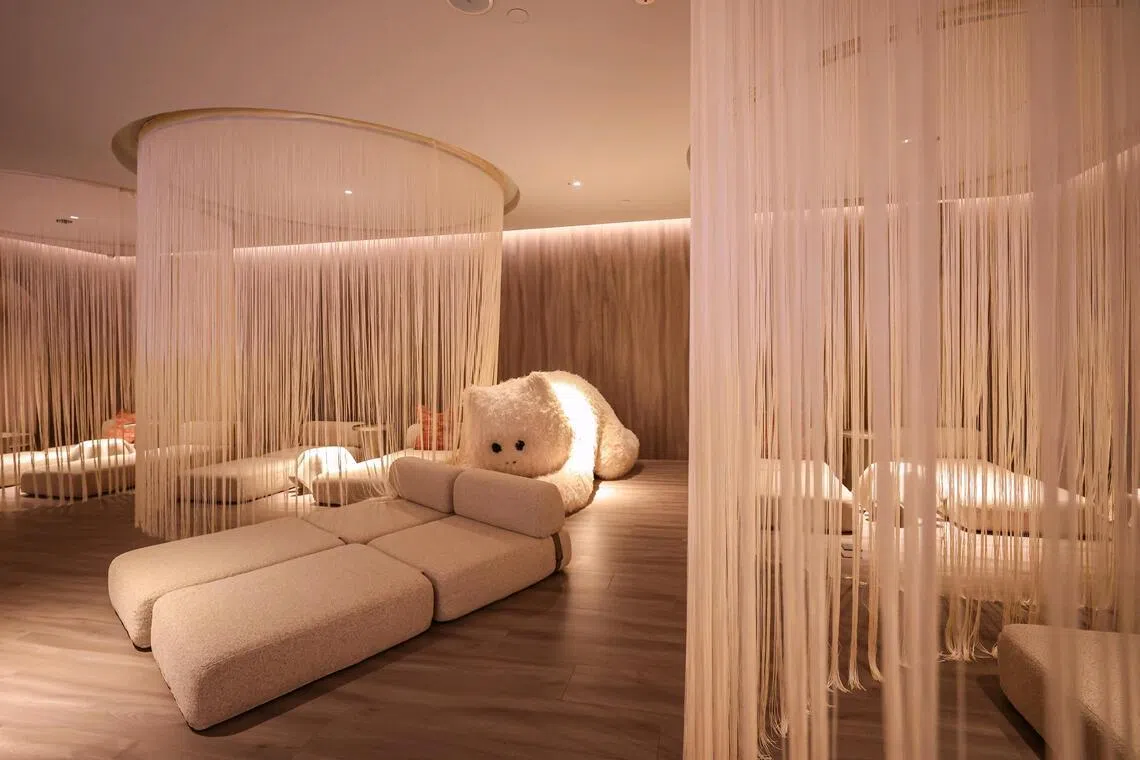
The leisure area at House+ Bubble.
ST PHOTO: BRIAN TEO
Both 2026 entrants are secure in the uniqueness of their propositions in a crowded wellness scene.
At least 10 venues focusing on recovery have sprung up over the last two years, chief among them the fast-growing Ice Bath Club, while Singapore’s first wellness attraction at Marina South – a $1 billion project – will open in 2030.
Asked if the competition troubles him, Mr Hou shrugs and says: “We’re not just a bathhouse or spa. We have attractions for many different groups. It is a comprehensive leisure complex.”
This Singaporean penchant for novelty was the reason he launched the first House+ Bubble spa here.
Still, for all the draw of its “urban micro-vacation” concept, it has become clear that a chapter-and-verse reproduction of the Chinese model will not do, adds Mr Hou.
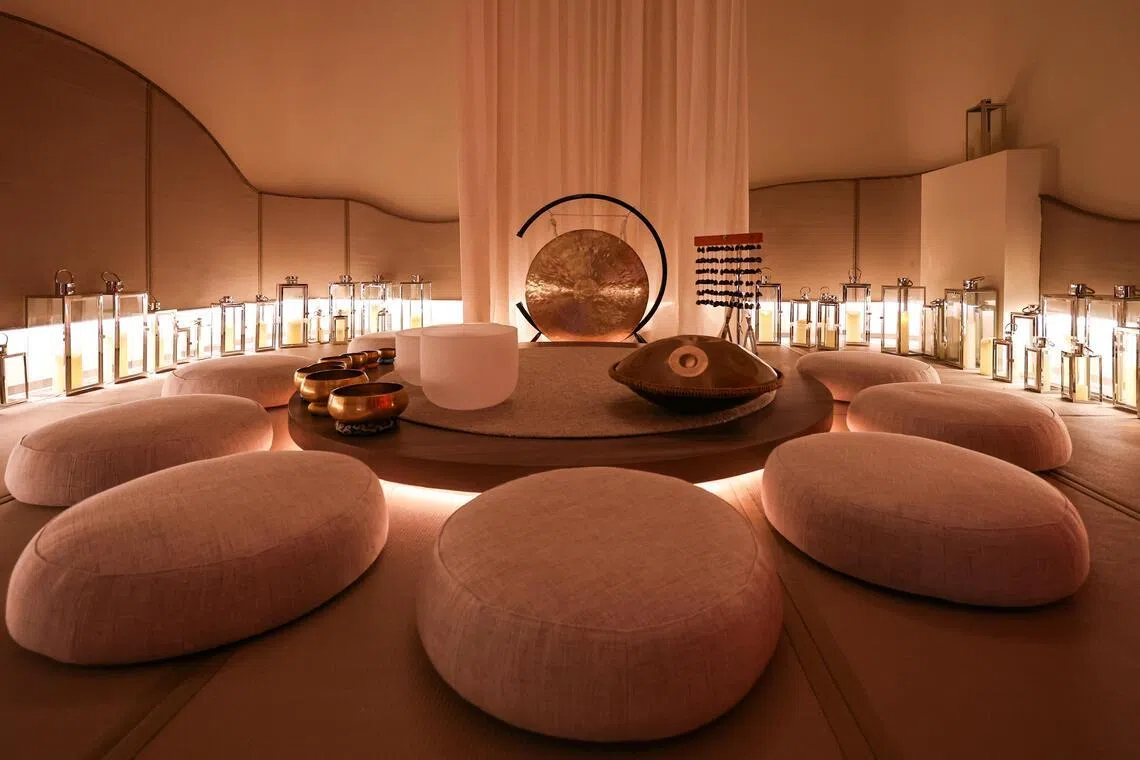
The meditation room at House+ Bubble.
ST PHOTO: BRIAN TEO
The spa will soon abolish its membership scheme in favour of a simpler “set” menu, he says. Currently, membership starts at $500 and entitles one to preferential rates to add-ons like the restaurant buffet and a range of treatments, including the popular body scrub seen in viral Chinese bathhouse videos.
The new system would instead bundle access, doing away with unpopular add-on costs, to deliver more value, says Mr Hou.
Close to a month since House+ Bubble’s soft opening, which served as a testing period, the conclusion is that a simpler and more sincere approach works better for Singapore, he adds.
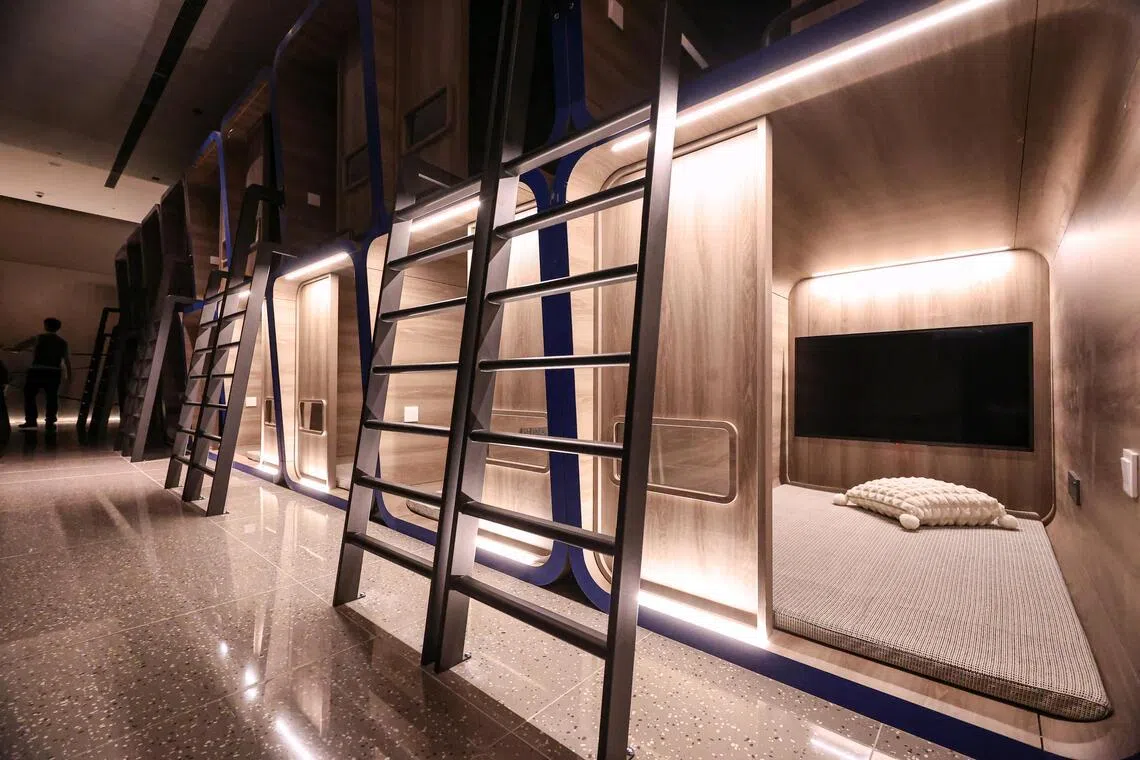
A nap pod at House+ Bubble.
ST PHOTO: BRIAN TEO
The budding modern C-wellness industry is part of a C-everything wave. A record number of Chinese players like beauty brands Judydoll and Joocyee, sports brand Anta, luxury eyewear brand Bolon and apparel brands Edition and Oh Sunny opened or expanded in Singapore in 2025. And in March, jasmine tea chain Molly Tea launched to snaking queues.
The influx coincides with the online trend of Chinamaxxing, an American invention that involves praising Chinese culture online through memes. But tempting as it is to draw parallels, C-wellness’ new gloss is of a different tone.
Quite unlike the subversive humour of Chinamaxxing content – which rests on the essential strangeness of Chinese culture to American users and began as a kind of reverse psychology protest to Trumpian politics – China is a familiar entity here.
“Chinese wellness is gaining visible momentum in Singapore, but it is taking a slightly different form from the US. Here, it is more like the lifestyle rebranding of something already culturally legible,” says scholar of consumer psychology and Nanyang Technological University (NTU) associate professor Chen Lou.
In the case of House+ Bubble and Yagyo Haven, Chinese wellness is being repackaged as aspirational, social and premium for newer generations, she adds.
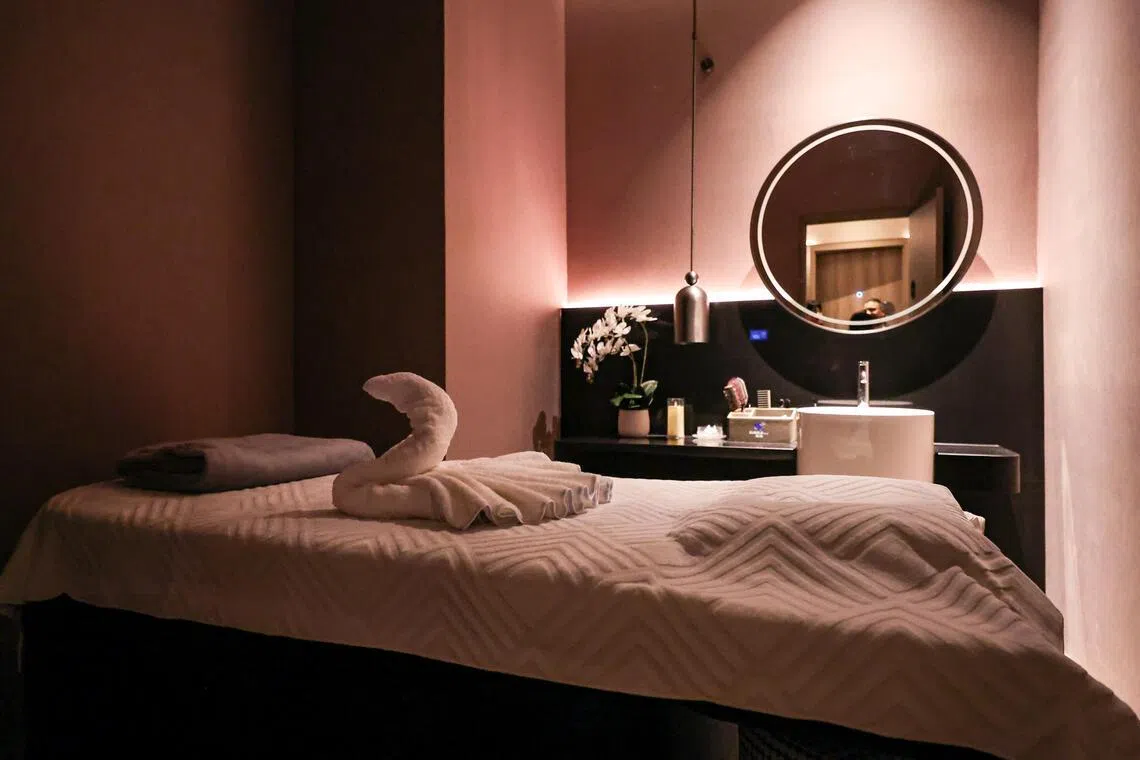
The spa room at House+ Bubble.
ST PHOTO: BRIAN TEO
A discussion of C-wellness also raises the TCM factor, the 5,000-year-old health system that is inextricable from the industry. Even a new-fangled project like House+ Bubble provides wuxing (five elements) regulation and scalp meridian unblocking treatments.
TCM tenets are a part of family life and are institutionally recognised, says Prof Lou, referring to the Traditional Chinese Medicine Practitioners Board under Singapore’s Ministry of Health and NTU’s Chinese Medicine degree. That familiarity may be why it is easier for young people to embrace TCM practices.
She says: “What is new is the framing. Practices once seen as old-fashioned are now being re-coded through wellness culture, aesthetics and self-care language, which makes them feel more relevant.”
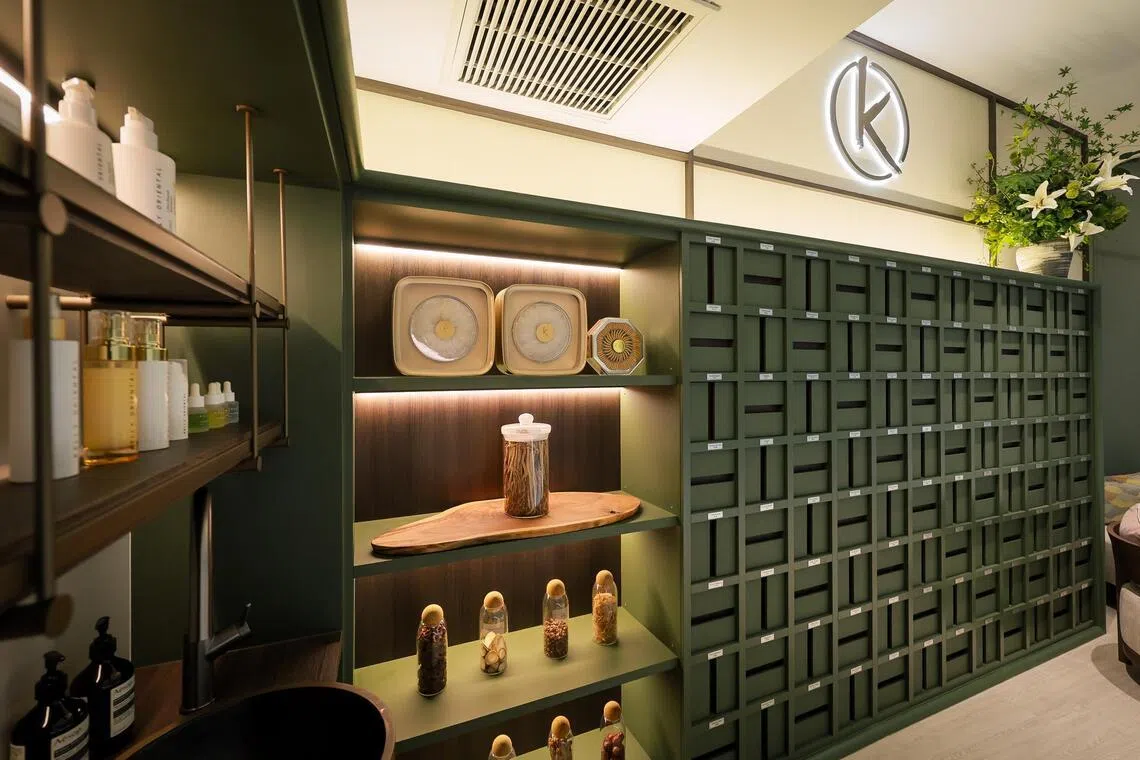
Kelly Oriental at Holland Village.
ST PHOTO: GAVIN FOO
Take TCM spa Kelly Oriental, for example. The two-storey Holland Village joint has a modern forest-green medicine cabinet, pop culture markers like a Betty Boop bearbrick figure and an Hermes bag displayed, as well as machine treatments in its catalogue.
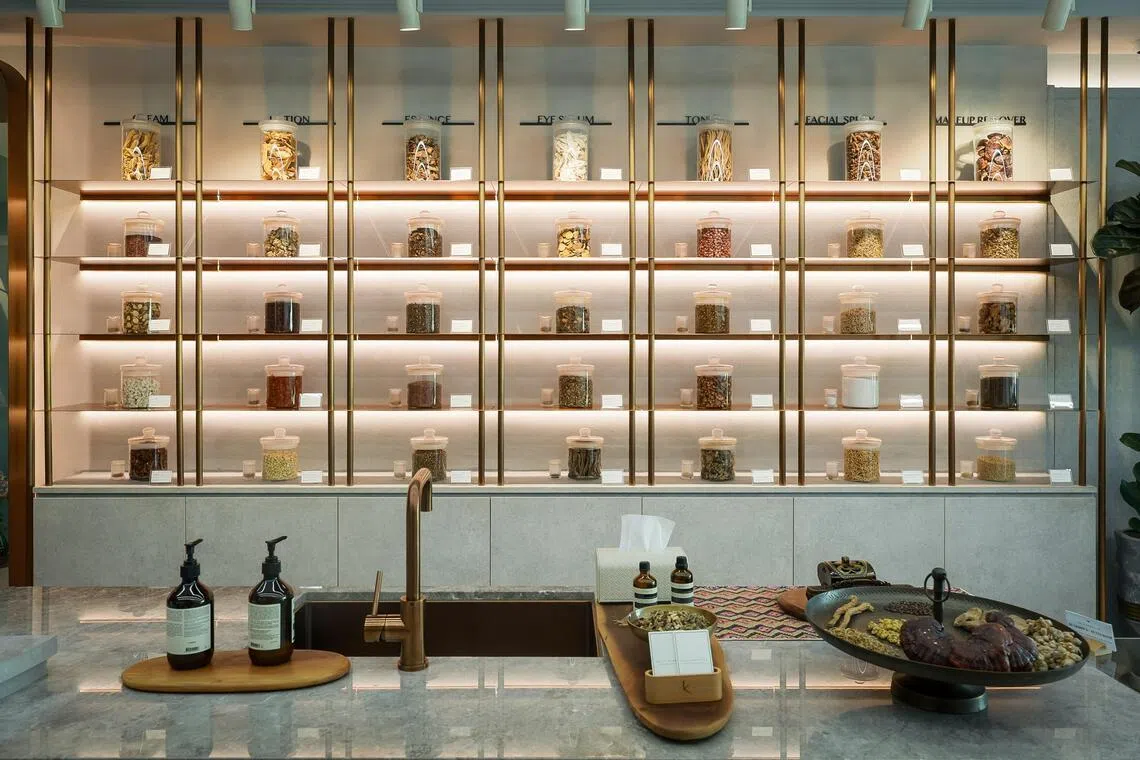
Kelly Oriental combines TCM wellness with a modern spa.
ST PHOTO: GAVIN FOO
The last is an oddity among TCM parlours.
Says founder Kelly Xu in Mandarin: “A masseuse’s skills are very important, but young people still like some bells and whistles. So, we add machines to give them the benefits of both. We combine TCM wellness with a modern spa.”
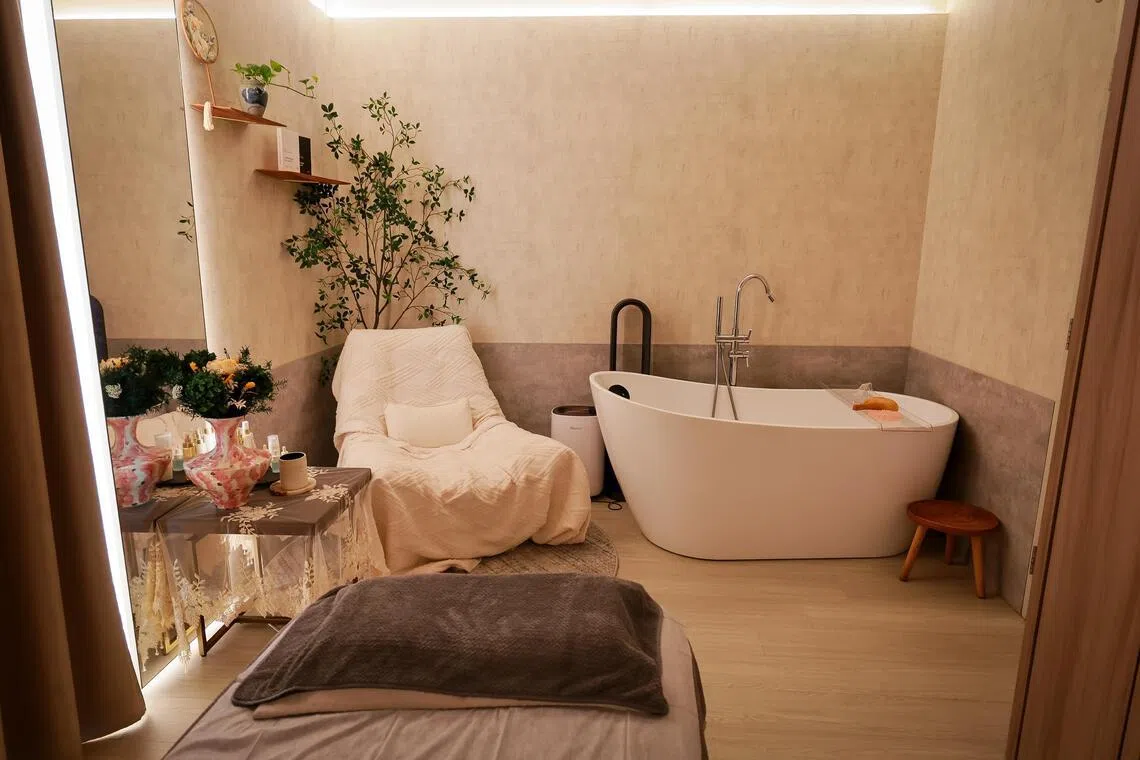
One of the treatment rooms in Kelly Oriental.
ST PHOTO: GAVIN FOO
Since founding in 2020, she has had a 20 to 30 per cent increase in young clients in their 20s to early 30s.
Mr Ivan Cheng, co-founder of local TCM haircare brand Jing Botanics, established in 2024, puts the growing curiosity around TCM in wellness and beauty down to a broader shift to more holistic and preventative approaches to health.
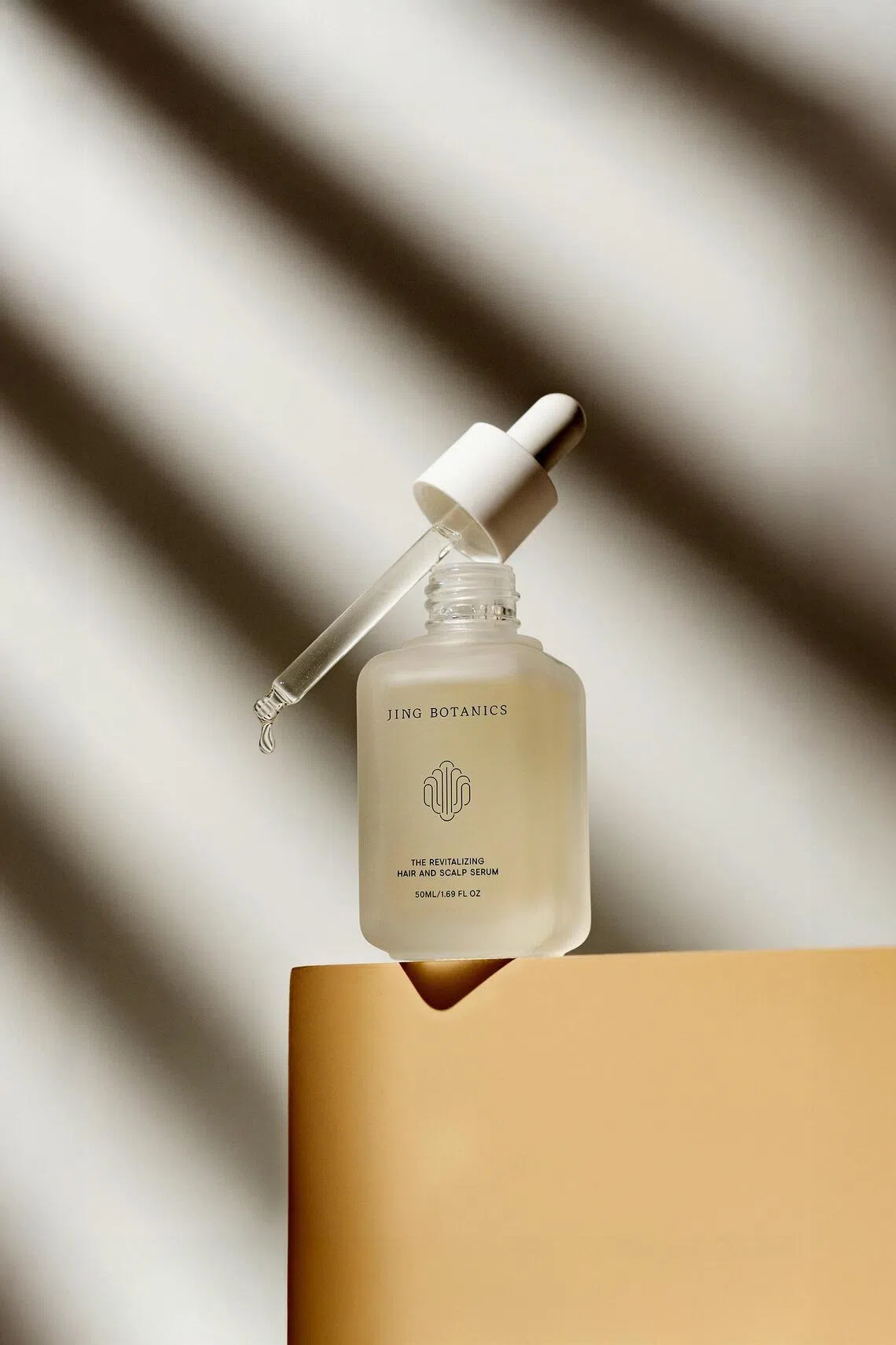
Jing Botanics’ Revitalising Hair & Scalp Serum.
PHOTO: JING BOTANICS
Quick fixes are out, while long-term solutions, focused on balance, are in, he says.
Taglined “TCM meets modern scalp science”, Jing Botanics’ branding is zen and photogenically minimalist – as in the rounded edges of a serum bottle, the chrome of its stainless-steel guasha comb and the labyrinthine pattern of a hair brush. More than half of its clientele are below age 40.
Says Mr Cheng: “As more people discover and rediscover how relevant these (TCM) ideas still are, it’s exciting to see these traditions continue to live on while being interpreted through a modern lens.”
Older players are catching on too.
To keep up with the competition, the longest-lasting Chinese-inspired 24-hour local bathhouse g.spa will look into leveraging data and TCM’s precision-oriented therapeutic philosophy into its range, says founder Gary Tang.
His 24,000 sq ft spa in Guillemard Road, established in 2009, has a theatre room and relaxation room. It averages 160 customers a day, up 20 per cent post-Covid-19 – a boost a g.spa representative attributes to work-from-home policies and gym-goers who do cold pool soaks after workouts.
It does not have the scale to rival House+ Bubble’s various amusements. But the injection of competition, Mr Tang says, is welcome.
He adds: “We do not fear it, because g.spa established its core differentiators from the beginning. Our ‘24-hour one-stop’ concept reflects a profound understanding of and respect for our clients’ time.”
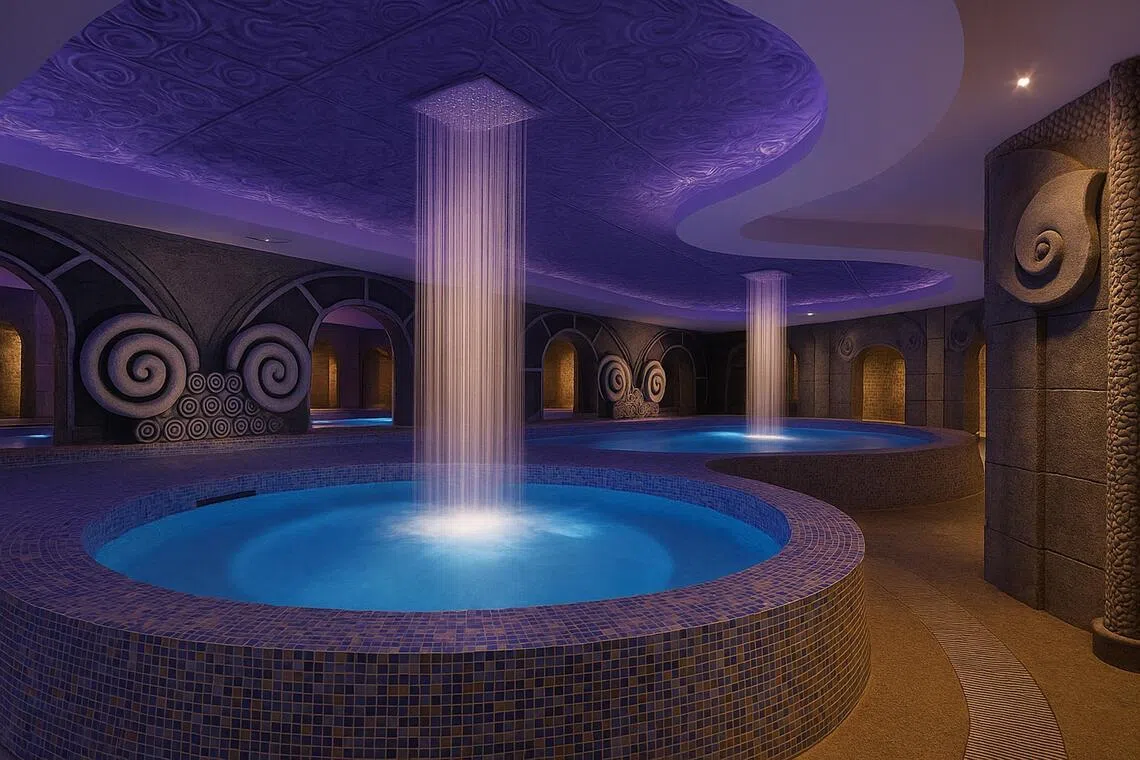
The Male Hot Pool at g.spa.
PHOTO: G.SPA
Besides, the Singapore market is a long game. It draws Chinese entrepreneurs who see in it a blend of East and West that can help export the business farther afield, even as a shared Asian identity suggests easier assimilation, says Kelly Oriental’s Ms Xu.
But it is fundamentally different from China.
She says: “It’s very easy to open anything in Singapore – it’s difficult to last. You must put in 10 times the effort for one fraction of the reward.”