What does it really mean to be strong?
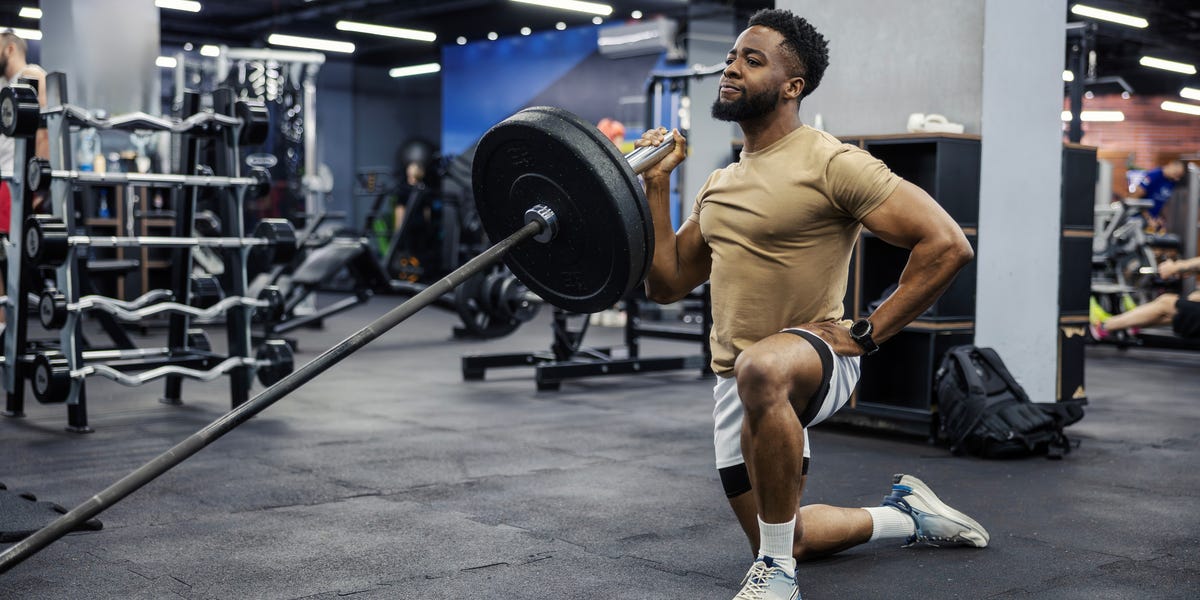
Sure, you can approach the topic like an old-school gym rat, and believe that the only thing that matters is how much weight you can move, prioritising lifting as much iron as possible over everything else. But that’s not how everyone spends their time—and that doesn’t necessarily make them any less strong.
Take someone like Andy Speer, C.S.C.S. Speer has trained for many of different aspects of strength, especially since his long career in fitness has been so varied in its focus. He’s been a gymnast and track and field athlete, a fitness model and MH Next Top Trainer winner, then later became a fan-favourite Peloton instructor, leading the way for the platform’s treadmill classes.
Speer joined MH US fitness director Ebenezer Samuel, C.S.C.S. and exercise physiologist and strength coach Dr. Pat Davidson for MH’s Strong Talk to discuss all of these different aspects of strength and the concept of the Strengthspan, which ranges to include Absolute Strength, Aesthetic Strength, Aerobic Strength, Explosive Strength, and Functional Strength. The conversation ranged widely, from Speer and Davidson’s approach to training, longevity, and looking at fitness in a more multi-dimensional way.
The Strengthspan Strong Talk with Andy SpeerViewing Strength From a Multi-Dimensional Lens
EBENEZER SAMUEL: Do you think we look at strength too one-dimensionally?
ANDY SPEER: I think some people look at strength—I don’t want to use the word too one- dimensionally—but they can look at it from their perspective of what is important to them and what they’re prioritising in their life at that time. And I think that ebbs and flows from [your] 20s, 30s, 40s. Some people stay kind of in one lane. Some people have kind of veer off and take different experimentations and priorities. I never want to be one to say you have to do it this way or think about it this way, that’s not how I operate.
ES: Because that also fuels one-dimensional [thinking] anyway, right?
AS: Exactly. I’ve always been a little bit more of a jack of all trades than a pinpoint going after one thing. Over the years I’ve competed in Olympic lifting, I gave my hand at one physique competition way back in the day. I’ve never been on the gold medal stand at those events, but doing all these things, I do pretty well on everything.
How Strong Is Too Strong for Absolute Strength?
ES: One of the curious questions of the absolute strength is how much of it do you need? You get to a certain point, when you can deadlift 400 pounds, you can bench press like 300 pounds—when is it too much? And when are there kind of diminishing returns on it?
PAT DAVIDSON: When I’m thinking about a strong guy—it’s a very basic place to start—is a 2-3-4, guy. What I mean by that is two plates on the bench, three plates on the squat, four plates on the deadlift. If you can do that, I’m like, “Hey, you’re strong.” You can obviously go way beyond that. But a 2-3-4 guy is kind of where my mind has kind of started as being like, you check that box.
AS: I would totally agree with Pat on the kind of traditional easy barbell computation of, ‘do you have the general requisite weight room strength to not feel like a weenie,’—but more recently in my life, just between teaching classes, trying to do athletic stuff, I started training for Hyrox a little bit too, so we only have so much time to train and focus to put towards one thing. I think there’s still a huge benefit towards training and touching that upper end threshold strength threshold. I think it’s really still very important. I think as we and I get older, and if I’m training for powerlifting, then yeah, we better be getting up there. If I’m bodybuilding, that’s definitely a critical component of it. If I want to just have that neuromuscular adaptation available, I can still train that. And what I’ve been doing recently, is just kind of like working up to one or two sets of a single or double that feel pretty heavy to me. I’m not gonna lie, I haven’t been keeping track of my numbers for a while in that top end department, but just being able to tap on that for a couple sets and a couple reps and then back off, and I’m not doing 10 by two at something anymore, because I don’t feel like I need that for where I’m at, but still with the trap bar, with the barbell bench, being able to get some of that nervous system response at a lower volume, but still get that stimulus. And that’s kind of where I’m at. I think that approach of being really strategic with your heavy reps, and even really strategic with your reps to failure or whatever you’re using for your working sets, and not having a bunch of fluff around it is really important as you age and as your time commitments take over, and as you’re interested in other things outside of the gym.
ES: I kind of disagree. I get the 2-3-4 thing—but I think that’s almost oversimplified. I generally think of it as everybody should be able to bench press their body weight. If we’re going to go with the squat, you should be able to do one and a half times or one and a quarter times your body weight. And you should be able to one and a half times your body weight on a deadlift.
The Balance Between Muscle and Cardio and Performance vs. Longevity
ES: Is there an upper limit where you want to put on a certain amount of muscle without losing your cardio?
PD: That’s so contextual.
AS: Yeah. It’s based on what are your goals? If my goal to look good as 180-pound guy, I want to look like I have a decent physique?
ES: What about for longevity?
AS: Performance and longevity live on the opposite sides of the spectrum.
PD: It’s a tough conversation. I would say high performance is definitely this place that separates itself from longevity. What it takes to to compete in certain sports at a super high level, but other sports maybe a little less. Elites in certain sports are probably healthier than elites in others.
Related Stories