image:
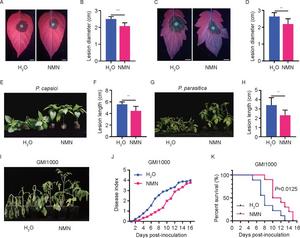
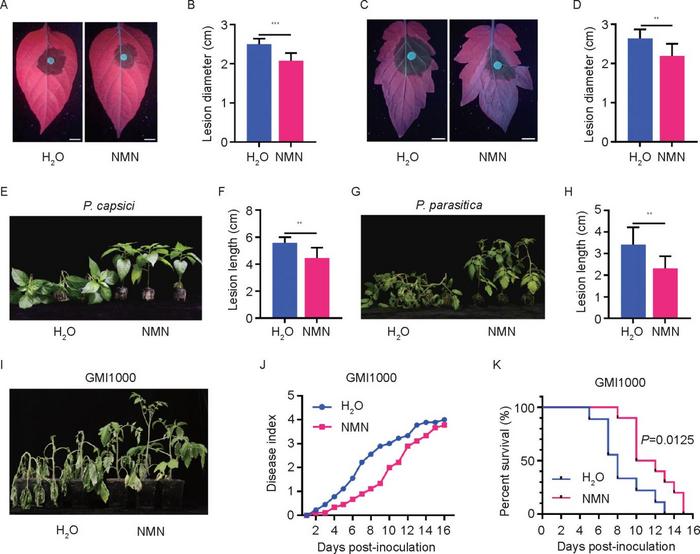
Fig. 3. Nicotinamide mononucleotide (NMN) enhances disease resistance in tomato and pepper plants.
Credit: Shuangxi Zhang et al.
Nicotinamide mononucleotide (NMN), a precursor in nicotinamide adenine dinucleotide (NAD) biosynthesis, is known for its important role in medicine. Recent investigations have also suggested its potential as a plant immunity inducer for controlling fungal diseases. However, whether NMN confers plant broad-spectrum resistance against diverse phytopathogens, and its underlying mechanisms remain ambiguous.
To that end, a team of researchers from China investigated the effect of NMN against multiple phytopathogens in tobacco. They reported their results in the Journal of Integrative Agriculture.
“We found that tobacco pretreated with NMN exhibits enhanced resistance against Ralstonia solanacearum CQPS-1, Pseudomonas syringae DC3000 ΔhopQ1-1, Phytophthora parasitica, and tobacco mosaic virus (TMV),” shares corresponding author Meixiang Zhang, a professor at Shaanxi Normal University, China.
In particular, NMN displays effectiveness within the concentration range of 50–600 μmol L–1, with 75 μmol L–1 NMN exhibiting the most pronounced effect. “The impact of NMN pretreatment could persist for up to 10 days,” adds Zhang.
Beyond tobacco, NMN pretreatment enhances disease resistance in tomato and pepper plants against diverse pathogens, underscoring NMN’s capacity to confer broad-spectrum disease resistance in crops. Moreover, RT-qPCR analysis reveals that NMN significantly upregulates the expression of the pattern-triggered immunity (PTI) marker gene NbCYP71D20 and salicylic acid (SA) marker gene NbPR1a. “This suggests that NMN enhances plant resistance by inducing both PTI and SA-mediated immunity,” explains Zhang.
Interestingly, the positive impact of NMN on plant disease resistance is not significantly compromised in both NMN adenylyltransferase (NMNAT)-silenced plants and NAD receptor mutant lecrk-I.8, suggesting the existence of NAD-independent signaling pathways for NMN-induced plant immunity.
“Our study establishes that the bioactive molecule NMN imparts broad-spectrum disease resistance in plants, offering a simple, environmental-friendly, and promising strategy for safeguarding crops against diverse phytopathogens,” says co-correponding author Yuyan An.
Furthermore, the team’s findings provide valuable insights for future in-depth studies into the functional mechanisms of NMN.
###
Contact the author:
Shuangxi Zhang, E-mail: sxzhang2022@snnu.edu.cn; Xinlin Wei, E-mail: xinlinwei@snnu.edu.cn;
Rongbo Wang, E-mail: wrb16128@163.com;
Correspondence Meixiang Zhang, E-mail: meixiangzhang@snnu.edu.cn; Yuyan An, E-mail: anyuyan@snnu.edu.cn
The publisher KeAi was established by Elsevier and China Science Publishing & Media Ltd to unfold quality research globally. In 2013, our focus shifted to open access publishing. We now proudly publish more than 200 world-class, open access, English language journals, spanning all scientific disciplines. Many of these are titles we publish in partnership with prestigious societies and academic institutions, such as the National Natural Science Foundation of China (NSFC).
Journal
Journal of Integrative Agriculture
Method of Research
Experimental study
Subject of Research
Cells
Article Title
Nicotinamide mononucleotide confers broad-spectrum disease resistance in plants
COI Statement
The authors declare that they have no conflict of interest.
Disclaimer: AAAS and EurekAlert! are not responsible for the accuracy of news releases posted to EurekAlert! by contributing institutions or for the use of any information through the EurekAlert system.