This is Everyday Science with Clare Wilson, a subscriber-only newsletter from The i Paper. If you’d like to get this direct to your inbox every week, you can sign up here.
Hello, and welcome back to Everyday Science.
Infections are back in the news, with the Kent meningitis B outbreak dominating headlines. But my attention was also caught by two studies out this week that shed light on our susceptibility to other diseases at different time points of our lives.
One looked at just how many different bugs infants get when they start attending nursery. The second looked at the other end of our lives, at old age.
Together they made me think about how much our susceptibility to different diseases changes over time – and what we can do to optimise our immune functioning at different stages.
New FeatureIn ShortQuick Stories. Same trusted journalism.
The mammalian immune system is one of the marvels of evolution. Without it, our fragile flesh would be vulnerable to marauding viruses, bacteria, fungi and parasites.
The immune system is capable of impressive feats of recognition – manufacturing molecular weapons called antibodies that lock in on pathogens like guided missiles – and memory; a single infection with measles in childhood usually gives lifelong immunity.
Here is how it changes, from the cradle to the grave.
Babies get immune protection in the womb
The immune system hasn’t yet started fully functioning when babies are born – that’s why they are so prone to catching every cough, cold and tummy bug that’s going round.
Fortunately modern medicine has come up with an impressive array of vaccines that can give their tiny bodies a small taste of a pathogen in harmless form, so the nascent immune system can “learn” how to defeat the real thing.
The best thing you can do for your baby’s immune system is just follow the NHS recommended vaccine schedule.
Babies do get a natural boost from their mother’s immunity, though. In the last three months of pregnancy, antibodies pass from the mum to the foetus, which last up to when the baby is nine-months-old.
That’s why women are now offered three vaccines during pregnancy that help protect their baby after birth: against flu, whooping cough and the most recent addition is one against a respiratory virus called RSV. Respiratory syncytial virus is a common cause of coughs and colds with almost all children contracting it before they’re two-years-old.
Breastmilk also contains antibodies, fine-tuned to the bugs that are going round at the time. These are passed on to the baby and hang around in the nose and mouth.
Young children at nursery get more bugs
The latest findings on childhood infections will come as no surprise to parents of young children.
A review of previous studies found that infants who start going to nursery around the age of one get about 15 different minor infections over the following year. Those who are cared for at home get about 12.
But when children start going to school, the nursery-goers get fewer infections. It depends on the illness, but one study found that in ages six to 11, having previously been to nursery was linked with up to 70 per cent fewer colds and ear infections.
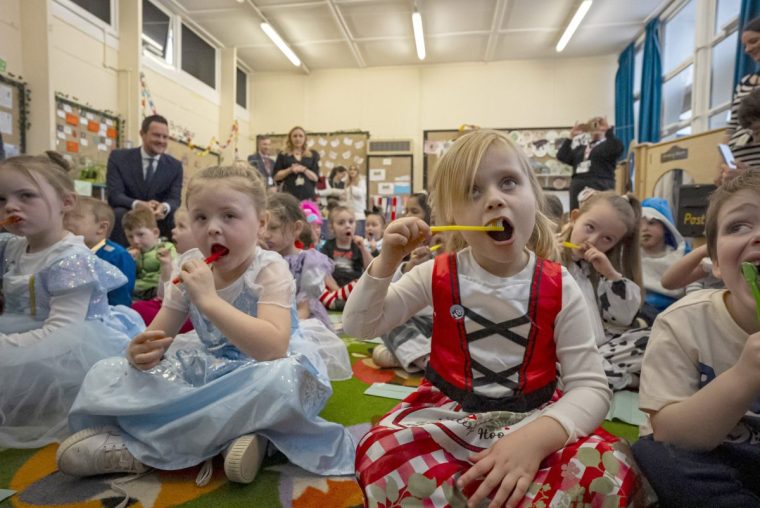 Infants who start going to nursery around the age of one get about 15 different minor infections over the following year (Ben Birchall/PA)
“Hopefully that’s reassuring for parents, that those these infections are counting for something, because the children will not be experiencing them at school,” said Dr Lucy van Dorp, an infectious disease researcher at University College London.
Parents might wonder whether it is better for their kids to get the infections earlier or later in their lives. That depends on the disease, said Van Dorp.
For RSV, it is better to avoid getting it as a young baby, when the virus can be dangerous – which is why doctors have welcomed the vaccine for pregnant women.
For chickenpox, symptoms can be more severe if the person gets it when older. However, a chickenpox vaccine has just been added to the routine childhood jab schedule, so there is no dilemma here either.
The paper was published in Clinical Microbiology Reviews.
Teenagers are exposed to lots of germs
It might seem surprising that teenagers and young adults are bearing the brunt of the current meningitis B outbreak in Kent, considering this is usually one the healthiest age groups.
The immune system has by now reached full maturity in terms of its functioning – although most teens still won’t have immune memory for as many bugs as a typical adult would.
It is not that teenagers are innately more susceptible to meningitis B – they are more likely to catch it because of the number of people they mix with, something that rises if they go to university.
“Their number of contacts tends to be higher than at every other age. They’re mingling a lot more,” said Professor Simon Williams, a public health researcher at Swansea University.
Teens may also be more careless around hygiene, sharing drinks and vapes, he added.
Social mixing plays a role because the bacteria causing this meningitis B outbreak are often carried harmlessly in the nose – by up to a quarter of adolescents.
For reasons that are unclear, sometimes when the bacteria spread to new hosts, they can turn deadly, crossing from the nose to the bloodstream and the brain.
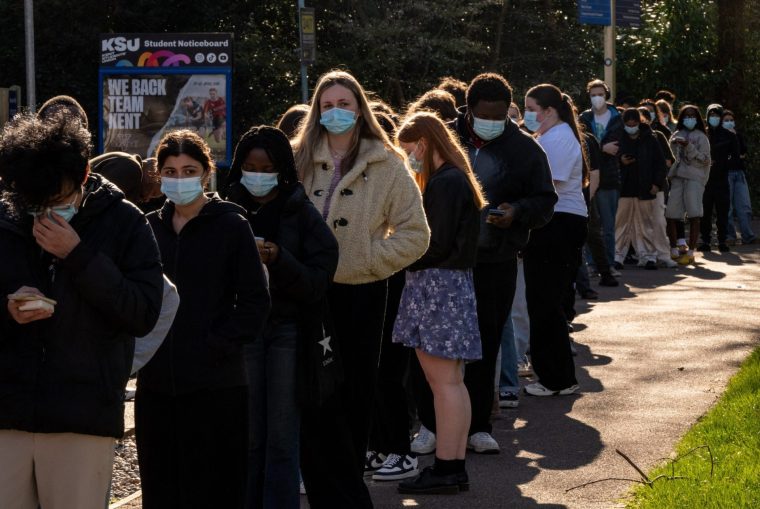 People queue to receive vaccinations at the sports centre on the University of Kent campus, following an outbreak of meningitis B cases (Photo: Chris J Ratcliffe/Reuters)
Again, vaccines are one of our best weapons against Group B meningitis, involved in this outbreak. Unfortunately, the vaccine only arrived in 2015 and is usually only given to babies.
But teenagers are offered immunisation against a different group of bacteria that can cause meningitis, called the MenACWY jab, to catch them before they go off to university.
Others targeted at young teens include the HPV vaccine, which protects against cancer of the cervix and anus and genital warts. This should be given before they start having sex.
The vaccine is now being offered to students who may have been exposed, although it can take up to two weeks to work. So antibiotics, which work immediately, are also being offered.
Middle-age is the start of immune decline
Like the rest of our bodies, the immune system’s effectiveness slowly declines with age. This has been known for a long time, but is hard to measure.
Two studies out this week have shed light on this process, by measuring the size of the thymus gland, a small organ in the chest that plays a crucial role in the immune system.
You might have heard of “T cells” – an important branch of the immune system that is crucial for killing bacteria, cells infected with viruses and cancer cells. T stands for thymus.
After being made in the bone marrow, T cells travel to the thymus, where they undergo crucial maturation processes.
Unfortunately, the thymus starts shrivelling up and becomes less functional as we get older. In 60-year-olds, the gland is less than half the weight than in 20-year-olds, and some of the useful tissue has been replaced by fat.
The latest research used chest X-rays that had been taken as part of two previous long-term studies, one investigating heart disease and one lung cancer, to precisely measure the thymus.
They found that the size of the thymus gland, adjusted for the person’s age, correlated with how long they lived, and their chances of dying from heart disease and lung cancer.
As ways of rejuvenating this previously overlooked gland are being tested in mice, this suggests a new way of potentially extending our healthy lifespan, although more research is needed, said Professor Graham Anderson, an immunologist at the University of Birmingham, in an accompanying editorial. The papers were published in the journal, Nature.
Hidden virus takes a toll in older people
The bad news is all parts of the immune system continues to decline with age – not just T cells but also B cells, which make antibodies.
This is why several vaccines are recommended, starting from age 65 to 75, depending on the pathogen, including for flu, Covid, RSV and pneumococcus, a bacterium that causes pneumonia.
The most recent addition to the schedule is a vaccine for shingles, which is when the chickenpox virus – which almost everyone has lying dormant in their nerves – reactivates and causes a painful rash.
Another virus that may reactivate after lying dormant is CMV or cytomegalovirus. This virus has a unique effect on the functioning of the immune system and it is not a positive one.
Most people catch CMV in childhood without noticing and their immune system suppresses it, but cannot eradicate the virus. Recent research suggests that as we get older, more and more of our immune cells become devoted to suppressing CMV.
“It’s building up this army which is specific for CMV, and it takes up space, so you have less space for T cells that protect you against flu,” said Dr Leo Swadling, an immunologist at University College London.
CMV is probably just one part of the reason why older people are not just more vulnerable to infections but also respond less well to vaccines. But it also gives hope that one day we will be able produce better vaccines, which optimise the response in the older immune system, said Swadling.
“If we can identify exactly the things which mean the elderly people are doing worse when they see an infection, we could try and tailor those vaccines to make them better,” he said.
I’ve also written
Designer “cross-breed” dogs, such as cockapoos, are often claimed to be healthier and better behaved than the pedigree breeds that are their parents.
But two of the most popular cross-breeds, cockapoos and cavapoos, tend to be naughtier, as I explain here.
I’ve been watching
I thought I wouldn’t enjoy Louis Theroux’s latest documentary, Inside the Manosphere, as it would be too depressing, but I was wrong.
The documentary maker brings his famed interview techniques of asking innocent questions and leaving long silences, to give his subjects just enough rope to hang themselves.
But if, like me, you hadn’t previously been exposed to these manosphere podcasters and YouTubers, it is a disturbing and eye-opening watch.