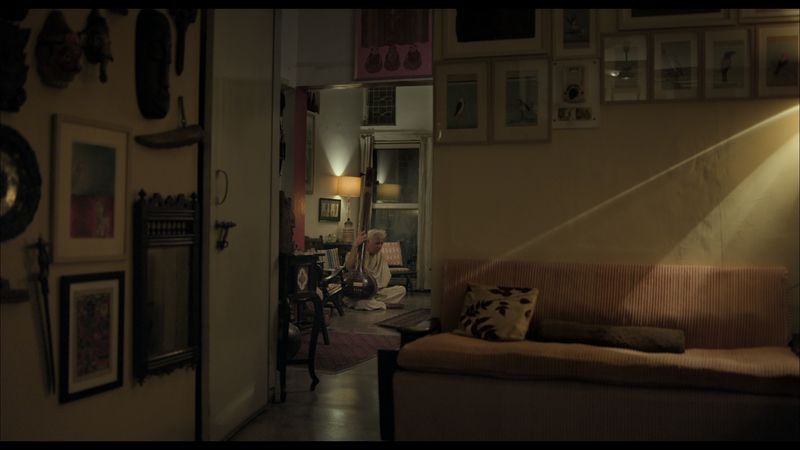
The old taxi is almost heaving as it makes the steep climb in the hills. There is conversation about his latest film ‘Alaav’. But you want to know more about the core of a nuclear reactor. He politely asks if you have a science background. You shut your mouth. Filmmaker Prabhash Chandra’s latest ‘Alaav’ was recently screened to full houses at the International Film Festival of Kerala (IFFK) and before that at the Dharamshala International Film Festival (DIFF). It is a portrait of an ageing Indian artist caring for his mother, capturing the rhythm of their everyday life.
Revolving around vocalist and actor Bhaveen Gossain’s (63) caretaking of his real-life 95-year-old mother Savitri, the movie has a quiet and meditative narrative that embodies tenderness, fatigue and the strange beauty of repetition in the characters’ days. The camera remains mostly still and observational, and never intrusive. The form slowly evolves with each frame and the pace of the duo’s daily life — slow, repetitive, without clear drama — shapes the film’s own rhythm.
The director ensures that time is allowed to pass within the frame, letting small gestures and silences reveal themselves.
He recalls, “I first met Bhaveen around 2015. I had gone to see him for a play I was working on; he was helping me with voice exercises. Slowly we developed a bond, and I also met his mother. Over time, I could not help but observe their quiet life.”
Chandra was not thinking about imparting any ‘message’ through the film. Understanding that care-giving is rarely dramatic but slow, repetitive and at times exhausting, he asserts, “But there is also a quiet dignity in it. In cinema, we often look for extraordinary events. Why does love have to be dramatic? Sometimes, it is simply about staying with someone through time.”
The filmmaker, who grew up in a middle-class family in a village in Bihar, like most children from similar backgrounds, was encouraged to focus on mathematics and science, subjects he excelled at. “Almost by chance”, filling out the Delhi University entrance form — his name appeared in the first list and he enrolled in Physics (Honours). “Over time, my academic journey gradually moved towards nuclear science, eventually leading me to pursue an MTech in Nuclear Science and Technology.”
Filmmaker Prabhash Chandra.
For someone who was at the Bhabha Atomic Research Centre, but would watch world cinema with his research guide during his MTech days, the transition to filmmaking was gradual. “The department had given computers to researchers in the plasma lab, and I spent long hours watching films there late into the night. For nearly seven years, I remained deeply involved with theatre and cinema.” During the time at Bhabha, on paper, his career and life looked perfect. But somewhere inside, there was a feeling that he could not spend his entire life in that field, thus deciding to step away from both the job and the PhD.
Of course, this did leave his parents and scientist friends scandalised. “I think my father is still digesting my choices. One of my scientist friends who moved to France called me and said, ‘Yeh cinema to hota rahega, there is a position here, and you will easily make 2,000 Euros a month.’”
Chandra’s debut feature film, ‘I’m Not the River Jhelum’ (2022), portrays the life of a young protagonist, Afeefa, living in Kashmir. He insists that it helped him in taking more measured decisions during this shoot. “That one was shot in the Valley, largely outdoors, sometimes almost in a guerrilla style. The situations were uncertain and the approach to shooting had to remain flexible. With ‘Alaav’, the space itself began to guide many of our decisions. We tried to observe how life unfolds within that limited space.” The film will be shown this month at the 5th edition of ‘INDIAINDIE’ in Barcelona, followed by screenings at Madrid and Spain.
As someone who believes that silence and stillness are important storytelling tools as they precipitate one to listen more carefully, he adds, “In a way, it is similar to classical music. In a raga, the musician enters a space where sound and silence slowly unfold. It requires patience and attention. When you allow stillness, small movements and emotions begin to appear more clearly.”
His process does not usually begin with a fixed theme, but observation of everything around him. Chandra says he believes in spending time in a place, shoot a little, wait, look again, and then return to that space. Finding himself drawn to ordinary lives and intimate human relationships, and how larger social and political realities quietly shape them, he has always been interested in trying to understand people’s inner lives.
He is currently working on a new film (untitled) and collaborating again with Bhaveen. The film follows the life of a migrant worker from Bihar in Delhi. “Like my earlier work, this one is developing slowly,” he adds. All praise for intimate festivals like DIFF, which invites some of the finest cinema from across the globe, the filmmaker laments that independent filmmakers are always negotiating with limited resources and uncertain avenues for distribution.
Even as many festivals often look for films that fit certain expectations or attract particular audiences, he feels that with reels and short videos, a more reflective kind of cinema sometimes appears out of place. “But there is no point surrendering completely to what platforms or markets demand. There may be repercussions, but that has always been part of independent filmmaking. In some way, that struggle is also part of the process,” he concludes.
— The writer is a freelance contributor