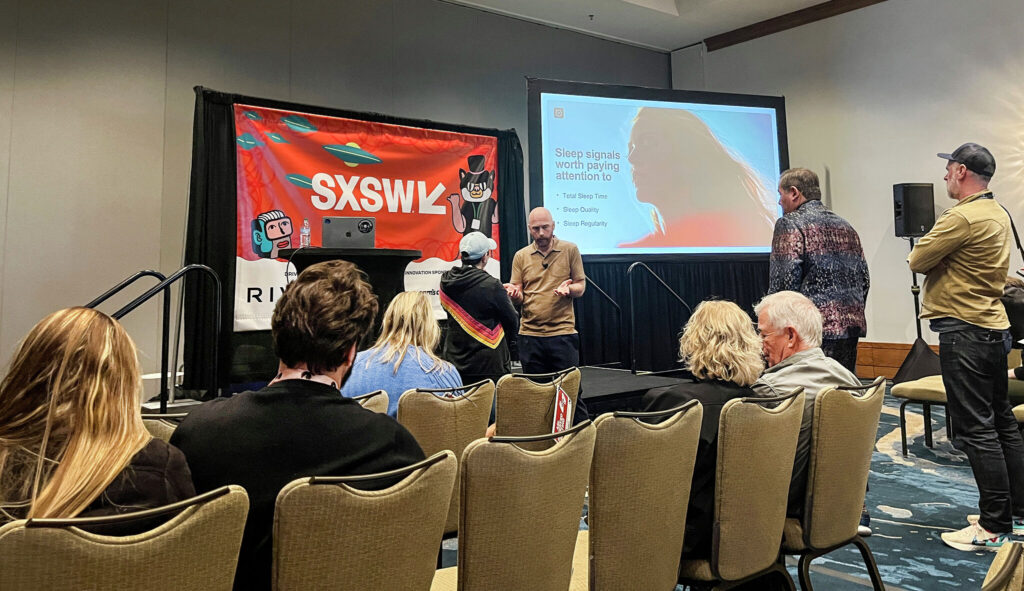
Sleep Cycle’s Mikael Kågebäck talks to a participant after his presentation on how changes in sleep sounds can predict coming illness.
Nicole Villalpando/Austin American-Statesman
Every year South by Southwest’s health conference gives a glimpse into the future of medical care in the United States and around the world. This year, artificial intelligence was again at the forefront of many conversations, as were supplements, longevity, women’s health and federal funding.

Here’s what we learned:
Article continues below this ad
Let’s talk supplements
Supplements have their place, but use nutrition first. “There’s no magic bullet,” said Dr. Dawn Mussallem, an integrated oncologist with Fountain Life and the Mayo Clinic. “You can’t out-supplement, out-GLP-1 a poor lifestyle.”
Focus on healthy food rather than processed foods. You should eat 40 or more diverse plant-based foods a week. Plant diversity helps build the gut microbiome better than taking probiotics. Also, aim for 30 grams of protein a day from real foods, 30 grams of fiber and three fermented foods a day. Half of your plate should be a vegetable or a fruit. Don’t forget movement, including strength training and short vigorous exercise bursts, sleep, sunlight and time in nature, and social connection to help improve longevity.
Use of supplements should be based on what your body is missing and in consultation with your doctor. Regular blood work makes sure you need the supplement and you are not over-supplementing, which can be dangerous.
Article continues below this ad
Supplements aren’t regulated like medications are. To have a better idea of what you are getting, look for “NSF” on labels. The organization, which originally stood for National Sanitation Foundation, screens the supplement for harmful metals and plastics and certifies that professional athletes can use it. Also ask questions and look at the research: What is the evidence that this supplement is safe and provides the results it claims?
Check every supplement with a doctor and a pharmacist to make sure it will not harm any other medication you take or create a dangerous side effect. Even the very popular peptides need to be used with caution. Peptides, which are made up of amino acids, are found naturally in the food we eat, but boosting these peptides in an unnatural way might trigger cancer, Mussallem said
“Peptides do concern me,” she said. “Actually, they terrify me.”
Article continues below this ad
Let’s talk medications
New medications will take longer to get to approval. When layoffs eliminated 20% of the U.S. Food & Drug Administration’s workforce last year, it lost the institutional knowledge that helps manufacturers get their clinical trials through the application process. The use of artificial intelligence, which the FDA has been using for decades, can’t replace that knowledge base. There is interest in data-sharing to help speed up the process, but manufacturers need to agree to it while protecting their intellectual property.
Don’t worry about pounds; worry about health. The treatment for obesity has gotten better with the new medications, but they should be doctor-regulated with focus on reducing fat and increasing muscle. A true revolution will come when insurance covers obesity treatment, when interventions happen earlier and medications aren’t seen as a quick fix, but a necessary treatment like blood pressure medicine or insulin.
Visceral fat is concerning. Scientist Rhonda Patrick of FoundMyFitness said the fat that is around the belly and internal organs increases the risk of cancer, triggers inflammation, “sucks energy away from the brain,” increases cravings and signals the beginning of insulin resistance.
Article continues below this ad
Hormone replacement therapy is back. The FDA removed the black-box warning from hormone replacements last year when re-evaluated data confirmed that breast cancer risk was minimal. More women are leaning into hormone therapy in perimenopause and menopause, but it should be started within the first six years of menopause. Decrease in dementia rates and heart disease might be seen in decades to come if more women lean into replacements.
Antidepressants and anxiety medications are difficult to quit. People have reported heart palpitations, dizziness, nausea, panic attacks, insomnia and increased depression similar to coming off opioids, said Dr. Mark Horowitz, who helped create the first guidelines for safely stopping these drugs. It has to be done carefully, over the course of months to years, taking less and less medication. The idea that some people have a chemical imbalance is a myth that 1960s psychiatrists hypothesized but never proved. If people are going to take these medications they should be prescribed for a set short period of time for a mental health episode with a plan to get off of them.
At a SXSW health panel, Dr. Dawn Mussallem, Dr. Amy Shah and Suzanne Devkota talk about the use of supplements in achieving better health.
Nicole Villalpando/American-Statesman
Are you sleeping?
Sleep should be prioritized including a routine that is the same every day and is seven to nine hours a day. “It’s when the body is the most active,” said Dr. Poonam Desai, the chief medical officer of Longevity Place. Sleep helps reset hormones, improve brain and muscle health, remove toxins and other important processes.
Article continues below this ad
Sleep can predict when the next illness is coming. Sleep Cycle’s chief technology officer Mikael Kågebäck used global data from the company’s app users. The app records the sounds it hears when a person sleeps and can tell how often they snore, cough, are in deep sleep, etc. When he saw the number of coughs increase among users in one area, a flu or other virus outbreak would happen two weeks later. He could predict down to the neighborhood in Austin.
Artificial intelligence is everywhere
AI isn’t human and never will be. “Human biology is very complex,” said Tala Fakhouri, who worked on artificial intelligence at the FDA. “I don’t know that any AI technology has been able to crack the code.”
She worries about bias in the medical data being fed into artificial intelligence systems because clinical trials have historically been filled with young, white males. “Humans have to be able to intervene to make the decisions.”
Article continues below this ad
AI agents can be tailored to the person. Pharmaceutical companies and hospital systems are developing platforms that offer options to choose your AI agent type: male or female, race, sympathetic or more like a drill sergeant. AI agents, which are avatars that help guide you through an app, also can be used in mental health treatments. Virtual reality software and AI help people with post-traumatic stress disorder or anxiety process different scenarios.
AI can help patients and doctors save time using your health records. Health companies are working on offering apps that allow patients to ask questions like “Do I need a tetanus shot?” and then search your health records to tell you if you are due for a shot or not and then where to get one. It can also help doctors prepare for a visit with a patient by offering the highlights of the health record. Health companies are working on tying the data on your smart watches and other devices to health records so doctors can see it, as well as send alerts with action steps to the patient and the doctor.
Patients still like people. AI’s best use can be helping humans deliver better care. One study found that AI provided information used by peer support specialists had better outcomes for people in recovery, but the key was still that peer talking to another peer, not just an AI-generated agent talking to a person.
Article continues below this ad
Sometimes people do feel more comfortable with an AI agent. People will type in more about their symptoms and health history into an AI prompt than they will tell a doctor. AI can be a judgment-free zone.