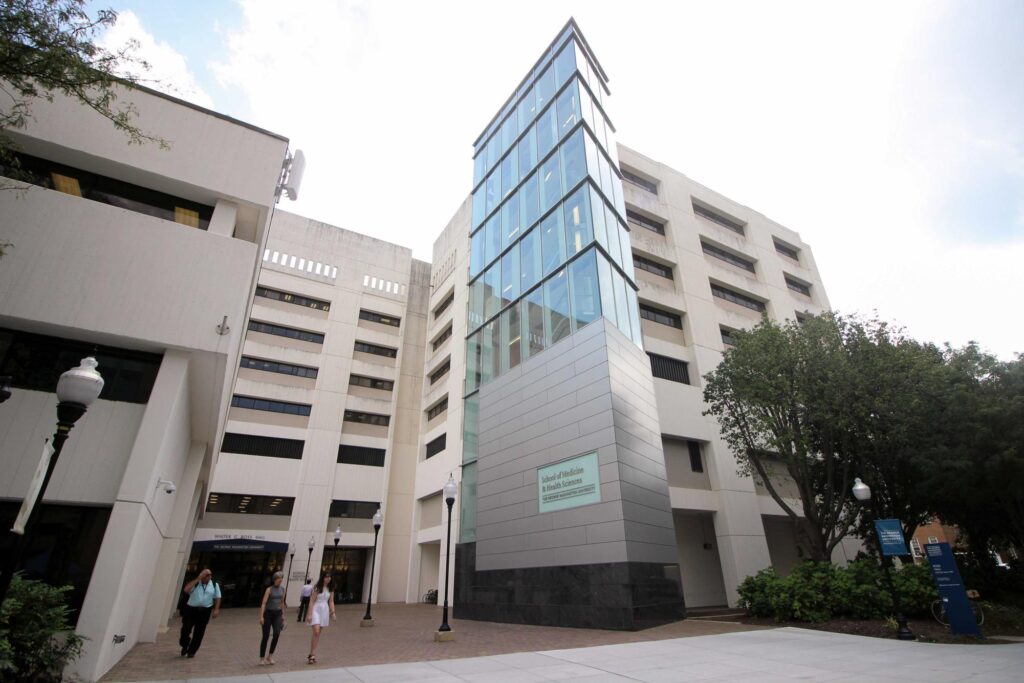
The School of Medicine & Health Sciences signed onto a nationwide Department of Health and Human Services initiative earlier this month to add mandatory nutrition education to school curricula starting next fall.
The SMHS joined 52 other medical schools in the initiative on March 5, part of Health Secretary Robert F. Kennedy Jr.’s “Make America Healthy Again” program aimed at addressing the root causes of chronic diseases in children. As part of SMHS’s voluntary commitment to the program, the school agreed to a new mandate requiring students complete at least 40 hours of nutrition education throughout their educational career, a minimum that SMHS students already exceed.
The HHS agreement also requires schools to nominate a “faculty champion” for nutrition education and mandates officials to create a public website stating the school’s plan to meet federal requirements, with schools that join the initiative receiving access to a $5 million pool of funds that the program will distribute during an upcoming nutrition education challenge.
A University spokesperson said the new initiative was a “natural extension” of SMHS’s previous curriculum guidelines, as the school’s MD programs already included nutrition requirements that exceed the new 40-hour federal minimum, which requires schools to embed education into existing classes as well as create new ones focused on nutrition. The spokesperson also said SMHS integrates nutrition education into their undergraduate curriculum through the culinary medicine program, which helps students become more “culturally responsive” when counseling and recommending diets to patients.
“Medical students receive more than 40 hours of nutrition-related instruction embedded throughout foundational and organ system–based courses, including enhanced case-based modules that highlight chronic disease prevention, nutrient-dense foods, and evidence-based dietary patterns,” the spokesperson said.
The Make America Healthy Again initiative, established by President Donald Trump through an executive order in February 2025 and led by Kennedy, aims to identify the cause of America’s “chronic disease epidemic” and reform various food, health and scientific systems through methods, like reducing the number of “highly chemically processed” foods and merging five different HHS agencies into a new Administration for a Healthy America agency.
Kennedy first began pushing for more nutrition education in medicine in June, saying he would withhold federal funds from schools that do not offer nutrition courses. In August, he and Secretary of Education Linda McMahon demanded medical education organizations submit written plans detailing the scope and timeline of a proposed nutrition curriculum by September, but did not mention withholding funds from schools that did not comply and have not yet done so.
HHS did not return a request for comment.
The Medical Education Nutrition Competency Framework, provided by HHS to aid schools in building their curriculum for the program, is made up of 10 different domains, including public health nutrition, food and nutrition-related communication skills, experiential hands-on learning, food systems and environmental impacts and billing, coding and reimbursement for food and nutrition services.
Health experts have criticized some of Kennedy’s previous initiatives, like defunding vaccine research and altering vaccination recommendations, but the American Medical Association, the Association of American Medical Colleges and the American Association of Colleges of Osteopathic Medicine have all praised Kennedy’s new nutrition curriculum for making something they view as “foundational” to health a requirement for students.
Four of GW’s peer schools — New York University, Tufts University, Tulane University and the University of Miami — also signed onto the initiative.