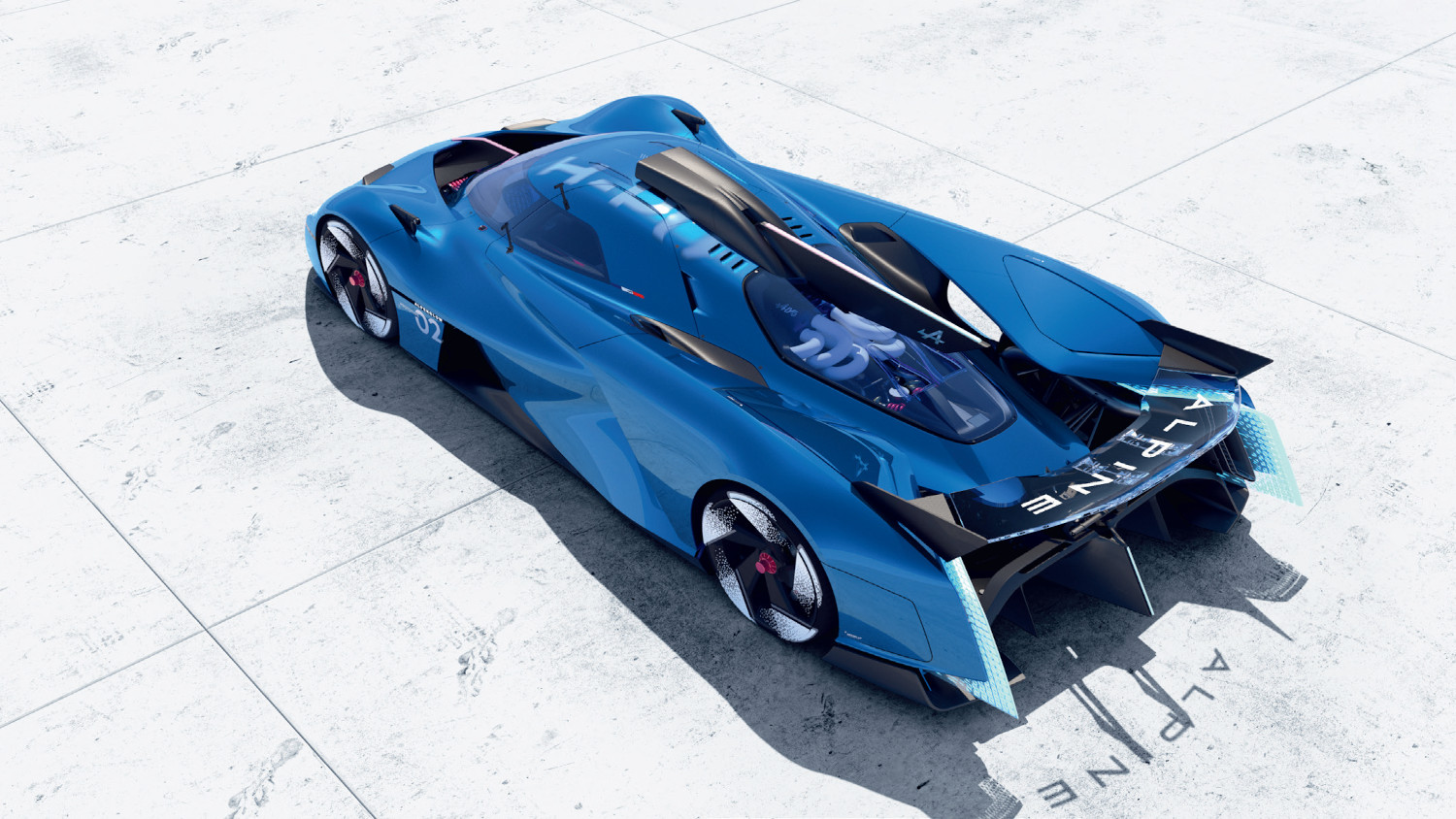
A collaboration between French automaker Alpine and Italian industrial group CRP is powering a new chapter in motorsports, writes Gabrielle Brown
Back in 2022, the hydrogen-powered Alpine Alpenglow concept car stunned crowds at the Paris Motor Show with its smooth curves and striking blue finish.
But it wasn’t just the futuristic exterior of the car that impressed attendees. The technology that lay beneath struck many as equally forward-looking: a hydrogen powertrain that can be refuelled in minutes and emits only water vapour, drastically reducing emissions while still delivering power.
That technology reappeared in 2024 in the Alpenglow Hy4, a vehicle capable of producing 340 bhp (brake horsepower) from its 2-litre, turbocharged, four-cylinder hydrogen engine.
At the launch of the Alpenglow Hy4, Alpine CEO Philippe Krief did not hold back: “The Alpine Alpenglow Hy4 is not just a standalone prototype. It’s our brand manifesto, a statement of our commitment to sustainable innovation and a testament to our belief that we can create thrilling driving experiences that reconcile environmental innovation and performance,” he said.
“This vehicle combines the thrill of the sound of an internal combustion engine with the promise of a sustainable future.
” Cut to the present, and Alpine’s hydrogen innovations can again be found inside the Alpenglow Hy6, which the company showcased at the 2025 Paris Motor Show in October.
Once again, show attendees got the chance to admire Alpine’s fusion of mechanics and aesthetics, as well as that signature rich blue colour scheme.
Just as eye-catching for observers is the Hy6’s transparent rear bonnet, which keeps the underlying technology firmly on display.
The latest engine from Alpine, meanwhile, is a 3.5-litre, bi-turbo V6 engine capable of producing 740 hp (horsepower) at 7,600 rpm.
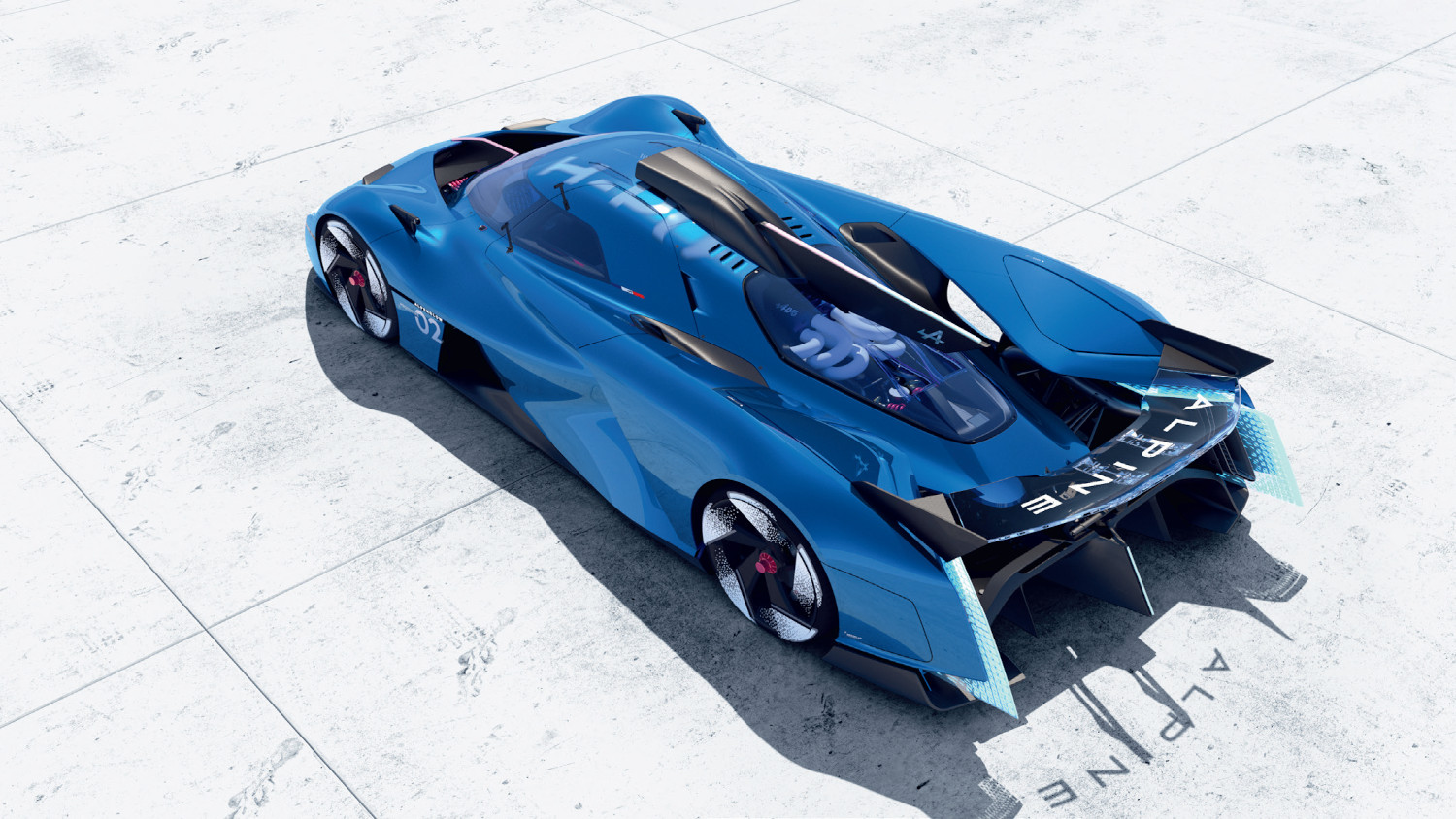 The Alpenglow Hy6, as showcased at the 2025 Paris Motor Show Credit: Alpine Cars
Design challenges
Initial designs for the combustion chamber and air loop were created using digital simulation, but Alpine’s engineers ran into some challenges. The 3D-printed polymer parts were bonded with aluminium flanges, but this caused sealing issues during bench testing, due to thermal expansion differences, vibration and high thermal loads.
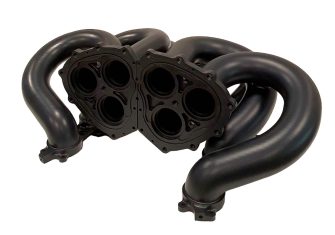 Intake plenum and manifold system for the Hy6, 3D-printed in Windform SP Credit: CRP Technology
For help tackling these issues, Alpine turned to CRP, an Italian industrial group specialising in additive manufacturing (AM), rapid prototyping and highprecision machining. The company has been involved in automotive manufacturing since the 1970s.
Engineers at CRP’s 3D printing and AM arm, CRP Technology, proposed a fully monolithic 3D-printed architecture, to be produced using SLS (selective laser sintering) technology and Windform SP, a carbon fibre-reinforced thermoplastic.
Following some tweaks, the final system consists of three monolithic components: one intake plenum and two intake manifolds. By integrating the fl anges, designers were able to eliminate the need for aluminium parts and ensure uniform material behaviour under turbocharged operation.
Alpine also got help from CRP Meccanica, the arm of CRP that offers high-precision CNC machining and advanced manufacturing for motorsports, aerospace and defence. CRP Meccanica’s team provided the post-processing roadmap from CNC machining to vapour smoothing of internal surfaces, in order to ensure an accurate fit and tight sealing, using a hybrid additive/subtractive workflow developed in-house at CRP.
The Alpenglow Hy6 may not have hit the racetrack yet, but it represents yet another step closer to hydrogen-powered motorsports, as well as providing a striking showcase of Alpine’s commitment to both mechanics and aesthetics.
This article first appeared in DEVELOP3D Magazine
DEVELOP3D is a publication dedicated to product design + development, from concept to manufacture and the technologies behind it all.
To receive the physical publication or digital issue free, as well as exclusive news and offers, subscribe to DEVELOP3D Magazine here