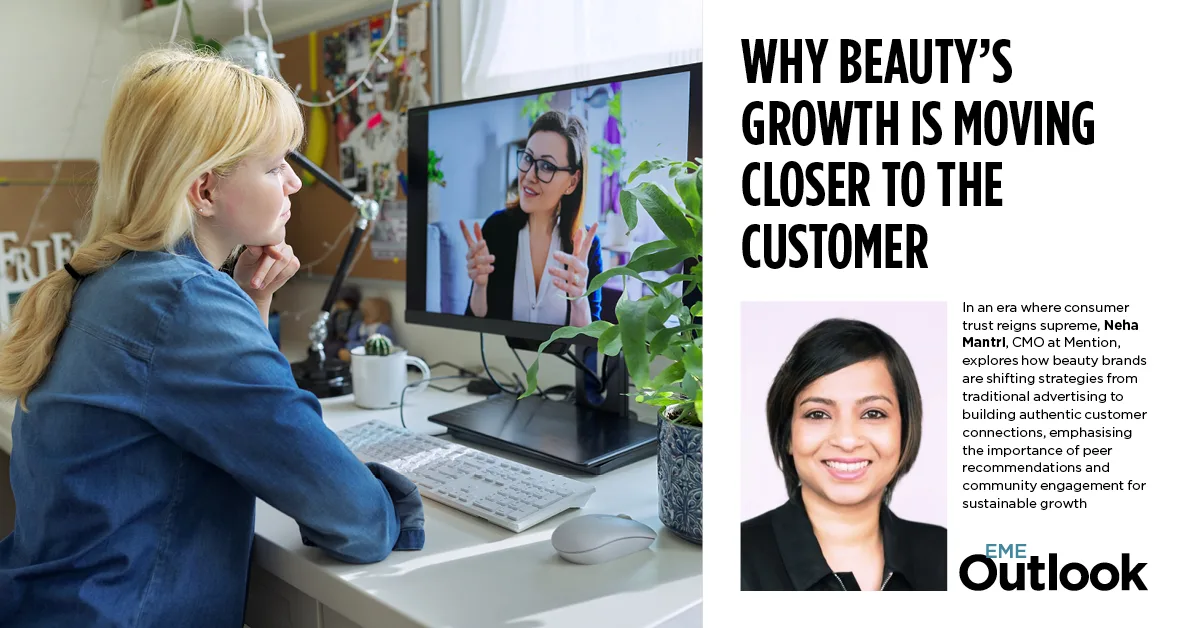
In an era where consumer trust reigns supreme, Wojtek Kokoszka, CEO at Mention Me, explores how beauty brands are shifting strategies from traditional advertising to building authentic customer connections, emphasising the importance of peer recommendations and community engagement for sustainable growth.
WHY BEAUTY’S GROWTH IS MOVING CLOSER TO THE CUSTOMER
When was the last time you purchased a skin care product after seeing an advert, instead of hearing about it from someone you already trust?
What’s happening now in the beauty world ties back to that question – brand strategies such as Estée Lauder’s Beauty Reimagined and Coty’s Coty.Curated is being sold as a smart change, with fewer distractions, tighter control, and better returns.
Look more closely, however, and you’ll see there is a clear movement beneath the surface in which trust now sits between brands and consumers. One clear reason is that both groups are reacting to the same commercial pressures.
Sourcing new customers now costs more than ever before. Consumers are becoming far more sceptical of traditional influencers, and more people now trust in peer recommendation over brand-led messaging.
This isn’t something that will vanish overnight; instead, it represents a clear example of how influence is evolving, as exemplified by recent campaigns.
It’s not enough for brands to simply show up anymore; being seen means very little if nobody believes in you. People want proof, but from those that they already listen to and trust, not from flashy adverts built to have a wow factor.
GROWTH DOESN’T ALWAYS FOLLOW VISIBILITY
Decades of beauty progress have relied on being front and centre above other competing brands.
Big roll-outs, polished photos, and famous faces pushing products – all of these have driven strong interest over time, with power and influence flowing clearly from brand to consumer – this framework created the global icons we know and love today.
Yet the conditions that sustained it have changed over the past few years. Recent research of over 1,200 consumers reveals that over half most often receive recommendations from friends and family, and 51 percent trust those recommendations above all other sources.
These figures show that growth is increasingly tied to personal referrals rather than promotional output alone.
THE SHIFT FROM CAMPAIGNS TO COMMUNITIES
What makes Coty.Curated particularly compelling is not just its emphasis on sharper data and streamlined investment, but how that data helps brands get closer to buyers.
Beauty Reimagined reflects the same thinking by accelerating product development and putting more effort into marketing aimed directly at consumers to build stronger connections.
Growth happens inside communities, through private chats and trusted networks rather than just through public social media feeds.
As highlighted in Harvard Business Review, people share not only to transact, but to signal identity, strengthen social bonds, and reinforce status within their networks.
However, not everyone shares their recommendations in the same way. There are those who share because they feel emotionally connected to the brand, those who share for incentives, and a larger group of individuals who like brands but only recommend when it feels relevant and socially safe.
This final group is what brands need to focus on, and it’s also where the opportunity lies. Almost half of consumers say they won’t act on recommendations if they don’t feel relevant. This highlights the importance of building confidence and genuine brand loyalty.
Brands must focus on enabling the right customers to recommend at the right moments, in ways that feel natural and genuinely relevant to their networks.
 Wojtek Kokoszka, CEO, Mention MeRELEVANCE IS EARNED THROUGH REAL EXPERIENCE
Brands can’t unlock the next wave of growth in the beauty industry by simply tweaking their marketing campaigns.
If they want to level up, they need real systems that let actual customers speak up about what matters to them.
Technology has a massive role to play here, but it can’t replace the human voice. Let data and artificial intelligence (AI) do what they’re best at: figuring out who’s actually influencing others, tracking how that influence travels, and clearing out any barriers in the moments that count.
This has the potential to bring brands and buyers much closer together, much faster.
If you look at the bigger picture, one thing’s clear: brands in beauty and retail can’t only rely on manufactured hype anymore.
Real growth comes when buyers have experiences they want to talk about and when brands build the systems that help those stories get told – that’s where the future is headed.
Coty and Estée Lauder aren’t just tweaking how they do business; they understand that the balance of power has changed.
These days, it’s consumers calling the shots, people choose which brands deserve to grow, and a lot of those decisions happen in conversations brands can’t steer.
Influence no longer comes from the loudest voice in the room or the one with the most followers; it comes from the most credible one.