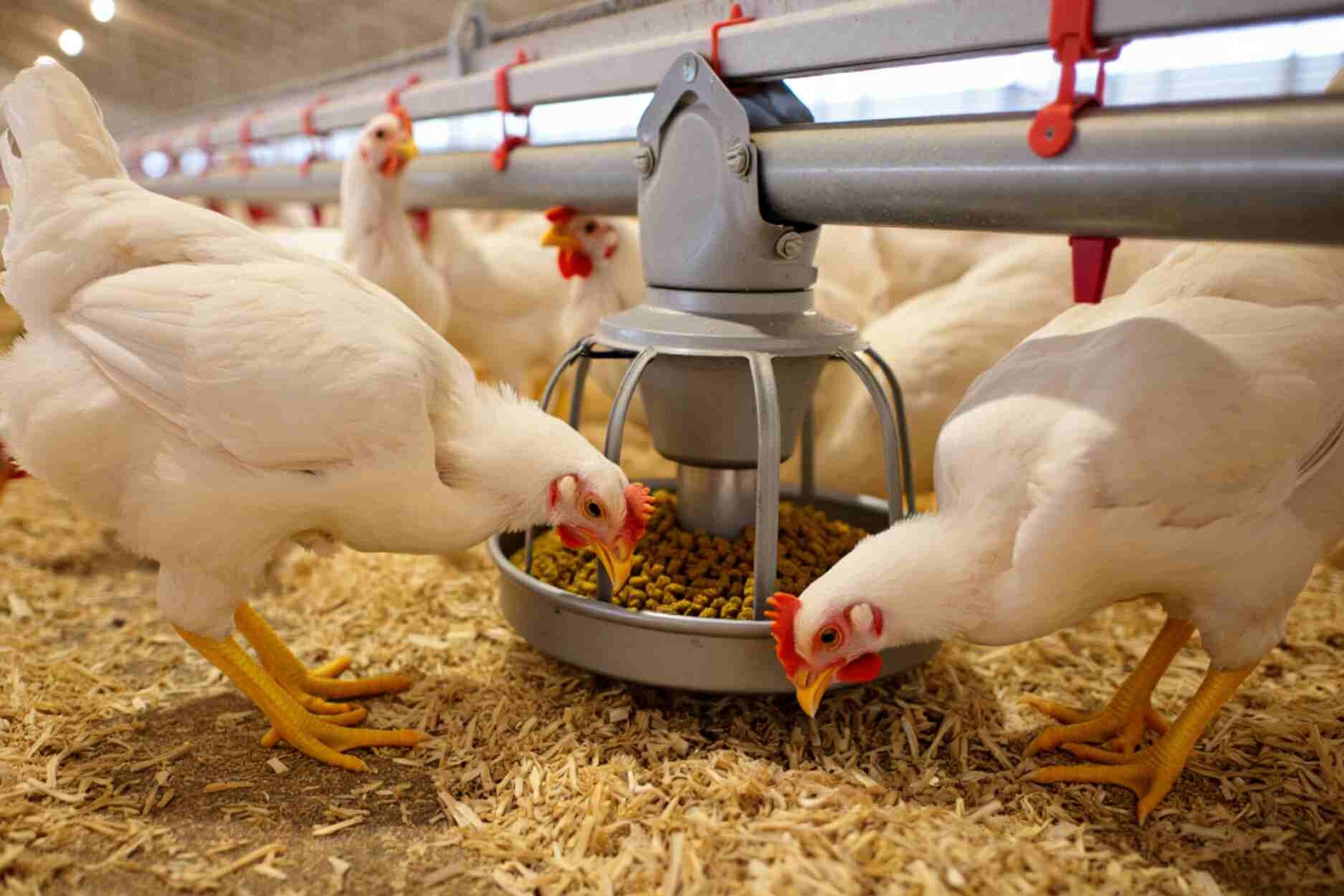
 Phosphorus oversupply can increase feed costs and contribute to environmental nutrient loading, whereas undersupply can compromise growth rate and welfare. Image created with the help of AI (Reve)
Feed formulation lies at the heart of broiler production, yet new data indicate that standard mineral supplementation may not always deliver optimum outcomes for flock health and performance.
A recent global report released by dsm-firmenich Animal Nutrition & Health highlights how calcium and phosphorus levels in broiler feed—though often aligned with textbook standards—do not necessarily match the physiological requirements of modern birds in commercial environments.
Drawing from thousands of Verax blood biomarker samples gathered from broiler flocks across 16 countries between 2019 and 2026, the report, ‘Physiology-led assessment of calcium and phosphorus status in commercial broilers’, reveals significant discrepancies between what is supplied in the feed and what is actually absorbed and utilized by the birds. This insight underscores an urgent need for poultry nutritionists and feed producers to move beyond traditional formulation guidelines and embrace more dynamic, data-driven strategies for mineral management.
Why it matters:Phosphorus oversupply can increase feed costs and contribute to environmental nutrient loading, whereas undersupply can compromise growth rate and welfare.Calcium oversupply can damage the kidney and create wet litter, whereas undersupply leads to skeletal abnormalities and high mortality.A physiology-led monitoring approach may enable more precise mineral nutrition, supporting bone health, flock uniformity, and nutrient efficiency.What the report explores
The report provides a global snapshot of broiler calcium and phosphorus physiology and examines factors that may influence mineral status in commercial flocks, including:
The difference between ionized and total calcium measurements.The role of vitamin D metabolism.Phytase efficacy in practical diets.The impact of limestone solubility and particle size.Interactions between acid-base balance and mineral metabolism.
Together, the analysis highlights opportunities for producers and nutritionists to optimise calcium and phosphorus supply without compromising performance.
Aligning nutrient supply with biological demand
According to the report, integrating physiological biomarker data with feed formulation practices could help poultry producers and integrators better align nutrient supply with biological demand – potentially reducing feed costs while improving sustainability outcomes.
The report shows that flock mineral status can be difficult to predict using conventional measures. Verax biomarkers enable a physiology-led, data-driven approach for precise nutrition, boosting bone health, flock uniformity, and nutrient efficiency while cutting excess phosphorus and reducing environmental impact.
“These results show that broiler mineral levels can vary widely even when feeds appear balanced, highlighting the limits of traditional measurement approaches,” says Dr Aaron Cowieson, head of Digital Consultancy & Solutions at DSM-Firmenich. “By using Verax biomarkers, we can take a physiology-led, data-driven approach to nutrition, supporting stronger bones, more uniform flocks and better nutrient efficiency, all while reducing unnecessary phosphorus and lowering environmental impact.”