




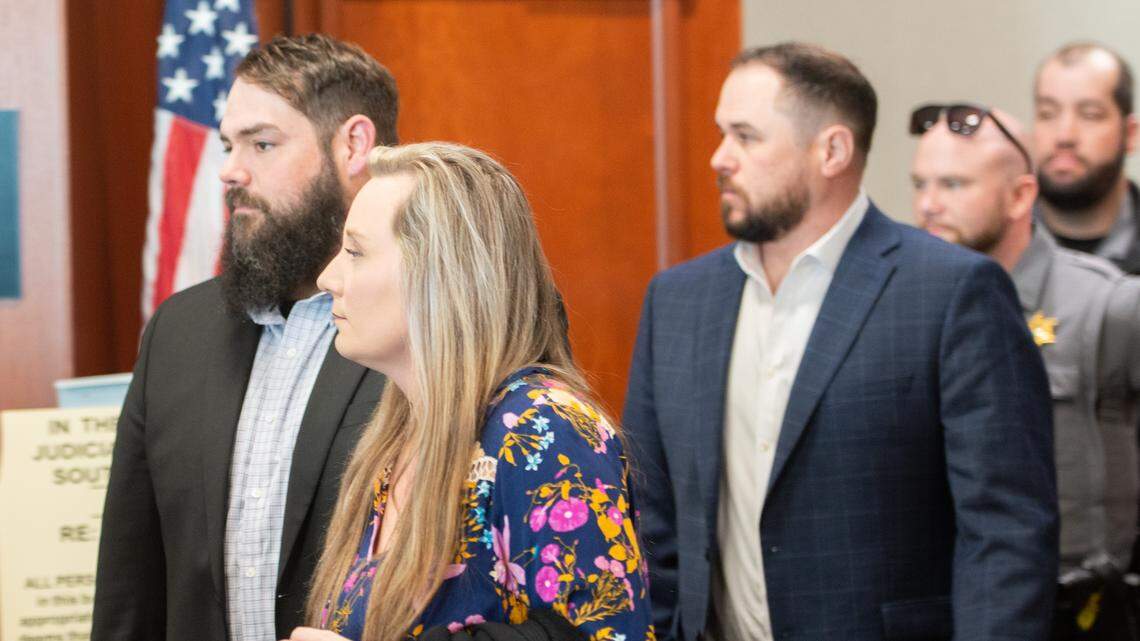
One of the two men who were denied immunity in the shooting death of a North Carolina man more than two years ago is asking the judge to reconsider his decision.
Kenneth “Bradley” Williams filed a motion on March 23 stating that the judge’s order failed to specify what unlawful act Williams committed that caused the shooting of Scott Spivey and appears to conclude that Williams fired before Spivey, despite Williams’ testimony that he only fired after the second shooter and Spivey fired their weapons.
It also asks the question what should Williams have done to deal with Weldon Boyd, who was “agitated” before the shooting took place.
Williams and his friend Boyd, a North Myrtle Beach restaurant owner, are facing a wrongful death lawsuit by Spivey’s family. The lawsuit accuses the two men of chasing Spive, a 33-year-old, for miles after a road rage incident and then shooting and killing him on Sept. 9, 2023, along Camp Swamp Road in the Longs area.
The Darlington man testified last month during a four-day Stand Your Ground hearing in an Horry County courtroom that he “had no other option” but to go along with Boyd’s decisions, including following Spivey and ultimately turning down Camp Swamp Road where the shooting took place.
The law, and how it’s being interpreted, stands at the center of the fatal shooting that has attracted national attention amid allegations of police misconduct by Horry County Police in an effort to protect Boyd.
Circuit Court Judge Eugene Griffith Jr. ruled on March 6, 2026, that Williams‘ testimony didn’t align with and contradicted other evidence in the case. After the hearing that ended on Feb. 20, Griffith also denied immunity to Boyd.
Both men will now have to continue with the civil process. Neither man has been charged criminally in the shooting after the state Attorney General’s Office ruled their actions were self-defense under South Carolina’s Stand Your Ground law.
Williams’ motion asks that the court reconsider its order and grant Williams immunity.
An unanswered question
Williams was a passenger in Boyd’s truck when they encountered Spivey, who was driving erratic and had pointed a gun at several drivers, including Williams, along S.C. 9.
Boyd called 911 and the two men claim to have only followed Spivey to alert police of his location. The pursuit eventually led to the shooting, which both men assert was self-defense after Spivey fired at them first.
While evidence shows that Williams did not forcefully demand that Boyd stop the vehicle and allow him to exit, no provision of South Carolina’s criminal law imposes a duty on a passenger to do so, Williams’ motion said.
Evidence in the case did show that Williams asked Boyd to slow down and yelled for Boyd to back up and “retreat” when both vehicles turned onto Camp Swamp Road. Williams also testified that he did not want a confrontation with Spivey, who had previously pointed a gun at him while the two men were traveling along S.C. 9 before the deadly shooting.
“Williams’s failure to more forcefully discourage the pursuit may reflect a lack of judgment, but it was not unlawful, willful misconduct knowingly calculated to lead to conflict — and it therefore cannot deprive him of his right to immunity under the Act,” the motion said.
The motion stated that while the court’s order concluded that Williams didn’t do enough to thwart Boyd’s pursuit of Spivey, it leaves “unanswered the question of what exactly Williams should have done.”
Boyd was already on the phone with 911, so there was no point in making another call. Boyd was obviously agitated, as evidenced by his conversation with the 911 dispatcher, so Williams risked escalating that agitation by shouting at him to stop the car, the motion said. “Most certainly, either seizing the wheel from Boyd or attempting to exit the speeding vehicle could have been disastrous,” the motion said.
What did judge say in order
The judge, in his order for Williams and Boyd, cited testimony from Frank McMurrough, a key witness who was driving by when the shooting occurred, in his decision. McMurrough said that he saw Spivey exit his vehicle with his gun down by his side, pointing at the ground, and the gun was locked back, indicating it was not in firing position. The judge also included an abundance of other evidence, including Boyd’s 911 calls where he told a dispatcher, “he’s trying to run from me now” and “I’m going to stay with him.”
The judge said in his order that Boyd’s decision to abandon “their stated destination and continue pursuing Spivey toward his home demonstrates that the defendants were engaged in an unlawful pursuit rather than a defensive action.”
And while Williams did tell Boyd to “back up” when he realized Spivey was going to shoot, he also testified that he didn’t “disagree with what Weldon did.”
“I didn’t see what he was doing wrong. He called police to let them know of a man with a gun. (Spivey) was a danger to everyone around him,” Williams testified.
The judge in his ruling on Boyd said he doubted Boyd’s credibility, citing evidence presented during the civil hearing, including audio recordings taken from Boyd’s phone where he describes that he “chased” Spivey and had a “f***ing blast” during the shooting, contributed to his decision.
Williams was a part of those recordings and could be heard saying he had no “remorse” for Spivey and laughing with Boyd about Spivey’s death.
Related Stories from Myrtle Beach Sun News