




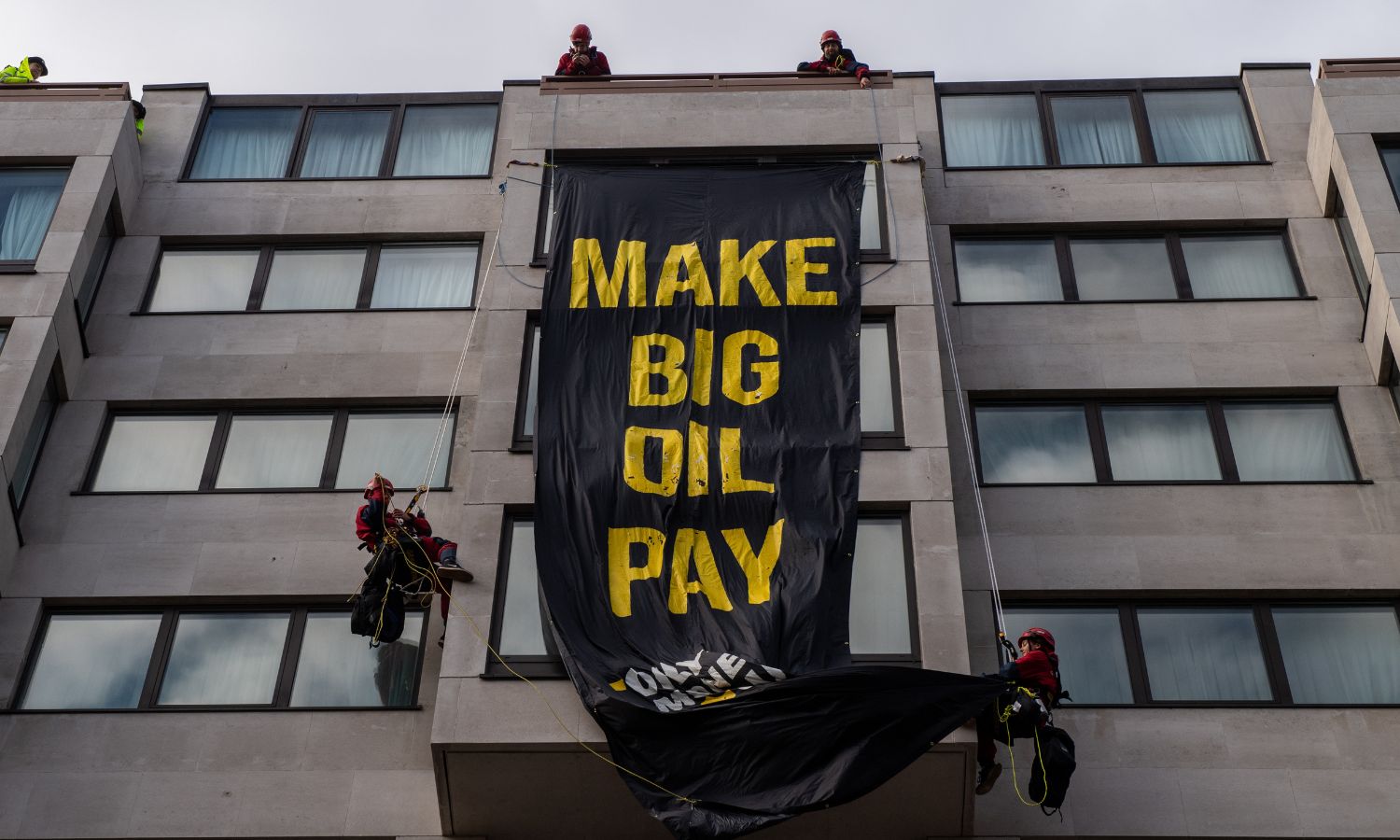
US Representative Harriet Hageman said the quiet part out loud: Members of Congress are crafting “a form of preemption” to block accountability from fossil fuel companies for their role in driving the climate crisis.
Hageman— who represents one of the top oil-producing states—said in February that she was writing legislation that would give the oil industry immunity from the dozens of lawsuits it currently faces. “Clearly, this is an area in which Congress has a role to play,” she blustered.
But is it? More importantly, should politicians be allowed to wipe away the rights of those suffering the consequences of oil companies’ decades-long deception about how their products would change the earth’s climate? Should they prevent future generations living with drought, disease, and incessant wildfires from seeking redress?
The answer is, unequivocally, no. That’s a position held by over 200 organizations, including the National Association of Counties which represents some 3,000 Counties in the United States. Our justice system is built to address wrongful actions, whether by an individual or corporation.
A quick review of previous attempts at corporate immunity provides insight into what’s currently at stake, why granting immunity to polluters puts us in danger, and why such decisions should be made by the courts rather than politicians.
Tobacco industry: No waiver, $260 billion settlement
Smoking has long been the leading cause of preventable deaths in the United States, costing hundreds of billions each year in health costs and lost productivity. Lawsuits against tobacco companies began emerging in the 1950s, but the industry successfully quashed them for decades by arguing that package warning labels transferred responsibility to the consumer.
A turning point came in the 1990s when state attorneys general launched dozens of suits seeking to recover medical costs from smoking-related illnesses borne by state taxpayers who had not chosen to smoke. These cases were strengthened by documentation, revealed through legal discovery, showing tobacco companies had known for years about the damage caused by their product and not only suppressed the information but spread disinformation to counter it. This approach turned the legal debate from one about individual responsibility to public harm.
In 1997, several tobacco companies proposed that Congress introduce legislation that would provide immunity from these class-action suits in exchange for a multi-billion-dollar fine and stronger warning labels, among other concessions. Sponsored by Senator John McCain, the bill’s penalties stiffened as it wound its way through the congressional process and the tobacco industry ultimately lobbied to kill it.
With that avenue closed, the industry settled the remaining lawsuits via the 1998 Master Settlement Agreement (MSA). The MSA required the four largest tobacco companies to pay $260 billion to the states in annual installments, along with actions such as dramatically reducing advertising and dissolving trade associations that spread disinformation. It was the largest civil litigation agreement in US history, and provided many lessons to another industry facing similar lawsuits.
Firearms industry: Won a waiver, $0 settlement
Around the same time of the MSA, dozens of cities were filing suits against the gun industry, seeking redress for lives lost to an epidemic of gun violence. Murder deaths by gun had risen steadily since the 1960s and jumped sharply in the mid-90s due primarily to the handguns flooding into cities.
To head off the lawsuits, the main firearms trade associations—the National Rifle Association and the National Shooting Sports Foundation—lobbied sympathetic lawmakers for immunity legislation. In early 2005 Senator Larry Craig and Rep. Cliff Stearns introduced the Protection of Lawful Commerce in Arms Act, which shielded the industry from liability even in cases where guns were used illegally or to commit a crime. President George W Bush signed the bill the following October, handing the industry the most sweeping legal protection ever afforded by the federal government.
Prior to the bill’s passage, lawsuits that made it to trial often resulted in punishment for bad actors whose negligence resulted in death. One example is the lawsuit brought by the families of victims of the “Beltway Snipers,” who went on a shooting spree in 2002 that killed 17 and injured 9 people. The suit named both the gun manufacturer and the dealer, who had failed to keep legally mandated records and could not account for hundreds of guns in his inventory. The result was a loss of the dealer’s license and a pledge from Bushmaster to change its distribution practices. Since PLCAA’s passage, however, not a single negligence case against a gun manufacturer has gone to trial.
Pesticides industry: Lobbying for waiver, avoiding damages
Ever since the World Health Organization classified glyphosate—the active ingredient in a widely-used pesticide sold under the name Roundup—as a probable human carcinogen in 2015, the pesticide industry has struggled to fight its way out of a litigation pit. In 2020, glyphosate manufacturer Bayer, which acquired the pesticide’s developer Monsanto in 2018, paid more than $10 billion to settle tens of thousands of lawsuits linked to glyphosate and other pesticides.
Thousands of lawsuits remain, however, compelling Bayer to simultaneously pursue immunity through the courts, Congress, state legislatures, and the Executive Branch. The Trump administration abetted the effort with a February 2026 executive order invoking the Defense Production Act to “ensure a continued and adequate supply” of glyphosate-based herbicides.
On the Congressional front, industry allies in the House of Representatives inserted language into a recent appropriations bill that would prevent states from restricting the use of chemicals or requiring manufacturers to include carcinogen warnings on packaging. It was ultimately stripped from the bill after pushback from health advocates. Bayer founded the Modern Ag Alliance to push for immunity legislation at the state level, and nine states are currently considering bills.
Finally, the US Supreme Court will hear a case next month filed by a man who sued Monsanto after his exposure to Roundup led to a 2018 diagnosis of non-Hodgkin’s lymphoma. The Supreme Court’s ruling will have major ramifications for whether the federal law regulating pesticide label warnings can preempt state lawsuits.
Suppressing rights to escape accountability
The fossil fuel industry has shrewdly applied the lessons from these precedents to its own pursuit of legal immunity, lobbying the White House, Congress, and state political leaders for protection. The Trump administration acquiesced with an April 2025 executive order and preemptive lawsuits against states suing fossil fuel companies. Attorneys general from 16 states with oil-centric economies also chipped in with a letter to asking the Department of Justice to create a “liability shield.” And lawmakers in four states have introduced immunity bills, following one in Utah which was signed into law this week.
Abetting the oil industry this way may undermine our foundational rights. The federalist concept set out in the US Constitution gives states primary responsibility for tort law, which addresses harm caused by wrongful or injurious actions. In addition to compensating victims, tort law also deters future harms by establishing consequences for injuring others. Tort-based litigation against automotive manufacturers led to safety innovations such as seat belts and airbags, for example. Immunity legislation undermines those state rights.
The tension between state versus federal law can be seen in the perpetual battle for court venues in which corporate lawyers push to move cases into federal courts where they believe they will find more sympathetic juries and judges. The oil industry has attempted similar maneuvers but was foiled by judges in lower courts as well as the Supreme Court, which declined to hear state-based climate suits. However, the recent Supreme Court decision to hear a 2018 case in which the city of Boulder, CO, sued oil companies for misleading the public about the damaging impact of their products could upend that precedent, ultimately weakening climate accountability.
Don’t let Big Oil beat the rap
At the heart of the dozens of lawsuits against the fossil fuel industry, which now represent one in four US residents, are the harms that climate change is imposing on people now and into the foreseeable future. These harms include billions of dollars in damages from climate-related extreme weather events, many of which can be linked to carbon emissions from fossil fuel companies, such as heat waves that will exponentially increase deaths as well as labor costs, and rising sea levels that will wipe out public infrastructure and real estate value.
The case against the companies also rests on the documented fact that the industry knew for decades their products could lead to these catastrophes but chose to not only continue business as usual but fight to obstruct any attempts at accountability.
Giving those experiencing the impacts of climate change (which includes you, reader) their day in court is a fundamental constitutional right. Reviewing recent history clearly shows that granting fossil fuel companies legal immunity would repeat dangerous mistakes, distorting justice and privileging corporate power over democratic accountability. It would also undermine citizens’ confidence in the ability of government and the legal system to protect them from harm.
Take 90 seconds right now to demand your Member of Congress reject the push for immunity for Big Oil’s devastating climate harms.