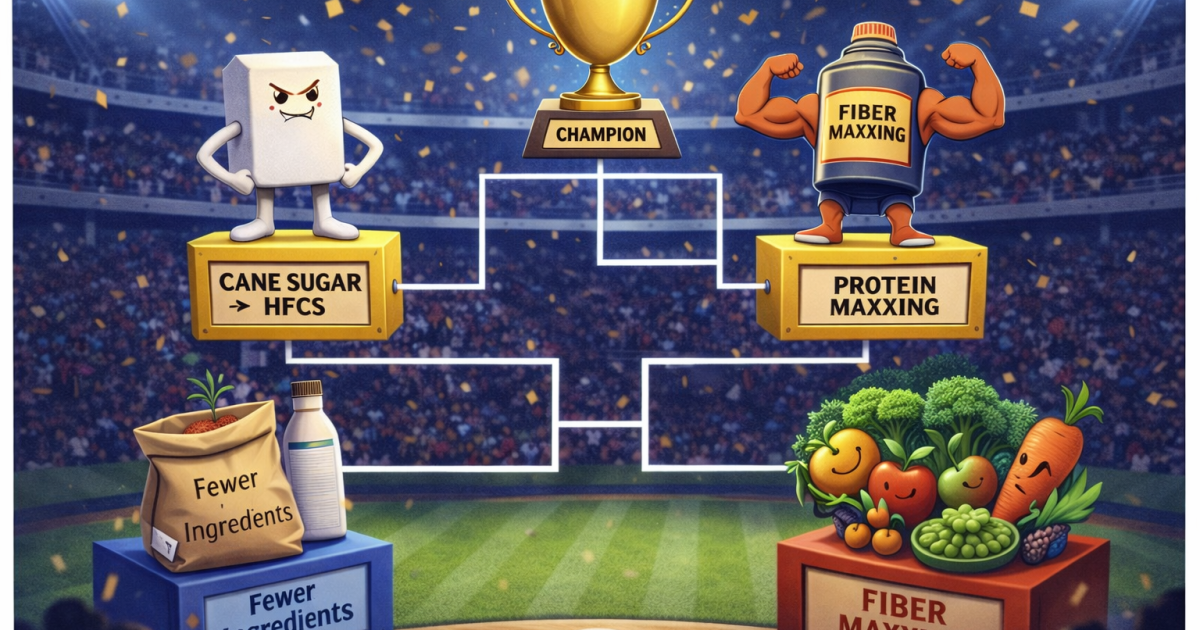
We’ve reached the Final Four of our nutrition bracket, so it’s time to break down some of the hottest claims in nutrition right now. Our contenders? “Cane Sugar > HFCS,” “Fewer Ingredients = Better,” Protein Maxxing, and Fiber Maxxing. Only one will take the title.
Final Four Exit: “Cane Sugar > HFCS”
MAHA-adjacent voices support reducing added sugar overall, but they often promote cane sugar as the better option because it’s seen as less “chemical” and less likely to show up in ultra-processed foods. That’s also the origin of the whole “Mexican Coke is better” story—same soda, but sweetened with sucrose instead of HFCS, so it must be healthier…right?
That claim doesn’t hold up.
Chemically, cane sugar (sucrose) is a 50/50 split of glucose and fructose bound together. HFCS—most commonly HFCS-55 (the version used in soft drinks, making up roughly 50–70% of HFCS use)—is about 55% fructose and 45% glucose, just unbound. Your body breaks sucrose into those same two molecules anyway, so metabolically they are very similar.
So why does HFCS get treated like the villain?
Partly historical. Some early animal studies suggested that high fructose intake could lead to worse metabolic effects, raising alarms. But rodents process nutrients differently from humans, and when tested in well-controlled human trials, this difference disappears.
A strong example is a rigorous, double-blind 2021 clinical trial funded by the NIH in which healthy adults consumed beverages sweetened with either HFCS or sucrose. Both groups experienced similar negative changes (such as increased liver fat, reduced insulin sensitivity, and worse blood lipids) compared to a control, but there were no differences between HFCS and sucrose. This study is one of the most comprehensive head-to-head comparisons we have.
Concerns about added fructose-containing sugars in large amounts are absolutely valid, with links to conditions like obesity and Type 2 diabetes. But the idea that HFCS is uniquely harmful while cane sugar is somehow fine doesn’t hold up in controlled human data.
Final verdict: Same game, different jersey.
And just like that the “Cane Sugar > HFCS” bracket comes to an end.
Final Four Exit: “Fewer Ingredients = Healthier.”
A beloved MAHA talking point is that we should eat “real food” and avoid ultraprocessed items. I agree! But, no one can seem to agree on what exactly ultraprocessed food means.
One way to define it is by the number of ingredients. If a food has fewer than _____ (fill in the number) ingredients, then it’s considered real food. Otherwise, it’s ultraprocessed. However, that’s a slippery slope.
Let’s use sandwiches as an example. Sandwiches are made of multiple components. They can be as simple as two ingredients (bread and cheese) or as complex as a large creation with many vegetables, meats, cheeses, condiments, and types of bread. Any somewhat “complicated” sandwich might have more than just a few ingredients, and I would say that’s a good thing. A sandwich with fewer than five ingredients is a sad sandwich, indeed.
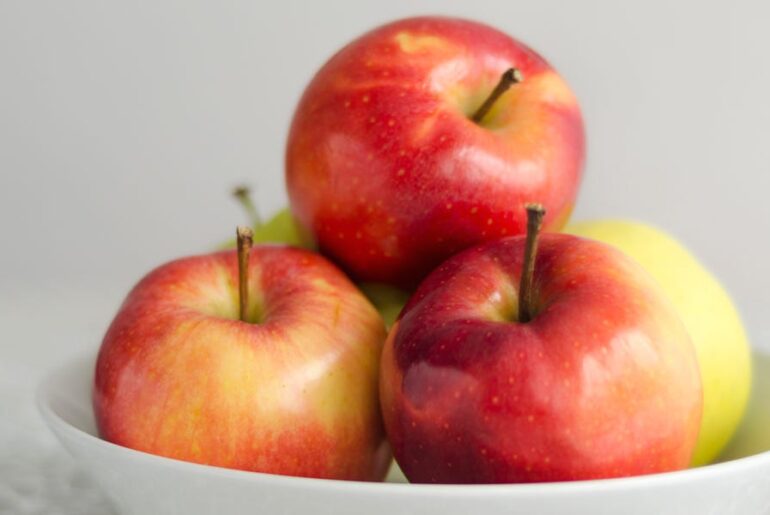
Of course, true enthusiasts might argue that each component of the sandwich should contain fewer than ____ ingredients. And down the rabbit hole we go. So, let’s examine just a single ingredient: an apple. An apple appears simple, but it contains many naturally occurring chemical compounds (e.g., catechin, epicatechin, quercetin, malic acid, cyanide, etc.). If we listed all of them, an apple would seem highly processed by this definition.
Additionally, “fewer ingredients” assumes that all items with just a few ingredients are good. However, arsenic, lead, and hemlock are all “single-ingredients.” Cyanide is a “natural” ingredient and is present in that chemical-laden apple mentioned earlier.
While fewer ingredients seems like a good definition for ultraprocessed foods, the argument quickly falls apart upon closer inspection.
Thus, Team “Fewer Ingredients= Better” makes its Final 4 exit.
Runner-Up: Protein Maxxing
The typical American gets plenty of protein; there is no evidence that protein deficiency is a common problem in the United States. Of course, there’s always a conversation to be had about people’s specific needs: athletes, people on GLP-1s, etc.
“Concerns about not getting enough protein arise when you’re undereating or taking a weight-loss medication. People on a restrictive diet, diagnosed with an eating disorder or taking a weight-loss drug tend to skip meals. That starts a cascade of effects including not getting enough protein and greater loss of muscle mass, which isn’t the type of weight you want to lose.”
—Kristi Wempen, RDN, LD, Mayo Clinic Health System
While the marketing of protein has exploded into some truly bizarre offerings (Protein Cold Foam Coffee!), whenever a new diet fad or a recycled one comes back into fashion, companies will seize the marketing opportunities. While the average person probably gets enough protein in their diet, the main question is whether you really need to pay more just because it’s marketed as having protein. The answer is probably no. That said, there are worse dietary fads, and as long as you’re eating a balanced diet with plenty of fruits, vegetables, and lean protein options, this fad is relatively harmless.
A strong showing—but not enough to win it all. Protein Maxxing finishes as the runner-up.
Champion: Fiber Maxxing
At its core, “fiber maxxing” is simply intentionally increasing the intake of dietary fiber—the parts of plant foods we can’t digest but our gut microbes love. Think oats, beans, lentils, fruits, vegetables, nuts, seeds, and whole grains. Unlike the other contenders, it isn’t hype—it’s based on science.
Average fiber intake by Americans is around 15–18 grams per day, while the recommendations are approximately 25 g/day for women and 38 g/day for men. This gap is why fiber is officially regarded as a nutrient of public health concern.
Fiber wins the bracket because it quietly does a lot of heavy lifting:
Gut health: feeds beneficial microbes, supporting a healthier microbiome
Metabolic health: helps regulate blood sugar and improve insulin sensitivity
Heart health: lowers LDL cholesterol and improves blood lipids
Satiety: increases fullness, which can help with overall energy intake
Digestive function: promotes regularity and reduces constipation risk
Mechanistically, fiber’s benefits come down to properties like viscosity (forming gels that slow digestion) and fermentability (fueling gut bacteria to produce beneficial compounds like short-chain fatty acids).
Large-scale meta-analyses consistently show that higher fiber intake is associated with lower risks of cardiovascular disease, type 2 diabetes, certain cancers, and even all-cause mortality.
One especially comprehensive umbrella review, covering 33 meta-analyses and about 17 million people, found convincing evidence for reduced cardiovascular mortality, strong links to lower risk of coronary heart disease and type 2 diabetes, and suggestive reductions in several cancers and strokes.
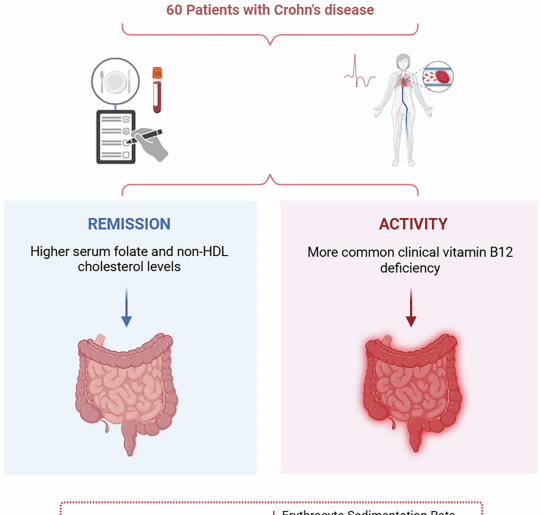
As always, there’s nuance, because fiber isn’t perfect in every situation. Some people with conditions like irritable bowel syndrome or inflammatory bowel disease may need to adjust the types or amounts of fiber, especially during flare-ups. And suddenly switching from very low to very high intake can cause bloating or discomfort.
But those are exceptions that require adjustment—not evidence to eliminate fiber altogether.
Final verdict: Not just a trend—a rare case where TikTok and science are on the same team.
And this year’s champion, cutting down the nets: Fiber Maxxing.