March 27, 2026
On November 20, 1982, President Reagan addressed the country in a radio broadcast that remains a reminder of why trade historically and justly has enjoyed broad and bipartisan support. Reagan eloquently argued the benefits of international trade, noting that when other countries don’t grow, they buy less from us, and we see fewer jobs created at home. He said when we don’t grow, we buy less from them, which weakens their economies and their ability to buy from us. He remarked that exports account for more than 5 million U.S. jobs and that two out of every five acres planted by American farmers produce crops for exports.
President Reagan staunchly advocated for free trade and saw it as a boost to global prosperity instead of conflict. He also recognized that the postwar trading system created and led by the U.S. benefited us more than anyone. Reagan believed in that rules-based system and did in fact impose targeted tariffs of up to 100% when dumping was evident. However, he was against any broad-based tariffs and saw protectionism as hurting everyone. Where issues came up, they should be fixed.
In that same radio address where he referred to the protectionism of the 1930’s and the world war that followed, Reagan said, “The world must never live through such a nightmare again. We’re in the same boat as our trading partners. If one partner shoots a hole in the boat, does it make sense for the other one to shoot another hole in the boat? Some say, yes, and call that getting tough. Well, I call it stupid. We shouldn’t be shooting holes; we should be working together to plug them up. We must strengthen the boat of free markets and fair trade so it can lead the world to economic recovery and political stability.”
In a November 26, 1988 speech just after the passage of NAFTA, Reagan said protectionism was being used “by some American politicians as a cheap form of nationalism” and said we should be wary of “demagogues who are ready to declare a trade war against our friends – weakening our economy, our national security, and the entire free world – all while cynically waving the American flag.”
My own awareness of the beauty of trade goes back to 1974 and a college economics class that covered David Ricardo and his Theory of Comparative Advantage. The eloquence and mathematical logic of what it says about trade and about the broader system of capitalism is illuminating. As the world moved away from an agrarian economy where we produced what we consumed, the specialized roles individuals took on to earn a living werebased on the same principle underlying Ricardo’s theory. As the industrial revolution ensued and individual specialization increased, the daily actions of most people proved the core of Ricardo’s principle. It is in the economic interest of both countries and individuals to focus on what they do best in a relative sense compared to other countries and individuals. That focus will always result in the greatest economic benefits. While Ricardo debuted his work on trade as a theory in his 1817 book, it is long overdue to be called the Law of Comparative Advantage. It is foundational and should be taught as a module to high school students across the globe.
The macroeconomic numbers prove the economic benefits of trade. While it existed even before Ricardo’s work more than two centuries ago, it was relatively small in economic terms until the postwar period. Indeed, the three decades or so after World War II have been referred to as the Golden Age of Capitalism as the postwar reconstruction and development resulted in unprecedented growth throughout the world. U.S. GDP grew from $300 billion in 1950 to $2.9 trillion in 1980, a nominal growth rate of 7.9% per year. That was certainly impressive and the 1950’s and 1960’s are referenced by many as the heyday of America’s economic growth. Over the same period, global GDP grew from $1.1 trillion in 1950 to $11.45 trillion in 1980 for a nominal growth rate of 8.1% per year. Across the world, trade in goods that expanded at a 12.3% annual rate was a key catalyst to the exceptional global growth during those three decades. The value of U.S. goods trade during that period grew moderately less at a nominal growth rate of 11.3%. As a result of slightly lower economic growth rates by the U.S. compared to the rest of the world, its share of global GDP declined from 27.3% in 1950 to 25.3% in 1980.
Since 1980 international trade has continued to grow at rates above global GDP. The nominal value of global trade went from $2.0 trillion in 1980 to $25.0 trillion in 2025 for a growth rate of 5.8% annually. Trade involving the U.S. grew at an even faster pace at 6.3% from $500 billion in 1980 to $7.8 trillion in 2025. One impetus for that was President Reagan whose advocacy of free trade resulted in reducing tariffs and other barriers. Just as the U.S. transitioned to overperformance on trade growth, it switched to overperformance in GDP growth from 1980 to 2025. U.S. GDP grew at 5.4% compared to 5.1% for the 20 largest economies in the world. In 2025 those countries represented 80.1% of total global GDP.
The table below shows the top 20 countries in the world ranked by nominal GDP in 2025 along with the change since 1980 and what that translates into as a compound annual growth rate over that period.
Country
1980
2025
Change
CAGR
US
$2,900
$30,600
955%
5.4%
China
$304
$19,400
6282%
9.7%
Germany
$857
$5,000
483%
4.0%
Japan
$1,100
$4,300
291%
3.1%
India
$186
$4,100
2104%
7.1%
UK
$605
$4,000
561%
4.3%
France
$695
$3,400
389%
3.6%
Italy
$480
$2,500
421%
3.7%
Russia
$1,210
$2,500
107%
1.6%
Canada
$276
$2,300
733%
4.8%
Brazil
$146
$2,300
1475%
6.3%
Spain
$231
$1,900
723%
4.8%
Mexico
$242
$1,900
685%
4.7%
S. Korea
$67
$1,900
2736%
7.7%
Australia
$163
$1,800
1004%
5.5%
Turkey
$69
$1,600
2219%
7.2%
Indonesia
$72
$1,400
1844%
6.8%
Netherlands
$194
$1,300
570%
4.3%
Saudi Arabia
$165
$1,300
688%
4.7%
Poland
$59
$1,000
1595%
6.5%
Total
$10,021
$94,500
843%
5.1%
Subtotal Europe
$4,331
$21,600
399%
3.6%
As the table shows, only two in the top 10 and eight in the top 20 countries had higher GDP growth rates than the U.S. Actual U.S. growth was 1.5 times the aggregate rate of the eight European countries included in the top 20 economies.
A clear catalyst for the growth in world trade and the transition to an ever-increasing percent represented by manufactured goods was Malcom McLean’s invention of container shipping in 1956. This innovative process brought extraordinary cost efficiency to the end-to-end movement of goods. Container shipping was a foundational driver of Japan’s export boom by transforming the speed, cost and reliability of moving goods manufactured in Japan to overseas markets. That model would be emulated by other Asian countries. The process advantages of container shipping were augmented by what I referred to in my “Giants Of The Sea: Ships & Men Who Changed The World” book as the second container revolution, also resulting from Malcom McLean. In 1984, he built 12 “jumbo econships” with a capacity of 4,482 TEU each. Those ships were 30% larger than any existing container ship and began a transition to ever larger ships whose scale economies augmented the process advantages of container shipping. Today, the largest container ships are 24,000 TEU or more than five times larger, leading to an extraordinary increase in the cost efficiency of container shipping.
As someone who has spent more than 45 years in the container shipping sector in various capacities, including two decades working closely with Malcom McLean, I’ve long believed in the benefits of trade and the costs of tariffs. There has been lots of misinformation about trade spread by politicians. Equating a trade deficit with a transfer of value is no more accurate than to say when an individual buys a good their net worth goes down by the same amount. In both cases, that claim ignores the value of the good received in exchange for cash. The U.S. dollar is the reserve currency of the world – an incredibly good thing – and as long as that continues we are destined to always have a trade deficit. GDP growth is a geometrically more relevant economic metric for a country. As shown earlier from 1980 to 2025 the U.S. overperformed relative to most countries not in spite of higher trade growth, but because of higher trade growth. Trade is good. Tariffs are bad. In addition to robbing consumers of their money, they rob them of choice and distort markets. Of course, trade causes dislocations, but the aggregate economic benefits are irrefutable. The onus is totally on policymakers to craft legislation that more equitably distributes those benefits. As President Reagan noted, we should not be shooting holes in the boat but instead plugging them up to avoid sinking our own economy.
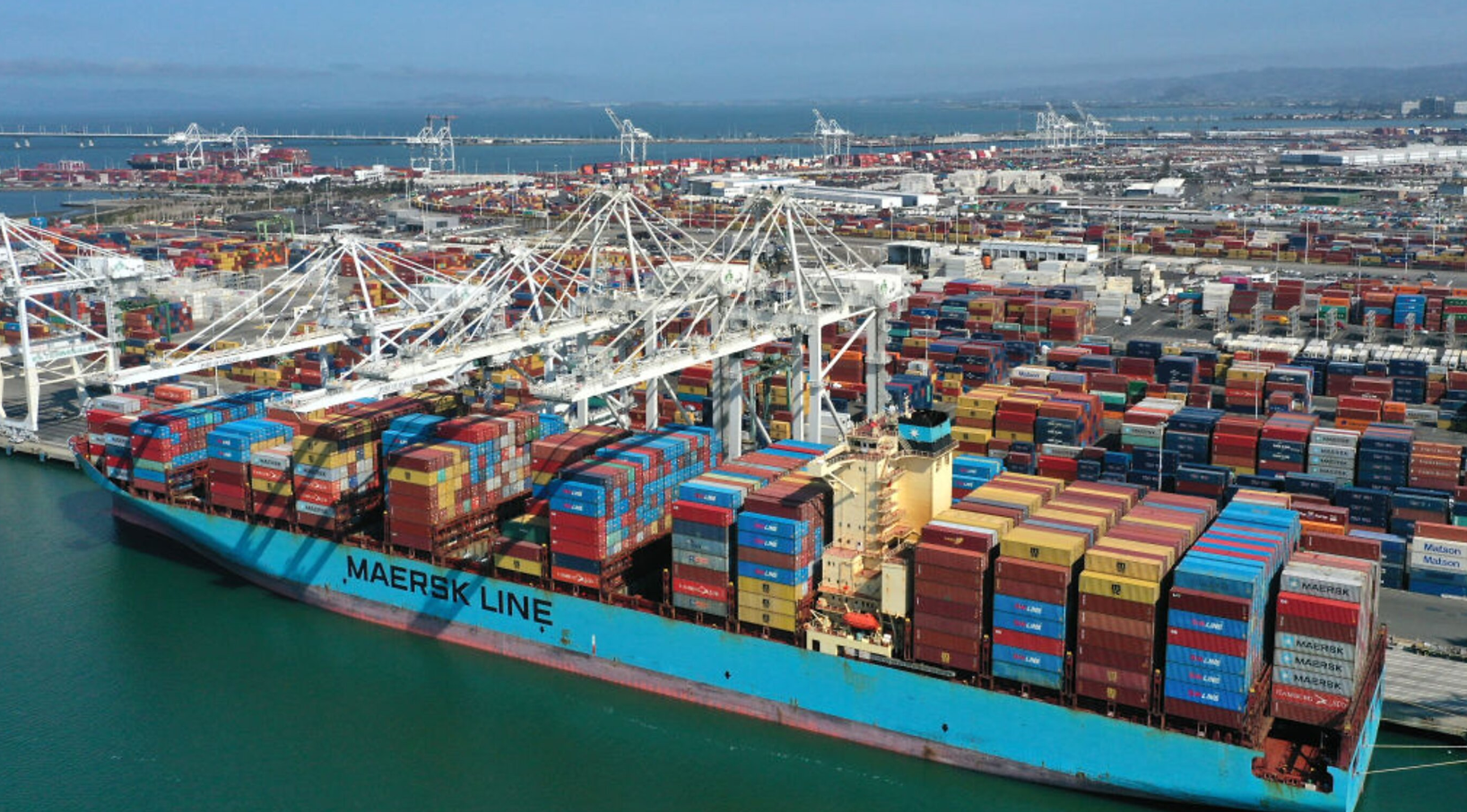
The economic eloquence of trade is beautiful and it is augmented by and delivered to the world by the beautiful conveyance system of container shipping that reduces the friction and barriers of moving goods across the globe. No carrier embodies the latter more than Maersk, a Danish maritime company whose 732 ships connect most major seaports in the world. In 2025, Maersk’s total container volume was 25,884,000 TEU’s. Based on the accepted average value per TEU, the containers that Maersk carried held goods worth more than $1.4 trillion. Maersk moved those boxes across oceans for revenue that totaled $29.6 billion, an amount equal to 2.1% of the value of those goods. Therein lies the secret related to the incredible efficiency of container shipping and the value it delivers to the world.
Last, but certainly not least, the beauty of trade is that it strengthens our national security by reducing conflict. It is axiomatic that tensions between countries is less when they are trading partners. IBM, one of the first truly international companies, trumpeted its “World Peace through World Trade” slogan it developed after World War II. That underscores that Tom Watson Jr., arguably the greatest capitalist who ever lived and profiled in the excellent book by that same title, knew that both economic and national security benefits flowed from trade. Not surprisingly, the first non-American IBM board member was Maersk Moller, the man who built Maersk into the most far-reaching maritime conglomerate on earth. A clear case can be made that globalization largely made possible by container shipping preserves national security as detailed in a two-part May 2024 article published by the Center for Maritime Strategy. As poet Walt Whitman said, “Peace is always beautiful.” Perhaps that will always be the greatest benefit of trade.
John D. McCown is a Non-Resident Senior Fellow at the Center for Maritime Strategy. Mr. McCown has four decades of experience related to the shipping industry. His research, analysis and writings for the Center for Maritime Strategy focus on the intersection of merchant shipping and maritime commerce with national security.
The views expressed in this piece are the sole opinions of the author and do not necessarily reflect those of the Center for Maritime Strategy or other institutions listed.