





Think of full-fat dairy and your mind probably turns to thick yoghurt, delicious cheese and creamy milk, all of which are undeniably tasty but, you might assume, not the healthiest option. For decades, we were warned that these “naughty but nice” foods were a threat to the heart and waistline but the good news is that they might not be as bad for us as we think. In fact, it appears that some full-fat foods have positive health benefits.
Supermarkets are already reporting an upswing in full-fat dairy sales as news filters through to social media and consumers switch to whole milk and full-fat yoghurts. Demand for Jersey milk, the ultimate rich and creamy “gold top”, is said to be at its highest for 50 years according to one of Britain’s biggest dairy producers, and supermarket shoppers are also buying more butter and cheese (a survey of 2,000 Waitrose shoppers recently found that a third had switched from eating a low-fat dairy product to a full-fat one in the past year).
It’s a trend prompted partly by a desire to eat foods perceived as more natural. Many reduced-fat dairy products have undergone higher amounts of processing with some having sugar, additives or thickeners added in an attempt to replicate the taste and texture of the fat that has been removed. But a raft of new scientific discoveries about potential health benefits has almost certainly added to the appeal. Milk and dairy products contribute nearly a third of the UK population’s intake of saturated animal fat, but they’re also an important source of a range of beneficial nutrients. It’s the complex interplay of compounds in milk and cheese and the impact they have on our bodies’ biochemistry and physiology that are now being investigated by scientists.
Ian Givens, professor of food chain nutrition at the University of Reading, says the unique chemical structure of full-fat dairy is responsible for its neutral, or sometimes even beneficial, effects on health. The way proteins, fats and other nutrients interact affects the way the body uses and absorbs them. “When hard cheese is consumed, for example, some of the fatty acids released join up with the calcium in cheese and form what we call ‘soaps’ that are highly inert and not digested,” Givens says. “This means that some of the saturated fat in the cheese is not actually absorbed by the body and is excreted [in faeces] instead.” It’s a similar story for full-fat milk and yoghurt.
At University College Dublin (UCD), food scientists recently looked at overweight midlifers to see the effects of adding 120g daily of full-fat Irish cheddar to their diet for six weeks. All of them experienced lowered cholesterol levels. “This is a group who may be advised to limit their cheese intake, yet cheese may actually be beneficial for their heart health,” says Dr Martina Rooney, a registered dietitian and researcher at UCD. “Our findings indicate that cheese can absolutely be part of a healthy, nutritious diet.”
In another recent study of 27,670 participants over 25 years, published in Neurology, scientists from Sweden found a lower risk of dementia in midlife and older adults who ate higher amounts of full-fat cheese. While it doesn’t necessarily mean that eating more high-fat dairy foods will reduce the risk of dementia, it does indicate that, for many people, including them as part of a balanced diet is no bad thing. “Personally I opt for full-fat because I like the taste of something creamier and it fills me up more,” says Dr Linia Patel, a spokeswoman for the British Dietetic Association.” Here’s what the experts say.
Full-fat dairy can help you to lose weight
Dairy products can be relatively high in calories, but counterintuitively, researchers have shown that those who consume them aren’t necessarily more likely to gain weight. For a Nature study Emma Feeney, an assistant professor of food science at UCD, and her team found that higher intake of full-fat milk and yoghurt was associated with lower body mass index, lower percentage of body fat and lower waist size than in those who ate little or no dairy. Part of the effect might be due to the fact that cheese and other forms of dairy seem to act in the same ways as weight-loss medications when it comes to warding off hunger.
“Some of the proteins in dairy actually stimulate GLP-1, the hormone produced in the gut that helps to regulate appetite and control blood sugar,” Givens says. “And that is part of the reason for their lack of adverse effect on body weight.”
Of course a small slice of cheese still provides about 120 calories and there are 130 calories in a tablespoon of butter. “The laws of thermodynamics still apply and the extra calories have to go somewhere if you consume too much dairy,” Givens says. “So, you can’t overdo it.”
Cheese (in moderation) can lower heart disease risk
With its high saturated fat and sodium content, cheese has long been considered a risk for raising cholesterol levels and worsening artery health. There’s evidence that a moderate intake of full-fat cheese, particularly the harder cheeses such as cheddar and parmesan, might be beneficial. One review of 15 papers found that people who ate about 35g cheese a day had a 10 per cent lower risk of cardiovascular disease than those who ate none.
And the vitamin K content of cheese — particularly strong sources include edam, aged gouda and jarlsberg — could help to prevent the kind of artery blockages that lead to heart disease and strokes, according to a study in 2022 led by Feeney.
The British Heart Foundation says cheese can be included in a healthy diet, but it’s important to keep an eye on portion sizes and aim for no more than about 30g hard cheese a day.
Eat full-fat cottage cheese to boost your microbiome
The way some cheeses are produced — with the addition of live microbes that are added to milk or used to ripen the cheese — makes them a probiotic food. Cheeses that are aged but not heated, such as Swiss, aged cheddar, gouda, edam and gruyère, are fermented and contain a range of beneficial bacteria that boost the microbiome, in turn, ramping up immunity and all-round good health.
 Cottage cheese is high in protein and gut-healthy bacteriaGetty IMAGES
Full-fat cottage cheese that is labelled as containing live cultures can contain plenty of Lactococcus lactis, plus good amounts of Lactobacillus casei and Lactobacillus kefiranofaciens, according to a study in Nutrition and Food Science.
“These are the kind of bacteria cultures also present in fashionable gut-friendly dairy drinks such as kefir,” says Alex Ruani, nutrition researcher at University College London.
Drink a glass of full-fat milk to boost metabolism
Cow’s milk — reduced or full-fat — is rich in a wide range of vitamins and minerals, including potassium, magnesium, riboflavin, vitamins A and B12. It is a complete protein meaning it provides all nine essential amino acids needed for body growth and repair and also provides the most easily absorbed form of calcium, important for bone health, in the diet. A 200ml glass of full-fat cow’s milk provides 70mcg — almost half the adult recommended daily intake of 150mcg — of iodine, a trace mineral that’s important for metabolism and for fertility. “Milk can definitely form part of a healthy diet for many people,” Givens says.
A global study involving analysis of 417,236 participants at the University of Reading showed that drinking full-fat milk does not raise your cholesterol levels and concluded there is “no need to limit milk intakes with respect to cardiovascular disease risk”.
According to the NHS, children should be given whole-fat milk to support energy needs for growth and development from age one to at least age two. For the rest of us it comes down to how much we like the taste. The creamier you go, the more you will need to watch calorie intake if you are trying to lose weight. A 200ml glass of whole milk contains approximately 130 calories and 7.4g of fat whereas a glass of gold top Jersey milk contains 150 calories and 9.6g of fat. “Fat is energy-dense — packing a lot of calories into a small amount — so it’s easy to overshoot your needs before you realise you’re full,” Patel says.
Choose full-fat yoghurt
Natural plain yoghurt is crammed with “good” bacteria, making it a highly gut-friendly food, but also contains protein and calcium for healthy bones and muscles. A full-fat version typically contains 3.5-5g of fat per 100g, not that much more than those labelled “low-fat”, which have 3g of fat or less per 100g. Due to the way it is produced, Greek yoghurt has a thicker and creamier texture with up to 10g of fat per 100g.
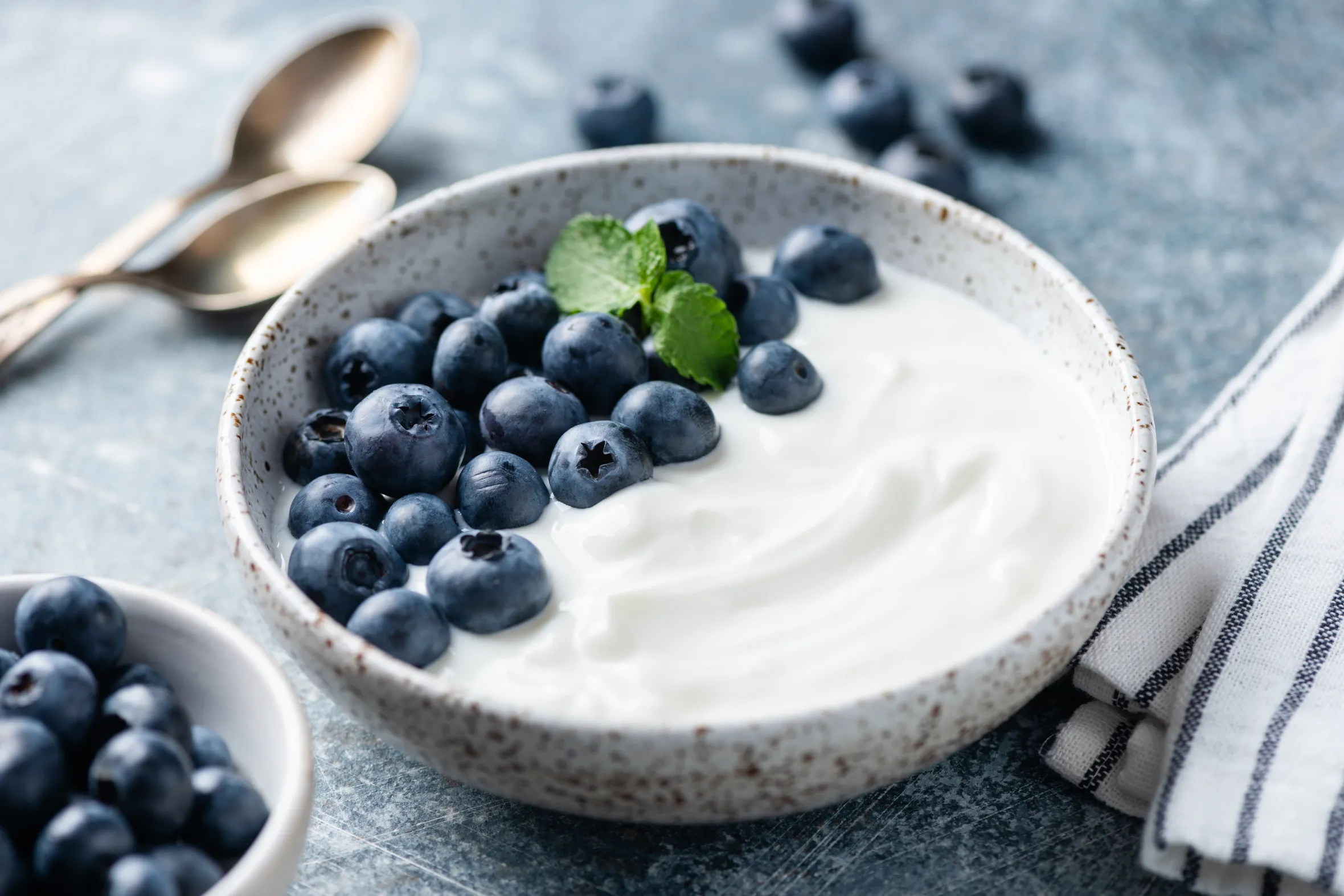 Full-fat yoghurt is also gut-friendly and less processed than low or no-fat alternativesGetty
“These are not levels that will make much difference to your waistline,” says the registered nutritionist Eli Brecher. “And some fat is useful for the absorption of vitamins A and K2 which are present in yoghurt. Full-fat plain natural yoghurt is less processed and doesn’t contain the sugar, artificial sweeteners or flavourings that are sometimes added to counteract the loss of creaminess in other yoghurts.”
A team at the Medical Research Council’s epidemiology unit at the University of Cambridge found that eating plain yoghurt regularly led to a 28 per cent lower risk of developing type 2 diabetes than those who never ate it. In the US, the Food and Drink Administration (FDA) allows dairy companies to claim that eating yoghurt regularly— at least two or three servings a week — may help to reduce the risk of type 2 diabetes.
Cream might reduce your risk of Alzheimer’s
Full-fat dairy products contain fat-soluble vitamins A, D and K2, as well as vitamin B12, folate, iodine, zinc and selenium, all nutrients important for good neurological function and cognitive health. A recent Swedish investigation showed that in healthy adults with no known genetic risk for Alzheimer’s disease, eating 50g of full-fat cheese a day led to a 13-17 per cent lower risk of developing Alzheimer’s Disease. Eating more high-fat cream was associated with a 16-24 per cent reduced risk but no such benefits were seen with full-fat milk or low-fat cream. Other studies, however, have produced mixed results on dairy foods and brain health.
“People who eat a lot of cheese and cream in Sweden might have other lifestyle factors — higher income, diet quality, specific exercise patterns — that may help protect their brains,” Ruani says.
You don’t have to avoid butter — but don’t eat too much of it
The nutrient content and structure of butter are different from those found in cheese and yoghurt, and consuming butter produces a greater increase in harmful LDL cholesterol. In a six-week trial by Feeney, published in the American Journal of Clinical Nutrition, people asked to eat cheese every day had significantly lower total cholesterol at the end of the study than those who were given butter every day. Portions were matched to provide about 40g dairy fat. Patel suggests butter should be used “sparingly — no more than a couple of teaspoons daily”.
How much is too much?
While the recent studies suggest that full-fat dairy can be part of a healthy diet it’s not an excuse to load up the cheese board daily. NHS recommendations suggest up to three servings a day of dairy — such as 200ml of milk, a 150g pot of yoghurt, or 30g of cheese — is a balanced approach. Dairy is still high in saturated fat (and full-fat dairy tends to be higher in saturated fat than low-fat products). It pays to read the labels. According to the British Dietetic Association, products labelled as low-fat must contain no more than 3g of total fat per 100g, while a low saturated fat claim requires a much stricter limit of 1.5g or less per 100g.
More than 30g a day of saturated fat for men and 20g for women can raise cholesterol and increase the risk of heart disease. “Moderation remains the key,” Patel says.