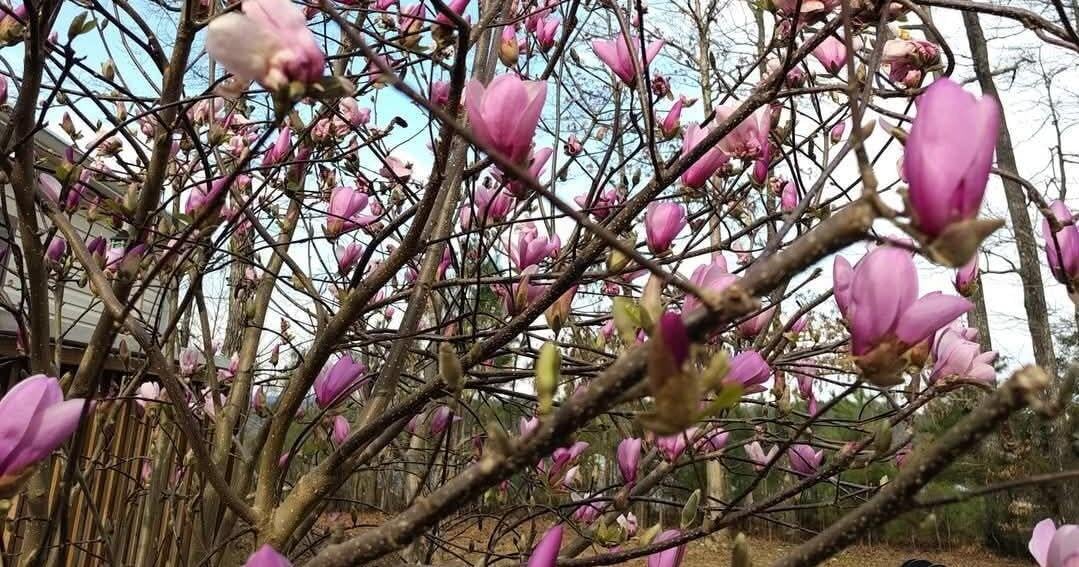
We have just celebrated the first day of spring a few days ago and left the cold days of winter behind.
I always think of that day on the calendar as a time to unlock the garden gate, although my gate has no lock. Immediately, I begin to look for new bloomers I can add to my yard and garden. If you are in the market for late winter/early spring blooming trees, I’d like to share one of my favorites. I can usually count on the saucer magnolia to make a spectacular show of blooms to let me know spring is just around the corner.
The botanical name is Magnolia x soulangeana, whose common names include saucer magnolia, tulip magnolia, chinese magnolia, or japanese magnolia. It is definitely a beautiful sight, flowering in late winter. It does have a rather short bloom time, but is still a beauty, even when it begins to shed its blooms. When the blooms land on the ground, it’s as though its shadow is now filled with blossoms or its reflection in a lake. Once blooming has completed, the saucer magnolia gives way to its beautiful leaves with sharply pointed apex. The saucer magnolia can be multi-trunked or the main branches are low on the trunk, with smooth, gray bark.
The Tulip Magnolia is a non-native, deciduous tree or large shrub in the magnolia family (Magnoliaceae). It is a hybrid cross between M. denudata and M. liliiflora, both native to Japan. They are not invasive and will grow about 15 to 30 feet tall and 15 to 25 feet wide. It is deer resistant and bears an abundance of fragrant, gigantic cup-shaped flowers with nine petal segments that are whitish on the inside and more colorful on the outside. According to the North Carolina Extension Gardener, the saucer magnolia has a fleshy root system that requires plenty of room. Its rope-like roots grow horizontally to provide stability. Its roots do not grow invasively or deeply like other types of magnolia trees that can affect a home’s foundation if planted too closely.
There are many different cultivars of saucer or tulip magnolia in shades of pink, plum, purple, burgundy, and then the occasional white and yellow. The yellow saucer magnolia is few and far between, but there is one on the UWG campus. The saucer magnolia or tulip tree, as I prefer to call it, is not to be confused with the stately tulip poplar or yellow poplar, flourishing in the woods of west Georgia that drops the yellow and orange blooms from way up high to the ground beneath it.
When looking for a spot to plant a saucer magnolia, choose a very sunny, but sheltered spot away from the wind. Since they are early spring bloomers, a late frost may sometimes damage the buds, resulting in a poor bloom season. Saucer magnolia trees can tolerate clay soil, but needs to be well-draining. They will benefit from mixing fertilizer into the soil when being planted, then in the spring, spread a balanced slow-release fertilizer on the surface around the tree before a rain, if watering the fertilizer in is not an option. Take the time to choose a good spot, and you will encourage more blooms on your saucer magnolia.
Although saucer magnolias are beautiful, they can be messy if not planted in the right location. You may be wondering how a tree with beautiful blooms can be messy. Well, an example of this was told to me by a friend. She inherited her tree when she bought her house, so her tulip tree was planted too close to the garage side of the house and the blooms fell on the concrete drive. When she pulls into the garage, the blooms are tracked into the garage from the tires. All in all, she says the beauty of the tulip tree beats the messy, but it would still be best to choose an area where the blooms do not fall on driveways, sidewalks, patios, and porches. Plant one before next spring and I guarantee you will be glad you did.
There are two plant sales at the Carroll County Ag Center this spring where you can find a wide selection of plants, shrubs, or trees for your yard or garden. The West Georgia Chapter of The Georgia Native Plant Society plant sale is on April 18. On that same day, and just a short walk from the plant sale, the Master Gardener’s Art in the Garden is at the Buffalo Creek Demonstration Garden.
The other plant sale that you don’t want to miss is The Master Gardener Mother’s Day plant sale on May 9. Mark your calendar and I hope to see you there!
If you have gardening questions, contact a Master Gardener Extension Volunteer at the UGA Cooperative Extension Carroll County office, located at the Carroll County Ag Center at 900 Newnan Road in Carrollton at 770-836-8546 or via email at ccmg@uga.edu.