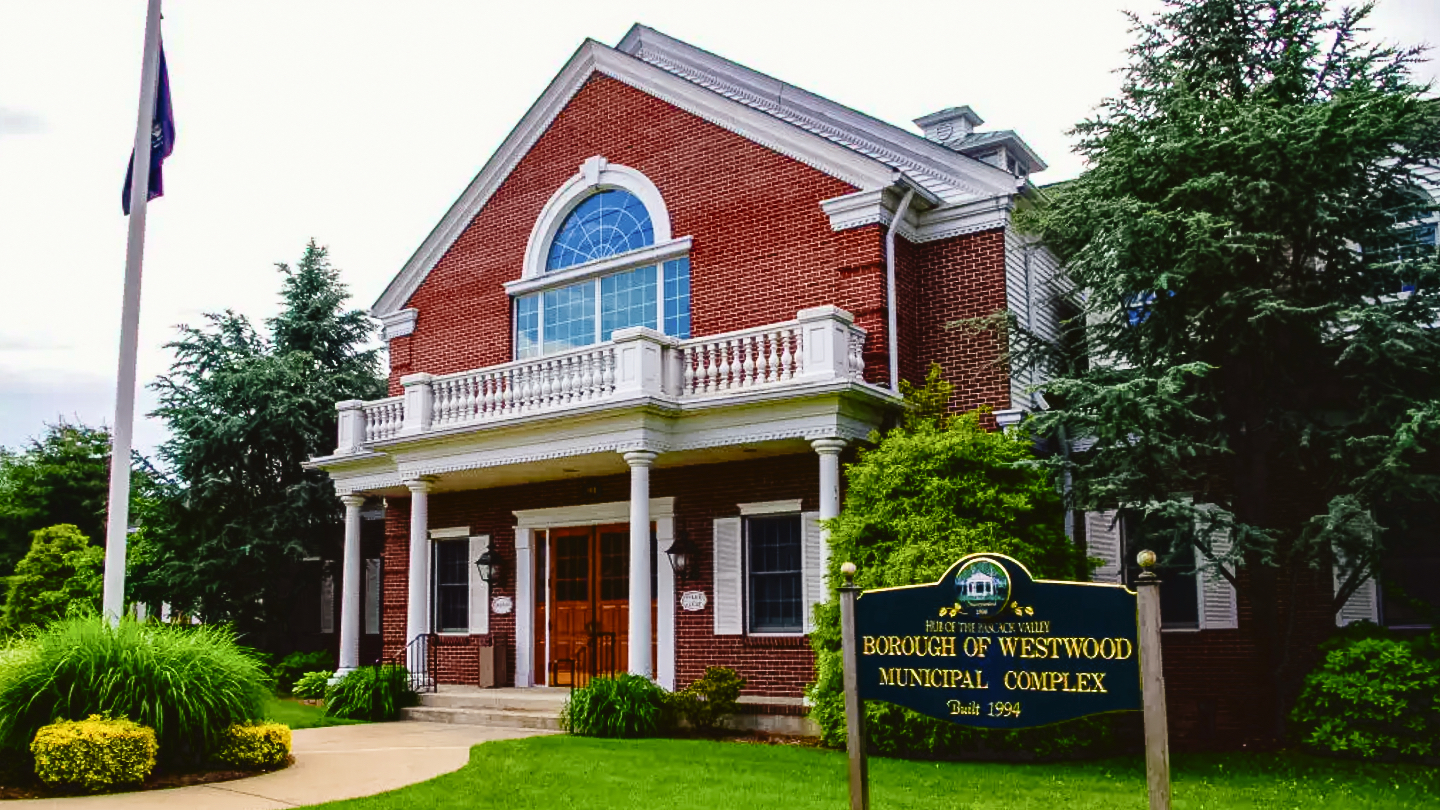
Westwood Borough Hall
WESTWOOD—Local officials have moved to protect the borough from builder’s remedy exposure, adopting a new affordable housing overlay zone and related compliance measures even as major disputes remain over how much housing the borough must realistically accommodate — and what may ultimately be built on a contested downtown tract.
The Borough Council on March 13 approved Ordinance 26-08 and three related resolutions tied to the borough’s fourth-round affordable housing obligations for the 2025-35 cycle. Borough officials have said the plan has been deemed “conditionally constitutionally compliant,” but warned that missing the state’s March 15 deadline would have jeopardized Westwood’s immunity from builder’s remedy lawsuits.
At the center of the action is a new AH0-3 affordable housing overlay zone applying to Block 907, Lots 2, 3, 4, 5 and 18. The ordinance is intended to encourage mixed-use low- and moderate-income housing through inclusionary development, while still allowing developers the option of building under the underlying Central Business District zoning standards. Maximum density is capped at 32 dwelling units per acre.
The council also adopted three supporting resolutions: one endorsing Westwood’s amended fourth-round housing and spending plan, one affirming the borough’s intent and bond in the event of an affordable housing funding shortfall, and one adopting an affirmative marketing plan for local affordable units.
A fourth resolution expressed the council’s opposition to the state’s amended 2024 Fair Housing Act, which requires municipalities to rezone to address affordable housing obligations. Westwood is one of 29 towns in a coalition led by Montvale Mayor Mike Ghassali challenging the amended law.
The borough’s immediate dispute is not simply whether it can comply, but how its obligation should be calculated.
Mayor Ray Arroyo has argued Westwood’s third-round realistic development potential, or RDP, was one affordable unit and its fourth-round undisputed RDP is zero because the borough has no vacant land available for future development.
Under the interpretation supported by Fair Share Housing Center, however, 25% of Westwood’s unmet need — 235 units — would require zoning for 59 units. Under the borough’s preferred interpretation, 25% would be calculated from RDP instead, yielding zero units.
In practical terms, the unresolved issue is whether Westwood must zone for dozens of affordable units despite having little or no vacant land, or whether its land constraints sharply limit what it must provide.
Arroyo and Council President Lauren Letizia have argued that vacant-land adjustment is meant to prevent overdevelopment that ignores local land constraints and sound planning principles. Arroyo has also said the legal dispute over how unmet need should be calculated is unlikely to be resolved before state compliance deadlines.
Even so, Arroyo said the borough’s overlay ordinances already account for the 59 units that would be required if Fair Share’s interpretation prevails.
Also unresolved is the fate of a roughly 300-unit development at 349 Broadway and 1 Westwood Ave., where the borough remains in litigation over a related eminent domain action. Two intervenors and a developer remain involved in the dispute, while Westwood is pursuing acquisition of part of the property for additional downtown parking.
If the borough succeeds, officials say the developable portion of the site would be reduced from 1.87 acres to 0.97 acre. Under the affordable housing plan, that smaller tract would be limited to a maximum of 31 residential units in a mixed-use format, with retail on the ground floor and residences above.
The eminent domain case remains pending in Superior Court.