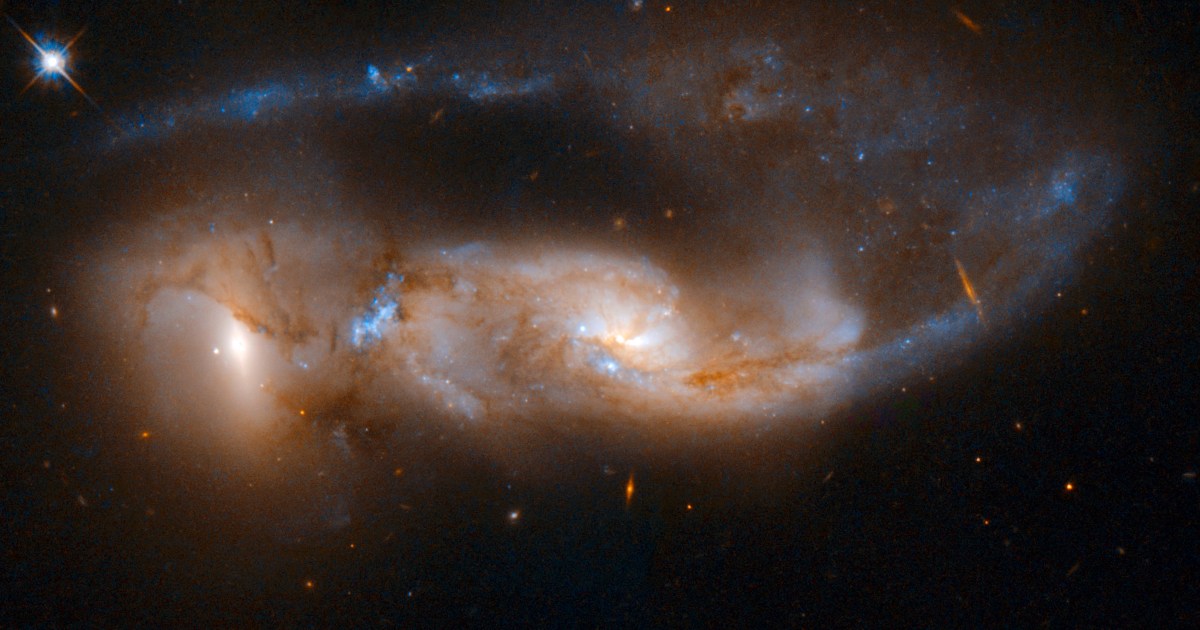
Throughout the visible Universe, trillions of galaxies abound.
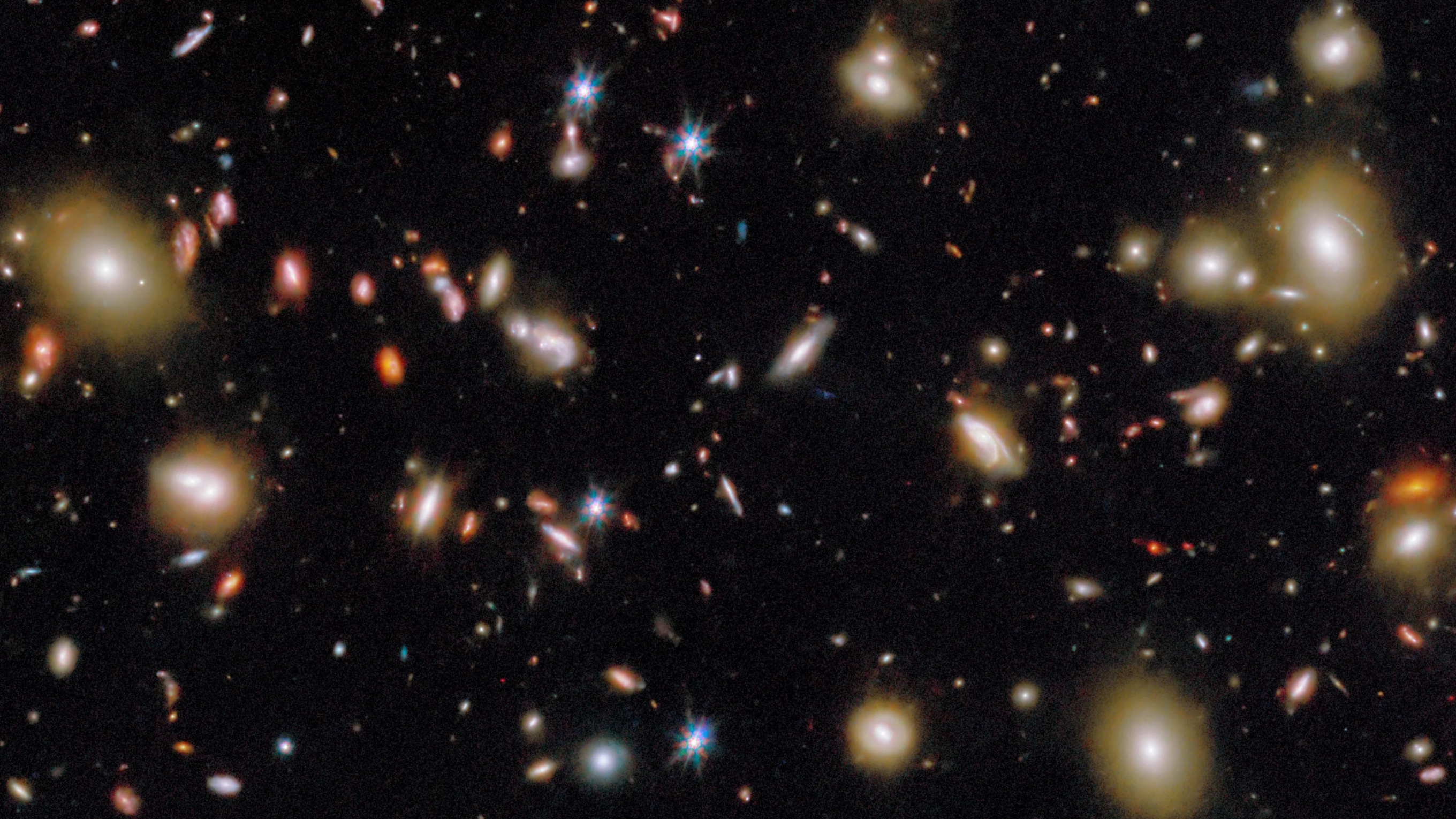
This deep-field view of the Universe showcases a portion of the COSMOS-Web field acquired with JWST. In this field are a wide variety of galaxies, where the largest, most massive ones are nearly all spirals or ellipticals, with some lenticular galaxies possessing properties common to both. However, about 5-10% of these galaxies, where their shapes can be resolved, are irregular, peculiar galaxies: evidence of galactic interactions and mergers.
Credit: ESA/Webb, NASA & CSA, G. Gozaliasl, A. Koekemoer, M. Franco, and the COSMOS-Web team
Most of the Universe’s stars, however, are contained in the largest, most massive galaxies.
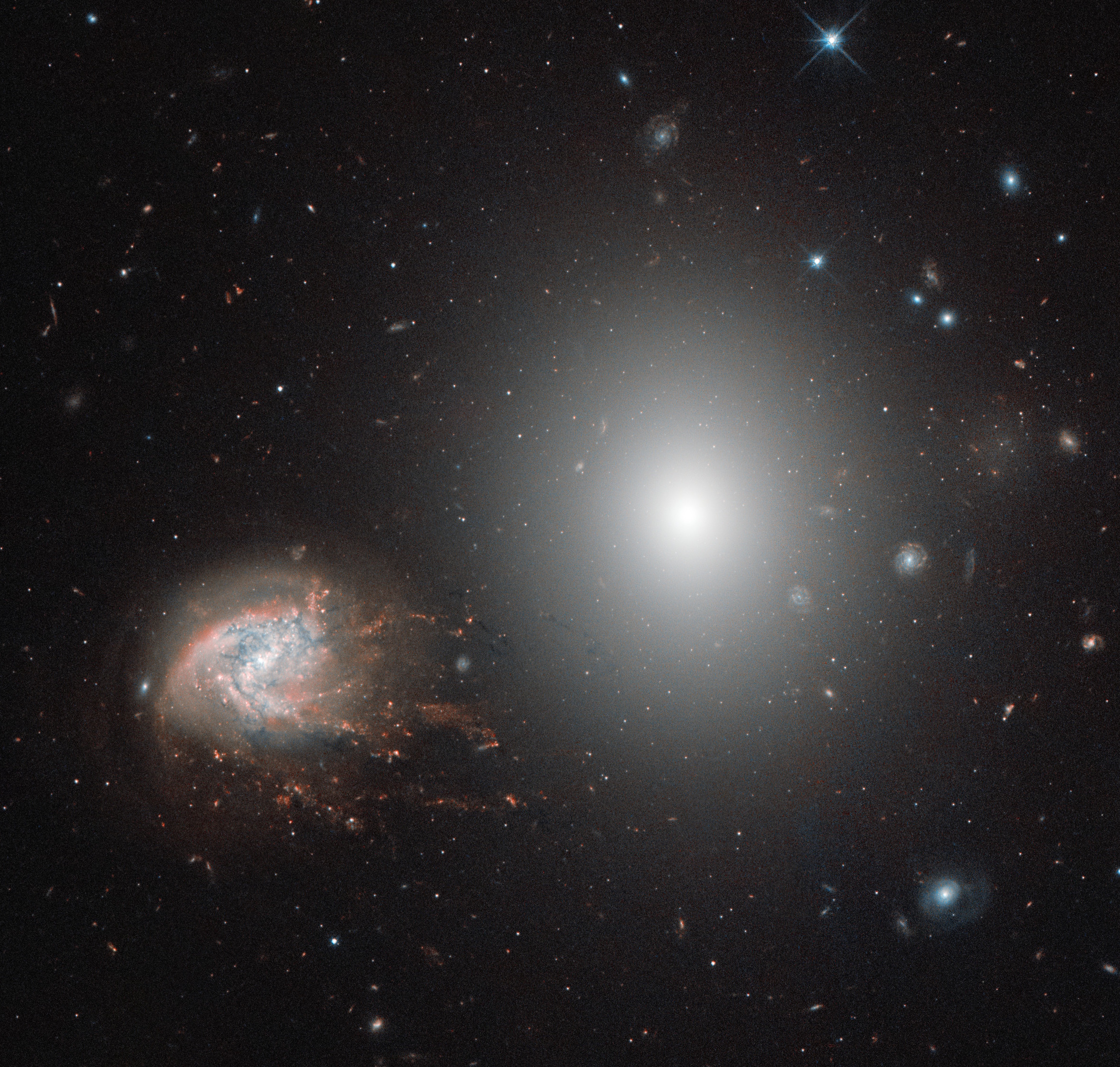
This image, acquired with the Hubble Space Telescope in 2018, shows the giant elliptical galaxy NGC 4860 alongside its passing neighbor, the rapidly-moving spiral NGC 4858. Both of these galaxies are located in the Coma Cluster, but NGC 4858 is special: it’s fast-moving, at 5600 km/s through the intracluster medium, and speeding through it in an edge-on fashion. The evidence for ram pressure stripping, including trails of newly formed stars in its wake, leads to this being known as a type of jellyfish galaxy: what was initially a spiral galaxy interacting with the intracluster medium.
Credit: ESA/Hubble & NASA
About 90-95% of those large, massive galaxies are either:
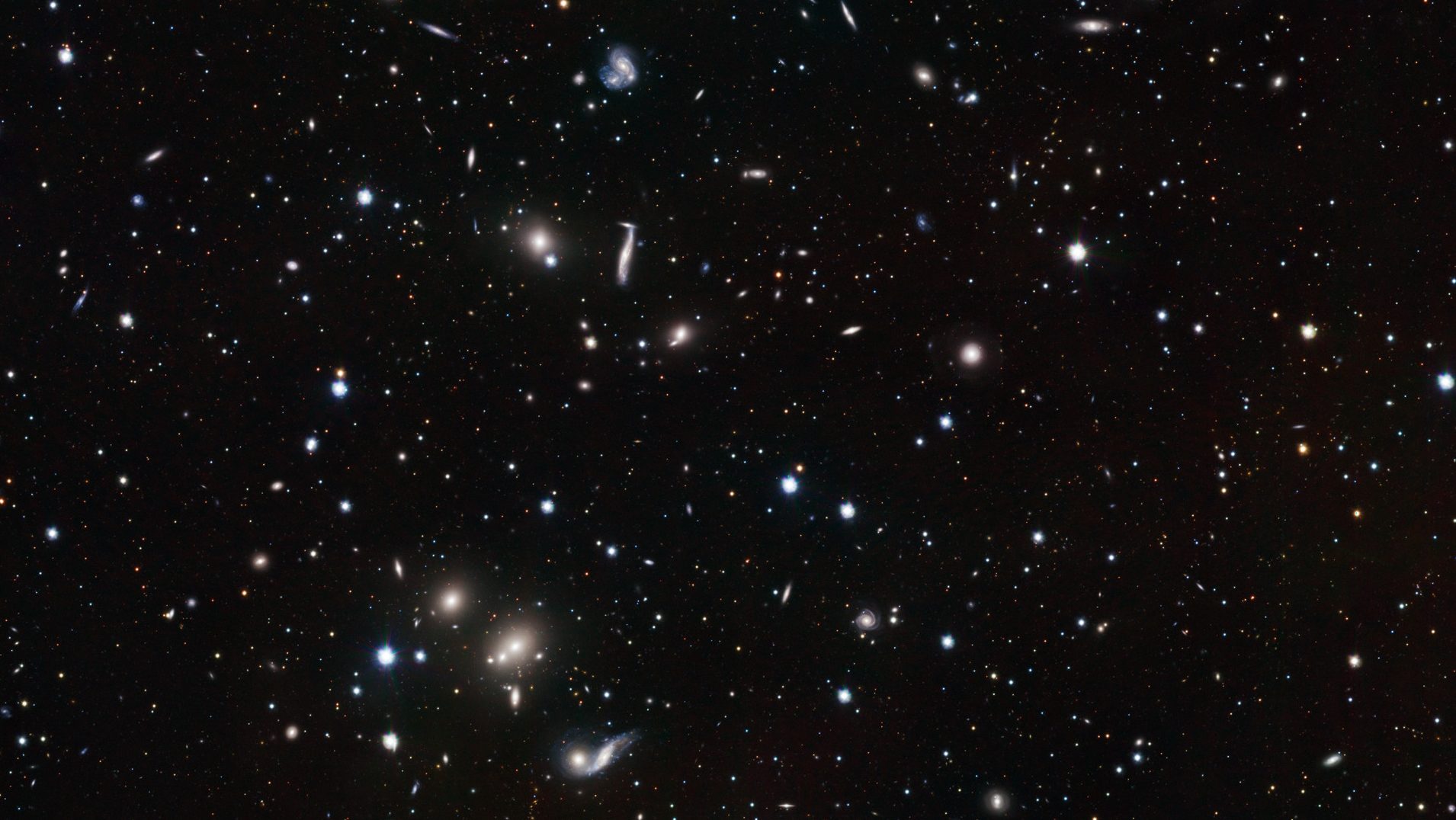
Most of the largest known galaxies in the Universe are found at the hearts of massive galaxy clusters, like the Hercules galaxy cluster shown here. Over time, galaxies within these clusters collide and merge, leading to bursts of new star-formation but making the galaxies more gas-poor, overall. After enough time (longer than the present age of the Universe) has passed, most galaxies within such a cluster will become giant ellipticals, rather than the disk-containing spirals that remain the most common species of large, massive galaxy within our modern Universe.
Credit: ESO/INAF-VST/OmegaCAM. Acknowledgement: OmegaCen/Astro-WISE/Kapteyn Institute
spirals, with gas-rich disks and well-defined arms,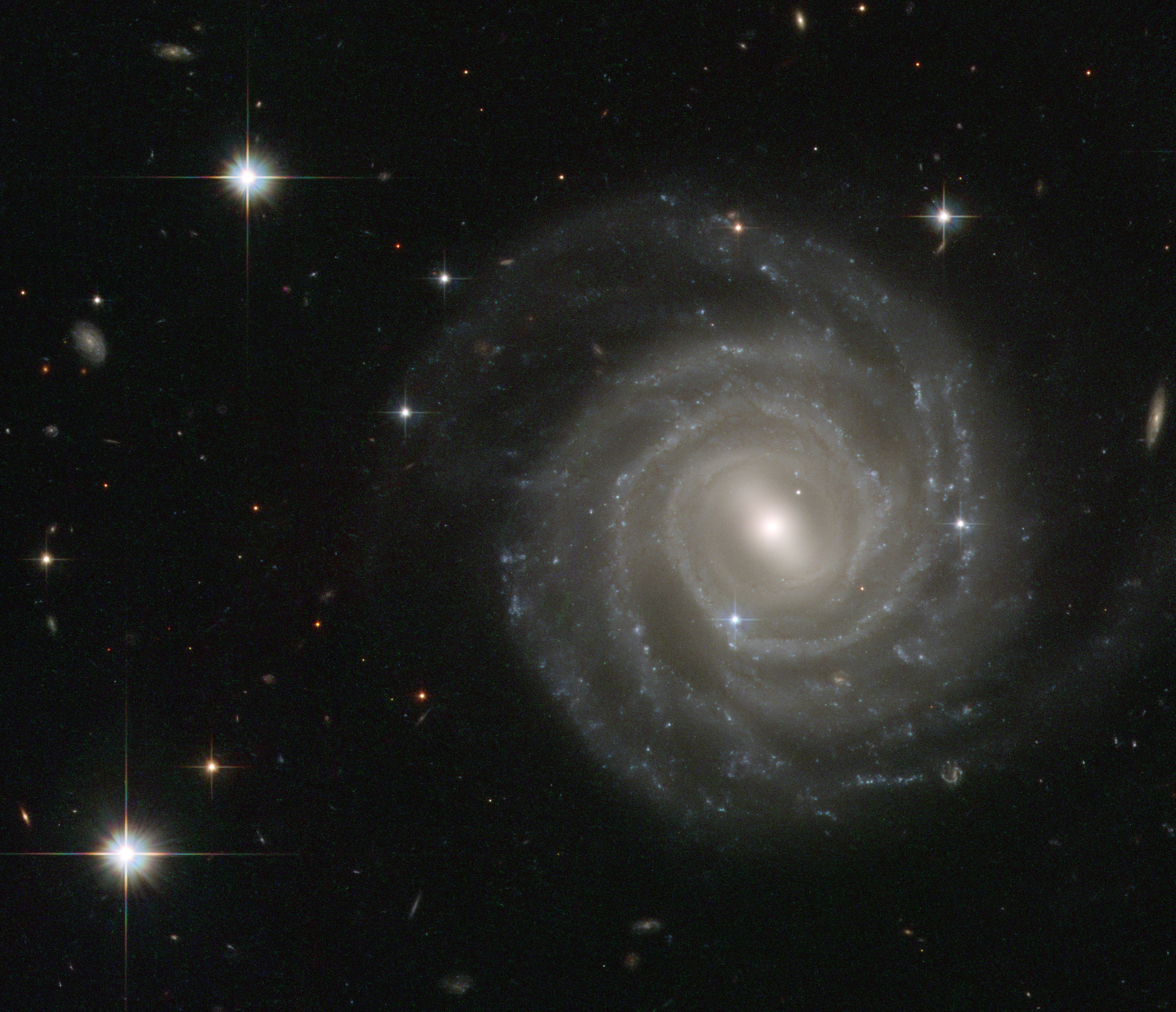
The spiral galaxy UGC 12158, with its arms, bar, and spurs, as well as its low, quiet rate of star formation and hint of a central bulge, may be the single most analogous galaxy for our Milky Way yet discovered. It is neither gravitationally interacting nor merging with any nearby neighbor galaxies, and so the star-formation occurring inside is driven primarily by the density waves occurring within the spiral arms in the galactic disk.
Credit: ESA/Hubble & NASA
ellipticals, with prominent bulges and little-to-no gas,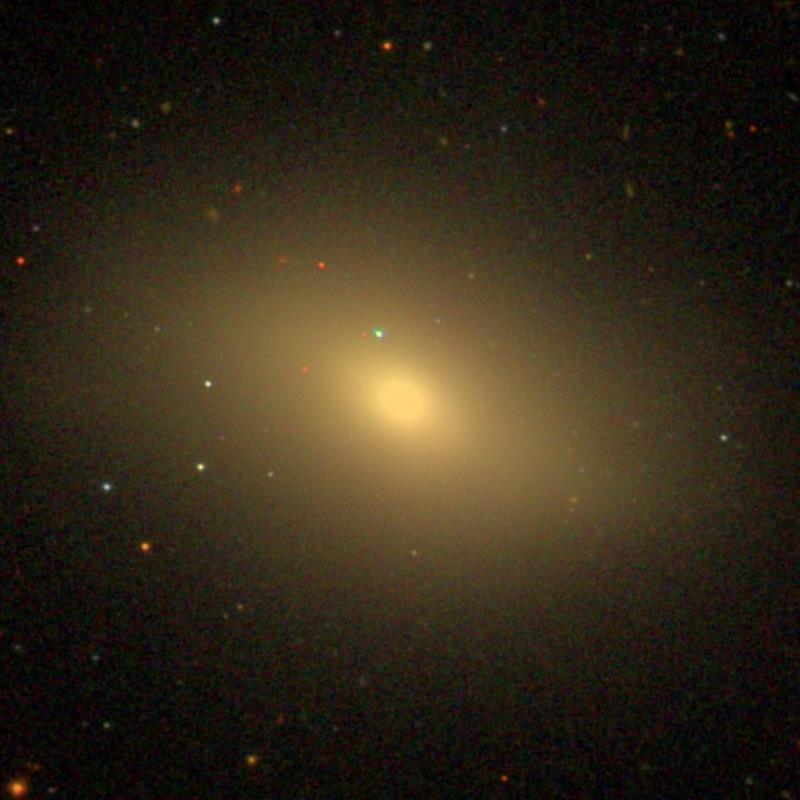
Giant elliptical galaxy NGC 584, shown here, was discovered and recorded in 1785, and is located approximately 62 million light-years away. Although it was not known to be an extragalactic object until the 1920s, it was briefly the most distant object known and recorded until NGC 1 was identified a few months later. Its stars are distributed in a bulge-like halo, with very little to no gas or star-forming material inside of it.
Credit: Sloan Digital Sky Survey
or lenticulars, which are hybrids containing both disks and bulges.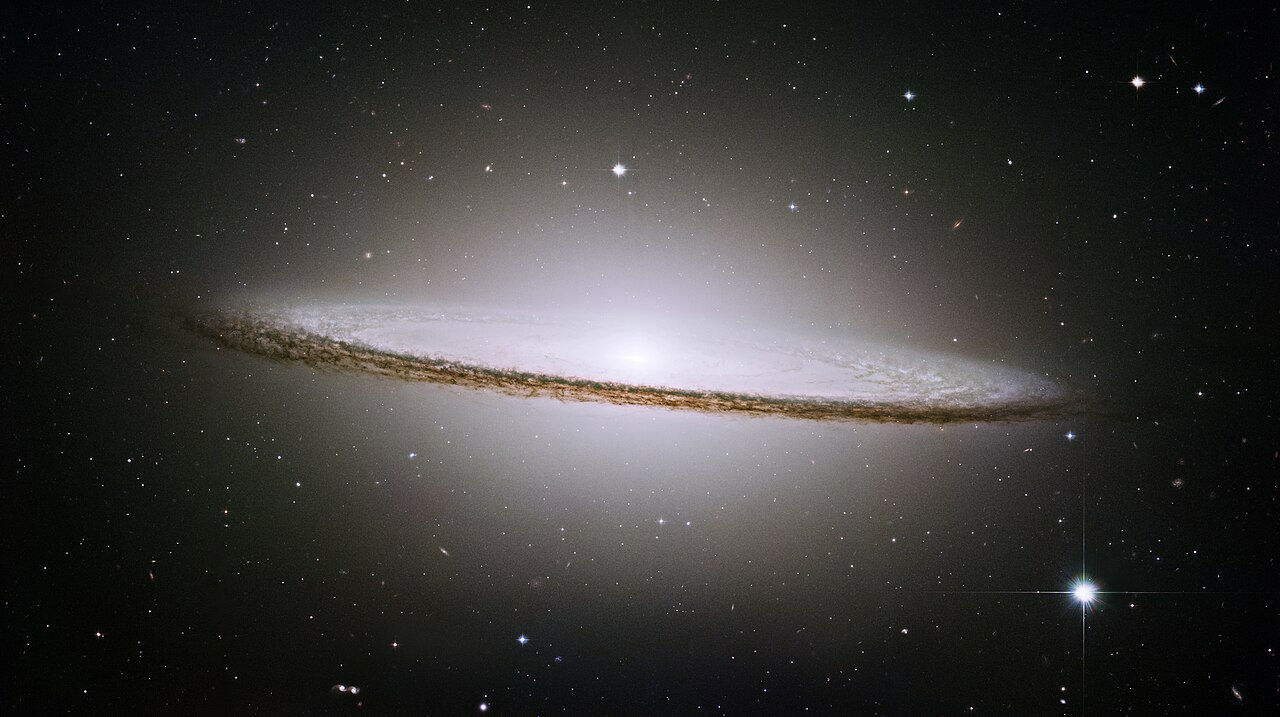
The Sombrero galaxy, shown in visible light and imaged by Hubble, is intrinsically the brightest galaxy within some ~35 million light-years of our Milky Way. As a lenticular galaxy, it has a large central bulge and ellipsoidal halo of stars common to elliptical galaxies, plus a gas-and-dust-rich disk that still forms stars like spiral/disk galaxies do. One must look to the Virgo Cluster, some 50+ million light-years distant, to find significantly brighter, much more massive galaxies.
Credit: NASA/ESA and The Hubble Heritage Team (STScI/AURA)
However, about 5-10% of galaxies defy that categorization: the peculiar galaxies.
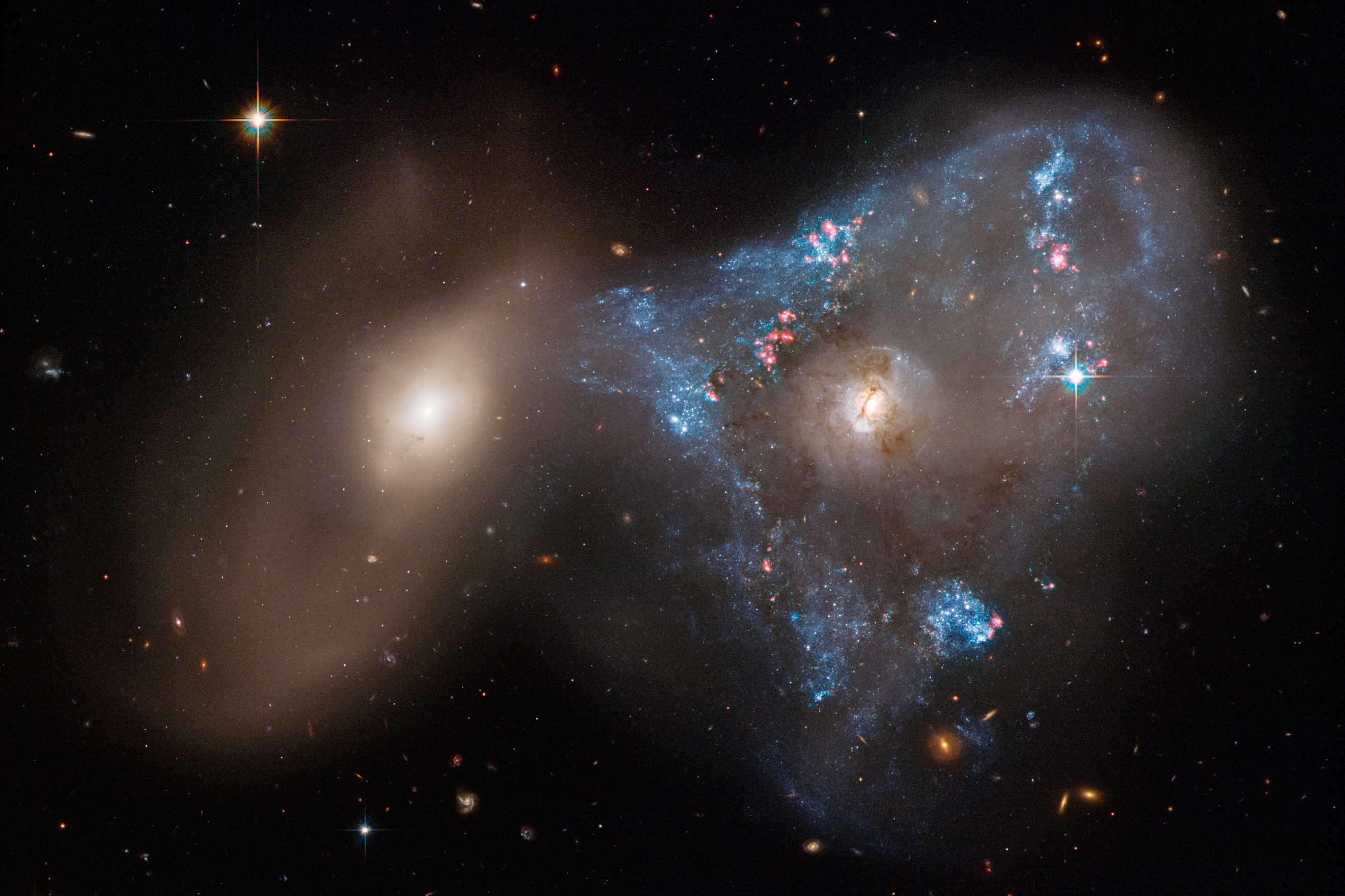
From a visual perspective, Hubble’s view of Arp 143 makes perhaps the telescope’s most striking and beautiful image of 2022. The pair contains the glittery, distorted, star-forming spiral galaxy NGC 2445 at right, along with its less flashy and more massive companion, NGC 2444 at left.
Credit: NASA, ESA, STScI, Julianne Dalcanton Center for Computational Astrophysics, Flatiron Inst. / UWashington); Processing: Joseph DePasquale (STScI)
Sometimes, there’s only a chance alignment along the line-of-sight between otherwise normal galaxies.
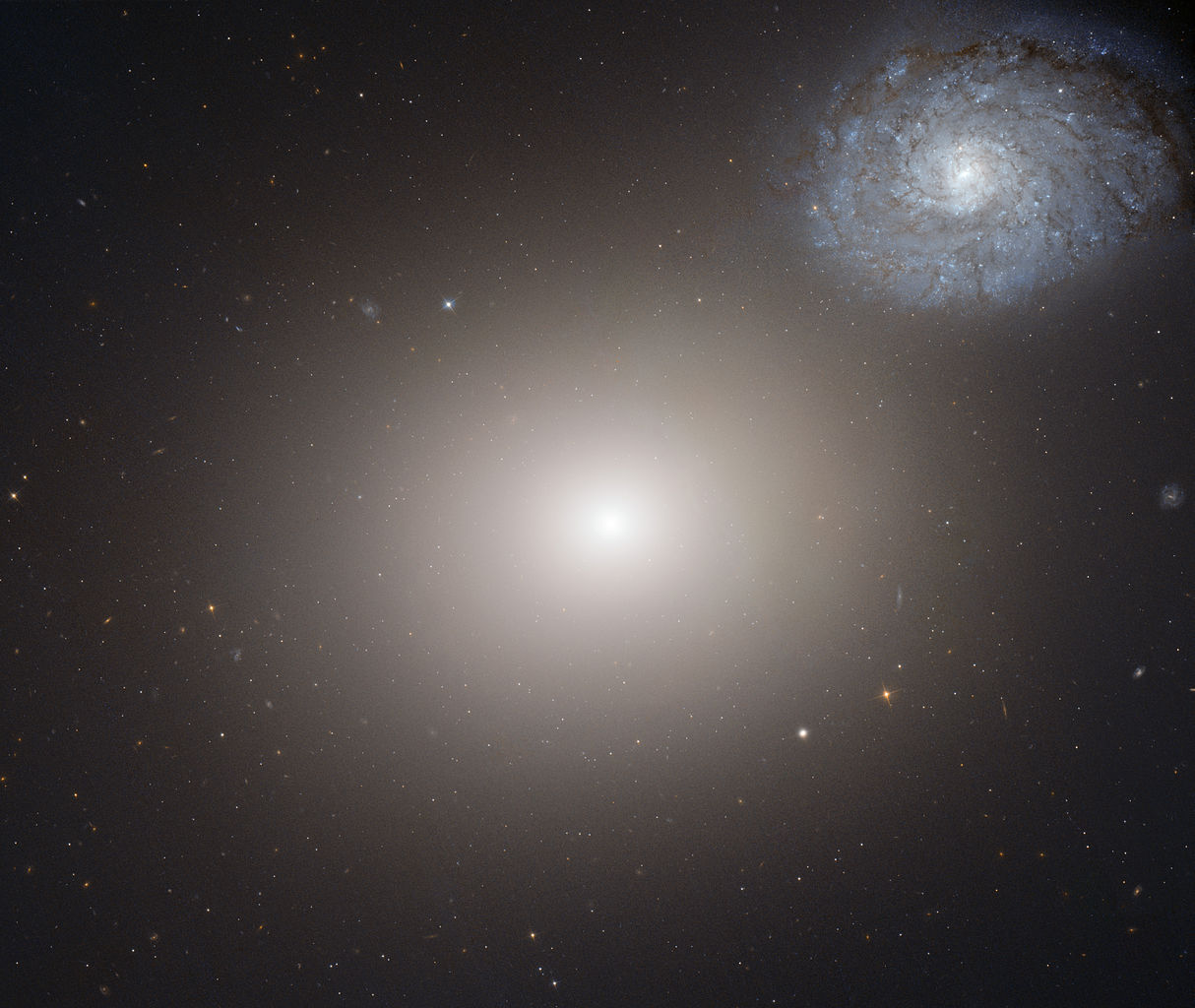
Messier 60, the giant elliptical at the center of the image, was catalogued as “peculiar” due to its line-of-sight overlap with the more distant spiral galaxy NGC 4647. They do not appear to be interacting, as no new star formation and no gravitationally distortive effects have been identified, with Messier 60 being much more massive than the Milky Way and NGC 4647 being somewhat less massive than our own galaxy.
Credit: NASA, ESA and the Hubble Heritage (STScI/AURA)-ESA/Hubble Collaboration
But at other times, these galaxies showcase significant interaction signals.
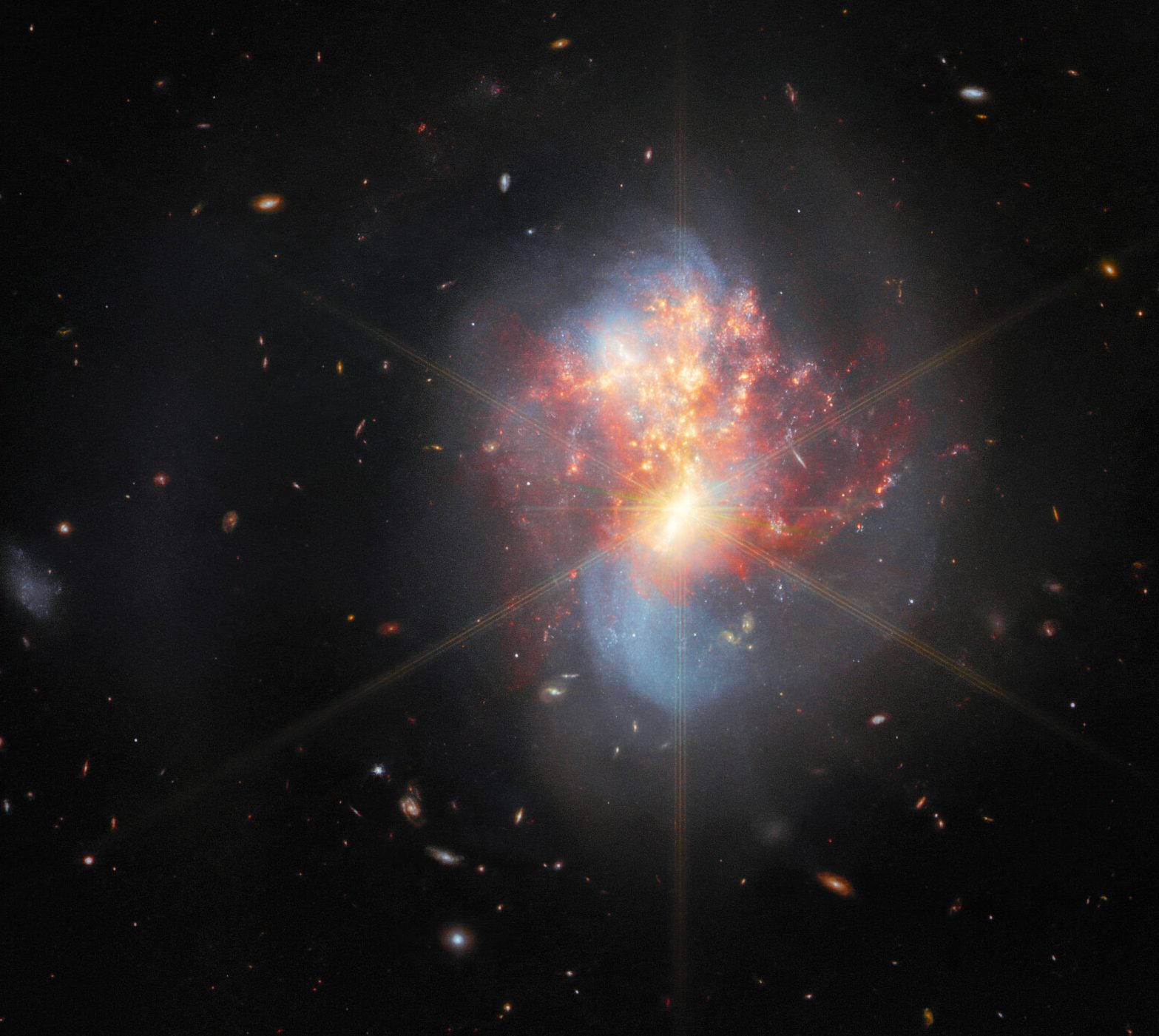
The pair of interacting galaxies in the process of a merger, known as IC 1623, is imaged here by JWST. Data from a trio of JWST’s instruments, MIRI, NIRSpec, and NIRCam, were used in the construction of this image. The ongoing starburst at the center produces intense infrared emissions. In galaxies in the early Universe, the entire galaxy itself can undergo a starburst, where stars form all at once over the entirety of a galaxy, albeit only for a brief period of time.
Credit: ESA/Webb, NASA & CSA, L. Armus & A. Evans; Acknowledgement: R. Colombari
When galaxies overlap, interact, or merge, their shapes change significantly.
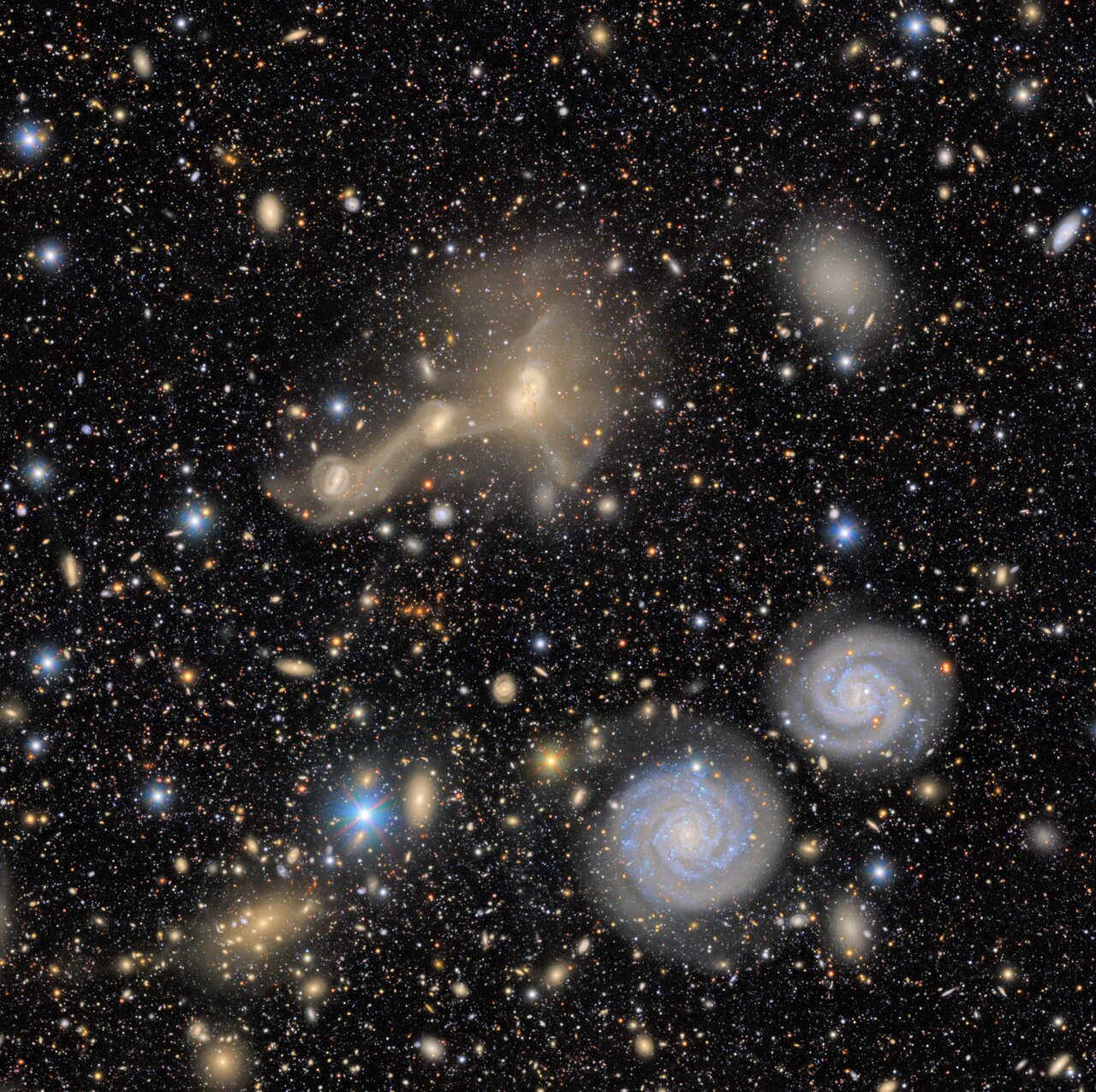
This image from the Vera C. Rubin Observatory’s first look observations shows the galaxy pair NGC 4411, at lower right, which are far apart in 3D space and not interacting, along with the galaxies of RSCG 55, higher in the image, which are interacting. The telltale signs of distorted galaxy shapes, tidal tails, and gas bridges, along with newly formed stars, are hallmarks of a gas-rich interaction.
Credit: RubinObs/NOIRLab/SLAC/NSF/DOE/AURA
Gravitational interactions perturb the internal gas, triggering star-formation.
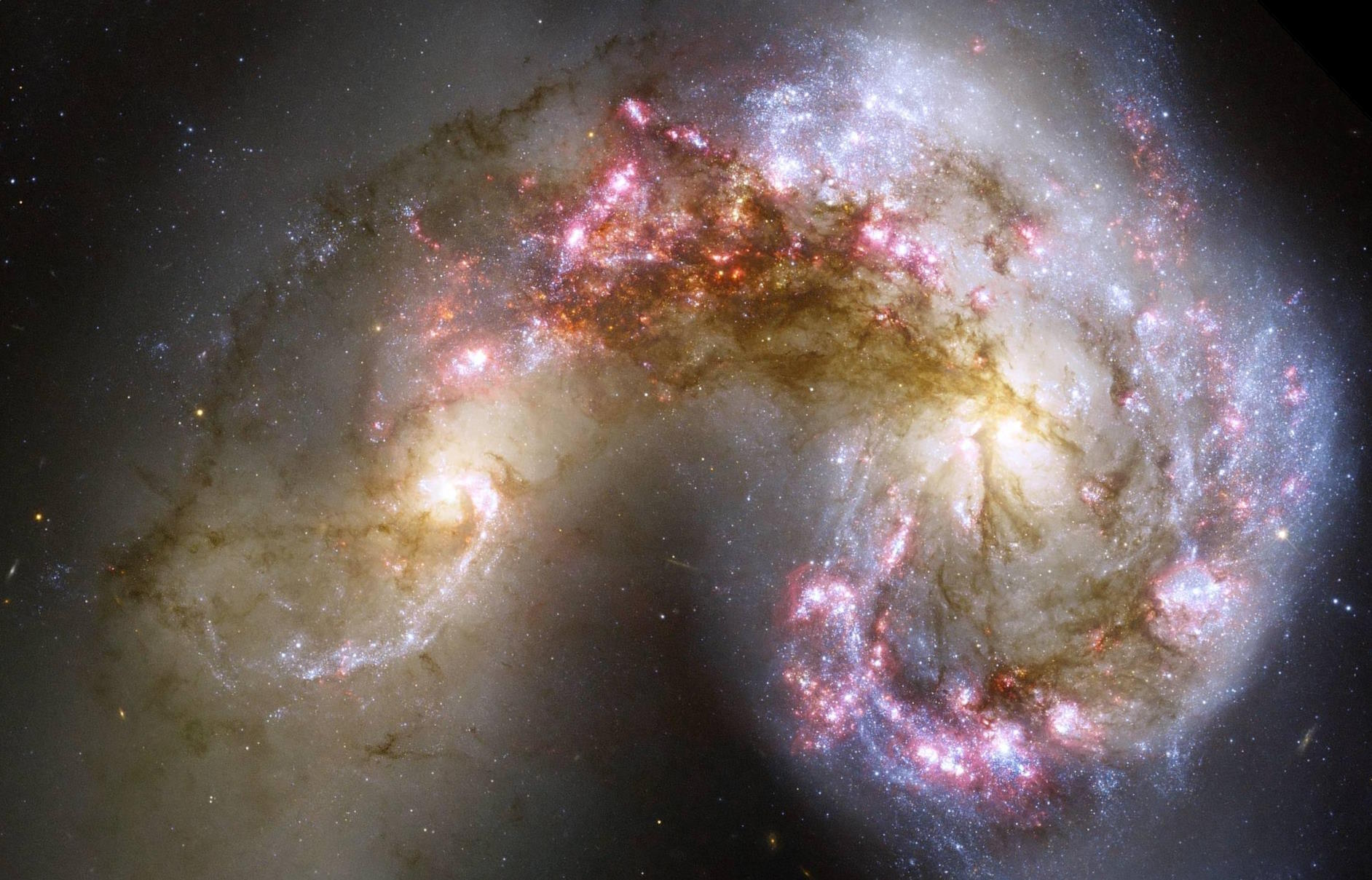
This Hubble Space Telescope image of the Antennae Galaxies, NGC 4038 and NGC 4039, shows two comparably-sized spiral galaxies in the process of interacting and merging. In about 4 billion years, the Milky Way and Andromeda may undergo a similar interaction, but recent simulations suggest that they might experience a near-miss instead, having to wait several billions of years more before eventually merging.
Credit: NASA, ESA, and the Hubble Heritage Team (STScI/AURA)-ESA/Hubble Collaboration
In severe cases, an entire galaxy can become a star-forming region.
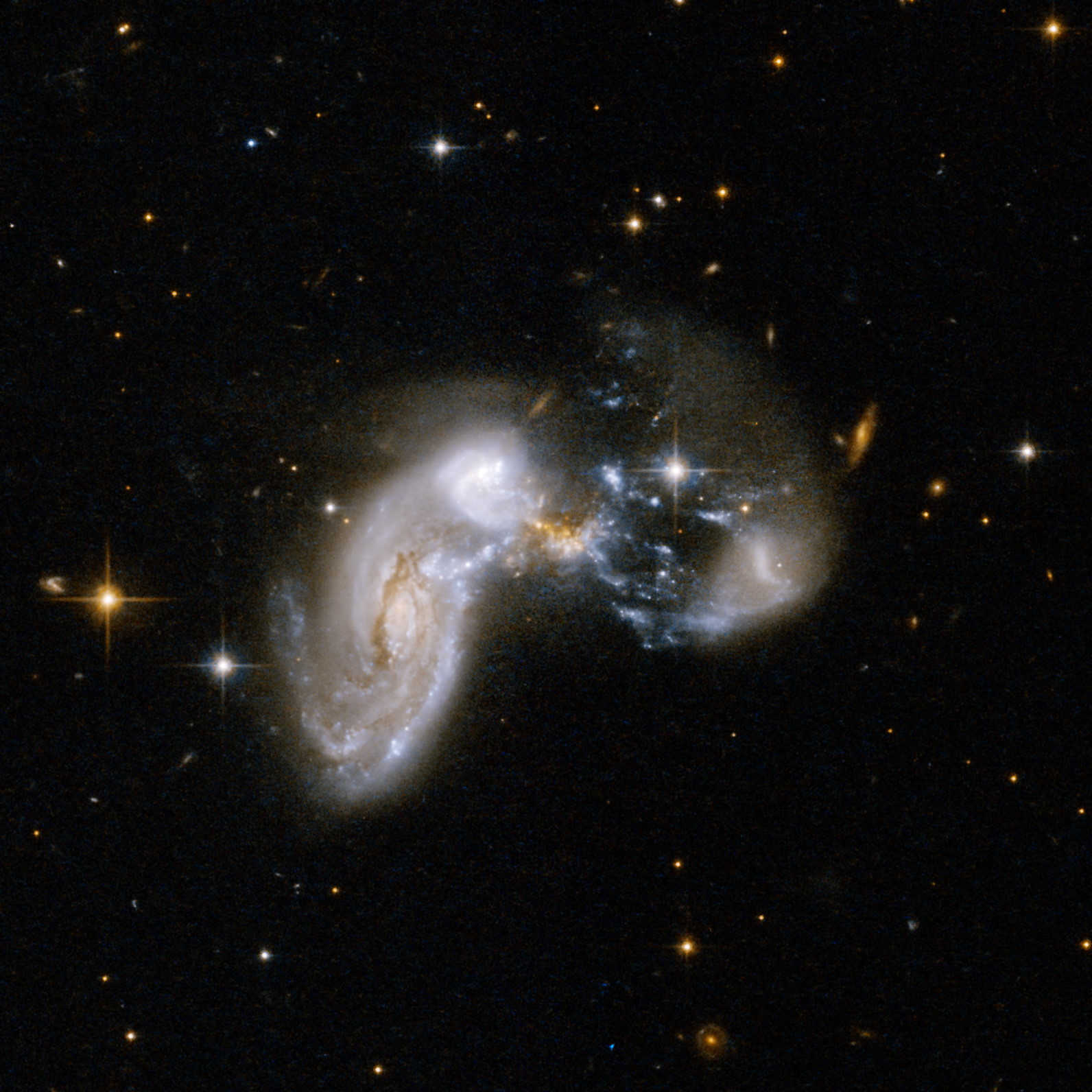
Zw II 96 in the constellation of Delphinus, the Dolphin, is an example of a galaxy merger located some 500 million light-years away. Star formation is triggered by these classes of events, and can use up large amounts of gas within each of the progenitor galaxies, rather than a steady stream of low-level star formation found in isolated galaxies. Note that the entire galaxy at right has become a star-forming region, and the presence of streams of stars between the interacting galaxies, which can either become part of a population of stars in the post-merger galaxy’s stellar halo, or could get expelled from the post-merger galaxy entirely, roaming the intergalactic medium. The end result will be larger numbers of stars bound together in a smaller number of total galaxies.
Credit: NASA, ESA, the Hubble Heritage Team (STScI/AURA)-ESA/Hubble Collaboration and A. Evans (University of Virginia, Charlottesville/NRAO/Stony Brook University)
Their shapes often distort as one galaxy exerts tidal forces on the other.
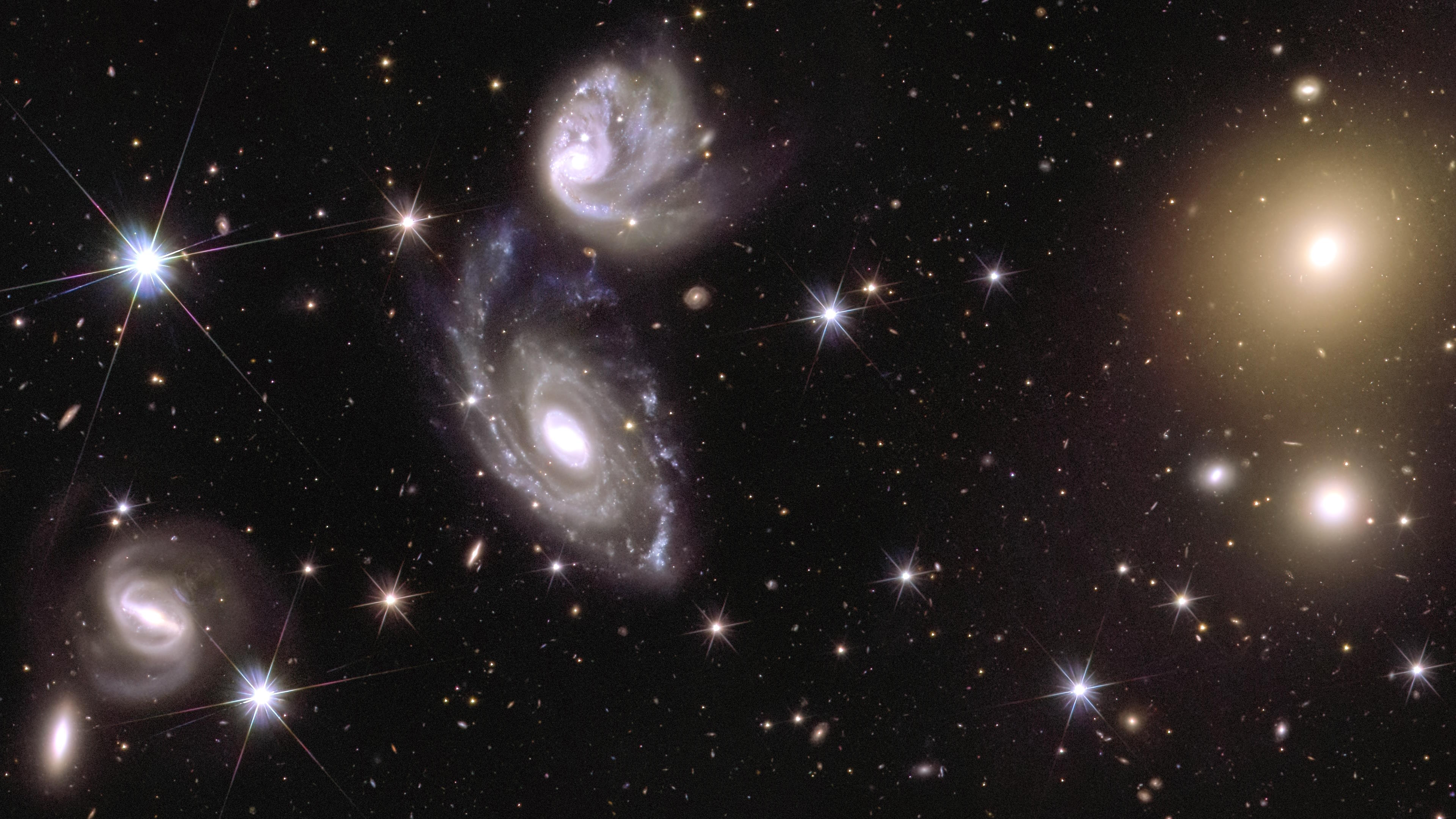
Within ESA’s Euclid’s first released mosaic are enormous numbers of galaxies tightly grouped together. Here, at a 150x zoom level, six prominent, massive, large galaxies are all seen from within Abell 3381, several of which are actively interacting. The extended spiral arms and features of ongoing, new star-formation reveal the nature and properties of these interactions.
Credit: ESA/Euclid/Euclid Consortium/NASA, CEA Paris-Saclay; Processing: J.-C. Cuillandre, E. Bertin, G. Anselmi
Originally catalogued by Halton Arp, the goal was to understand galactic transformations.
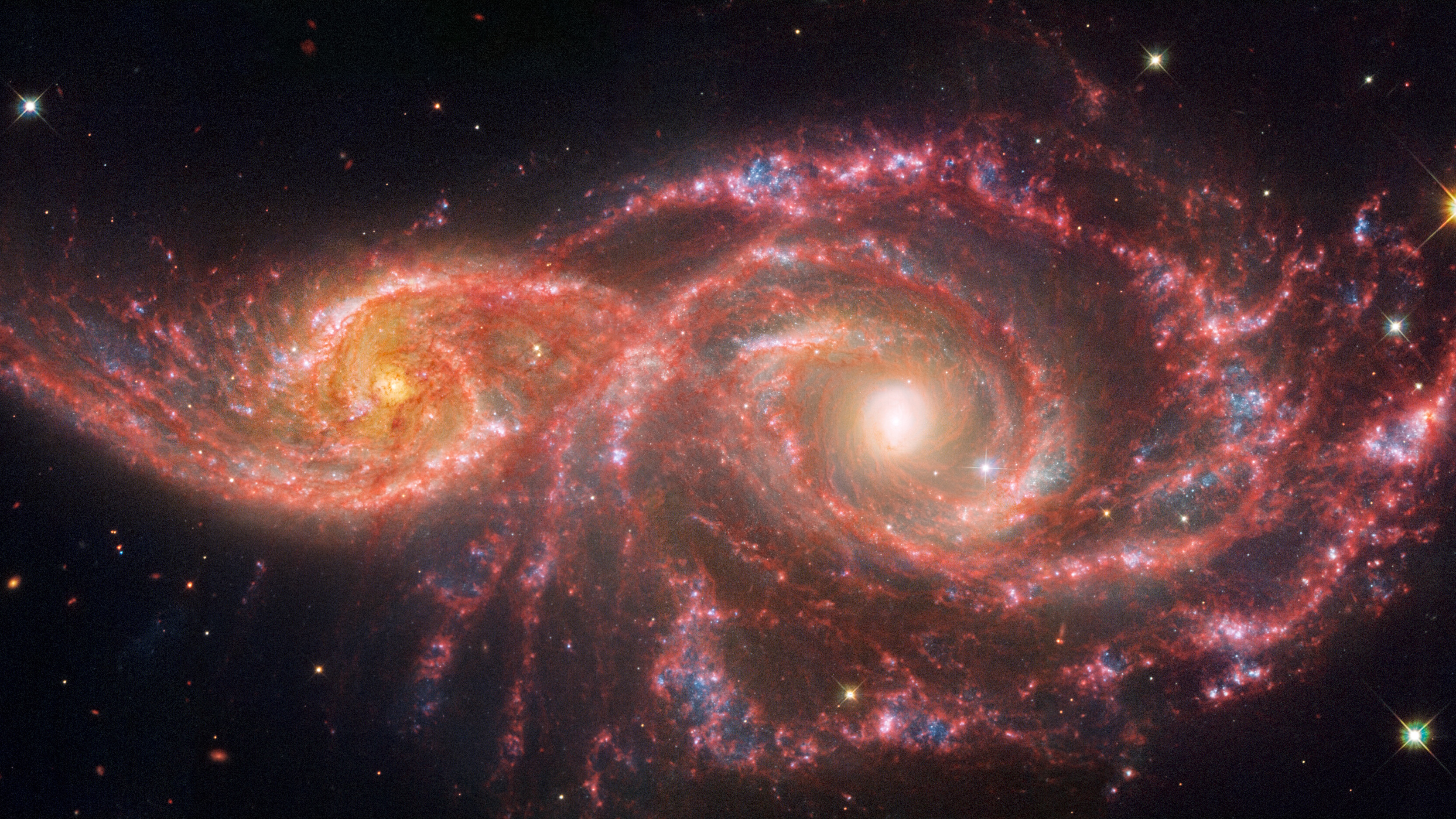
These aren’t a pair of eyes gazing at us from the depths of space, but rather a pair of interacting spiral galaxies that are forming stars at enhanced rates due to their mutual gravitational pulls on one another. This image composite uses mid-infrared data from JWST alongside visible light and ultraviolet data from the Hubble Space Telescope, where the redder regions showcase the presence of ongoing star-formation.
Credit: NASA, ESA, CSA, STScI
Many peculiar galaxies show former disk galaxies converting their gas into stars.
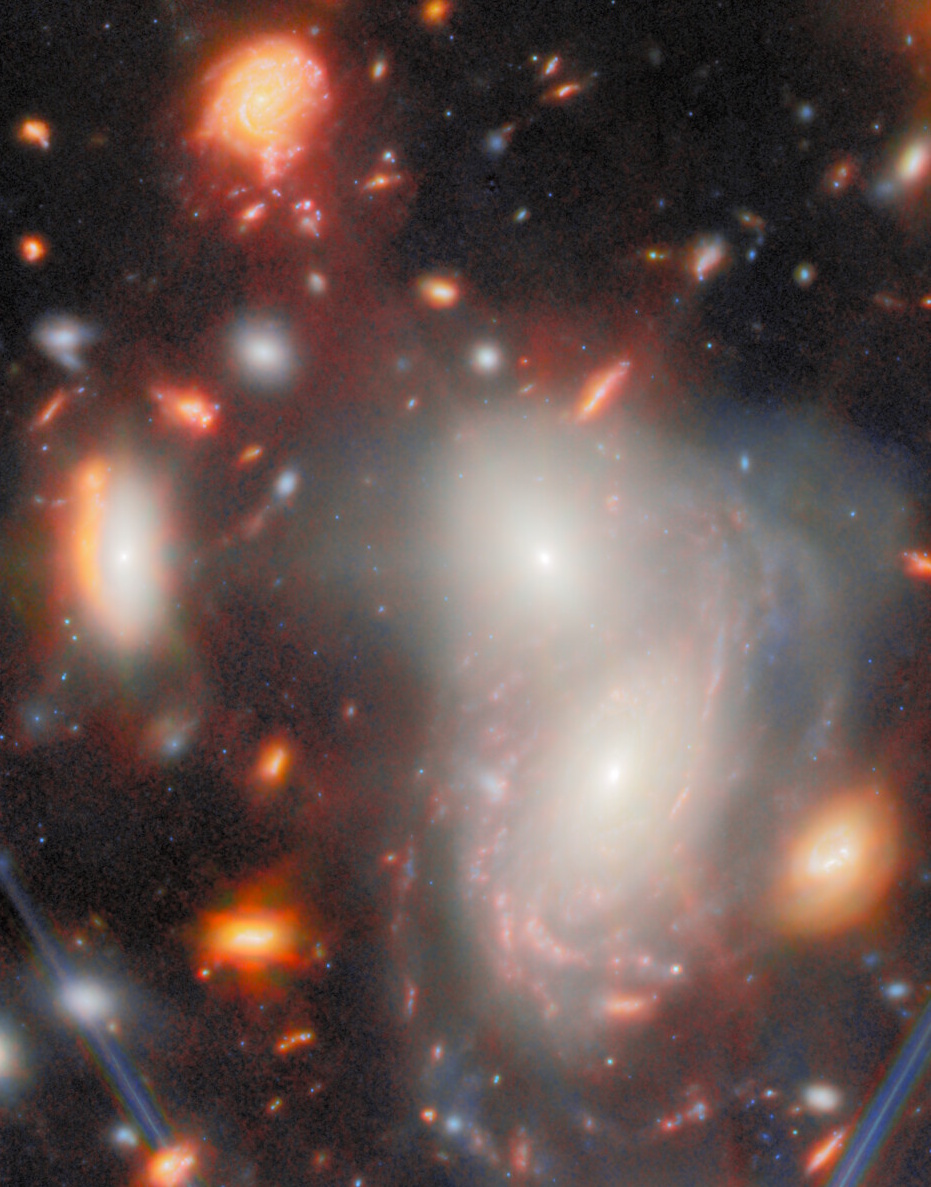
Both foreground (right) and background (upper left) galaxy collisions and interactions can be seen in this image, with foreground galaxies unaffected by gravitational lensing and background galaxies greatly affected by it. Galaxy interactions are a primary cause of new star-formation throughout cosmic history, as this image showcases. Both of the galaxies at lower-right were formerly disk galaxies prior to beginning the interaction. Their future fate, however, is uncertain.
Credit: ESA/Webb, NASA & CSA, H. Atek, M. Zamani (ESA/Webb); Acknowledgement: R. Endsley
This glimpse of cosmic violence showcases the beauty of galactic mergers.
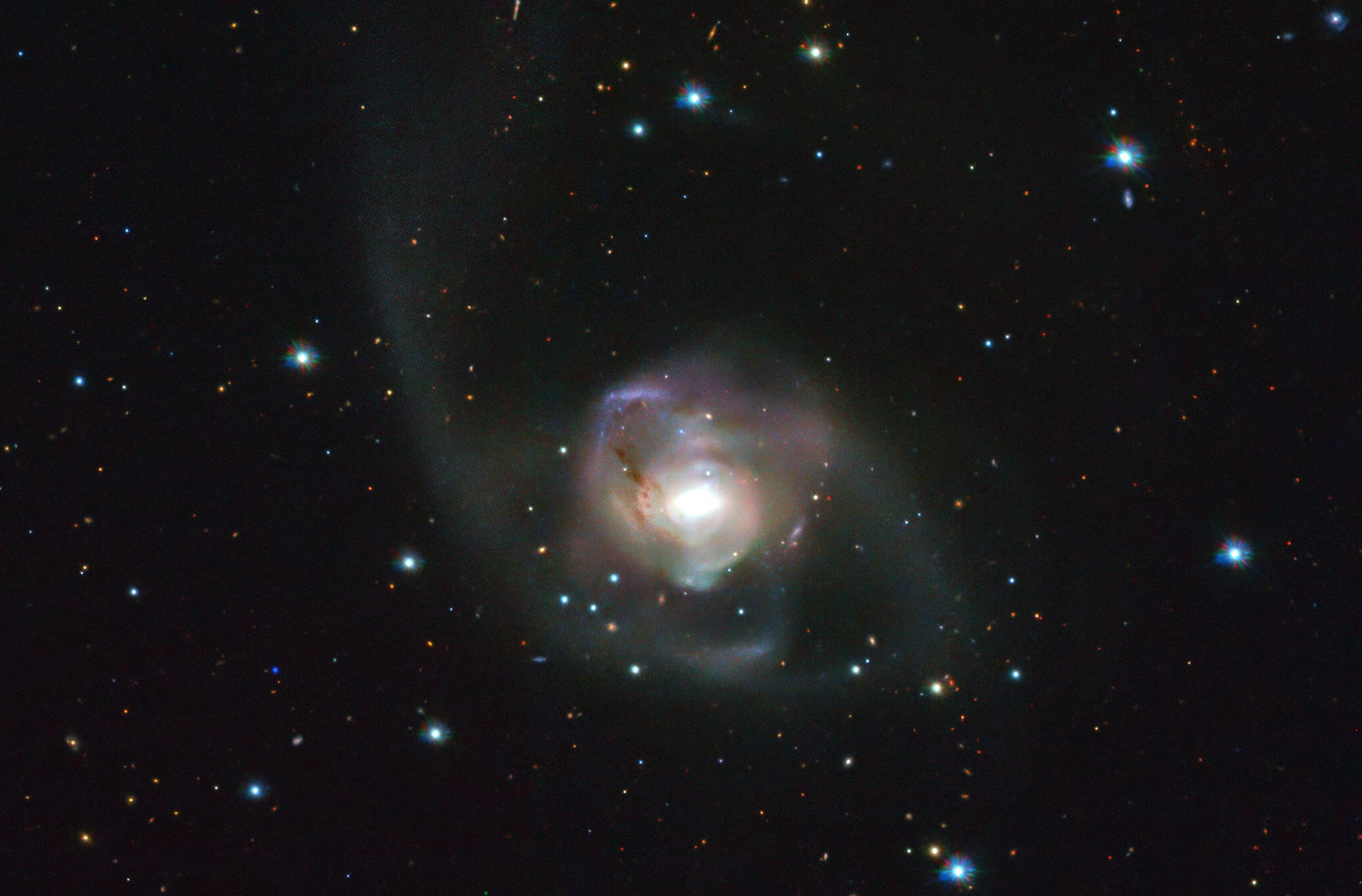
The galaxy NGC 7727 shows extended spiral arms: likely the aftermath of a recent major merger between two comparably massive galaxies. The presence of two supermassive black holes inside this galaxy, as well as the extended streams of gas and stars, show one possible outcome of a major merger of two similar-mass, initially gas-rich galaxies.
Credit: ESO/VST ATLAS team. Acknowledgment: Durham University/CASU/WFAU
While ellipticals occasionally result, the most common merger outcome is another disk galaxy.
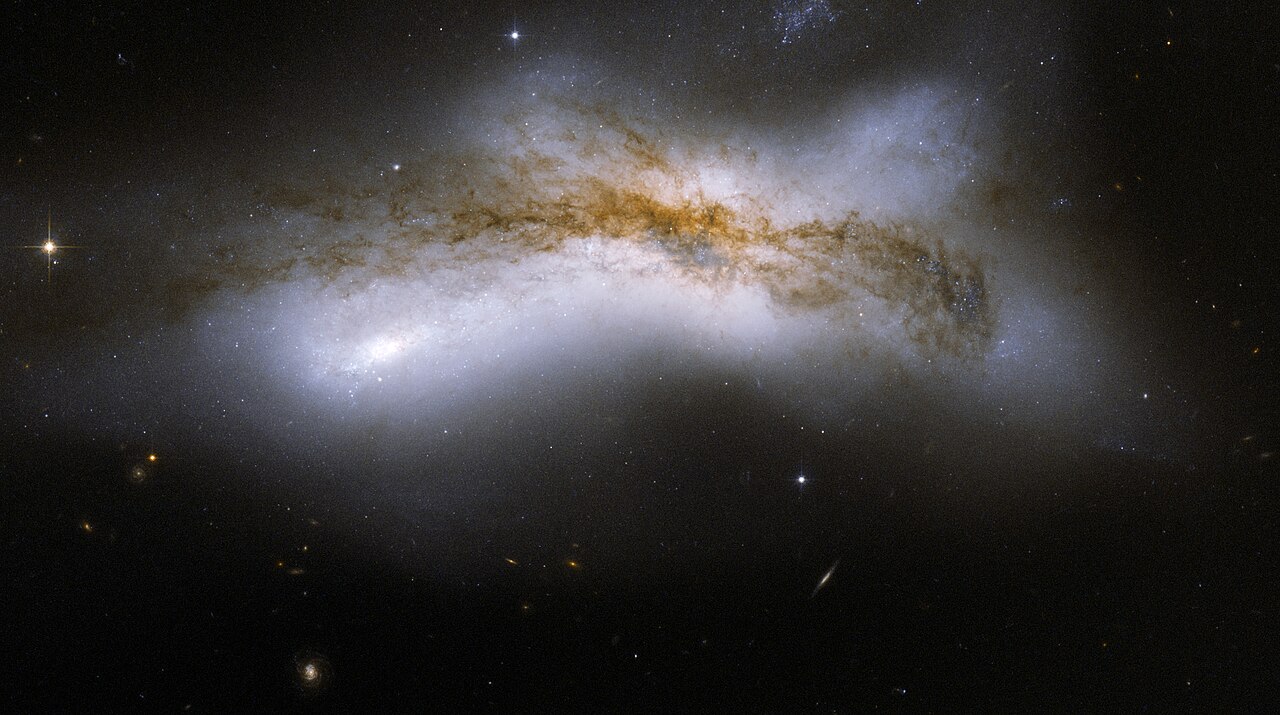
This collection of interacting galaxies, alternately known as either NGC 520 or as Arp 157, shows the early stages of a collision between two formerly disk galaxies that began about 300 million years ago. Collisions such as this typically take 1-3 billion years to settle into an end state, and whether this forms a new disk galaxy (the most common outcome) or a red-and-dead elliptical galaxy (an uncommon outcome) remains to be seen. Whether the gas persists or whether it gets completely consumed and/or converted into new stars will ultimately determine the outcome.
Credit: NASA, ESA, the Hubble Heritage (STScI/AURA)-ESA/Hubble Collaboration, and B. Whitmore (STScI)
Wispy tails often emerge: ejecta that enriches the intergalactic medium.
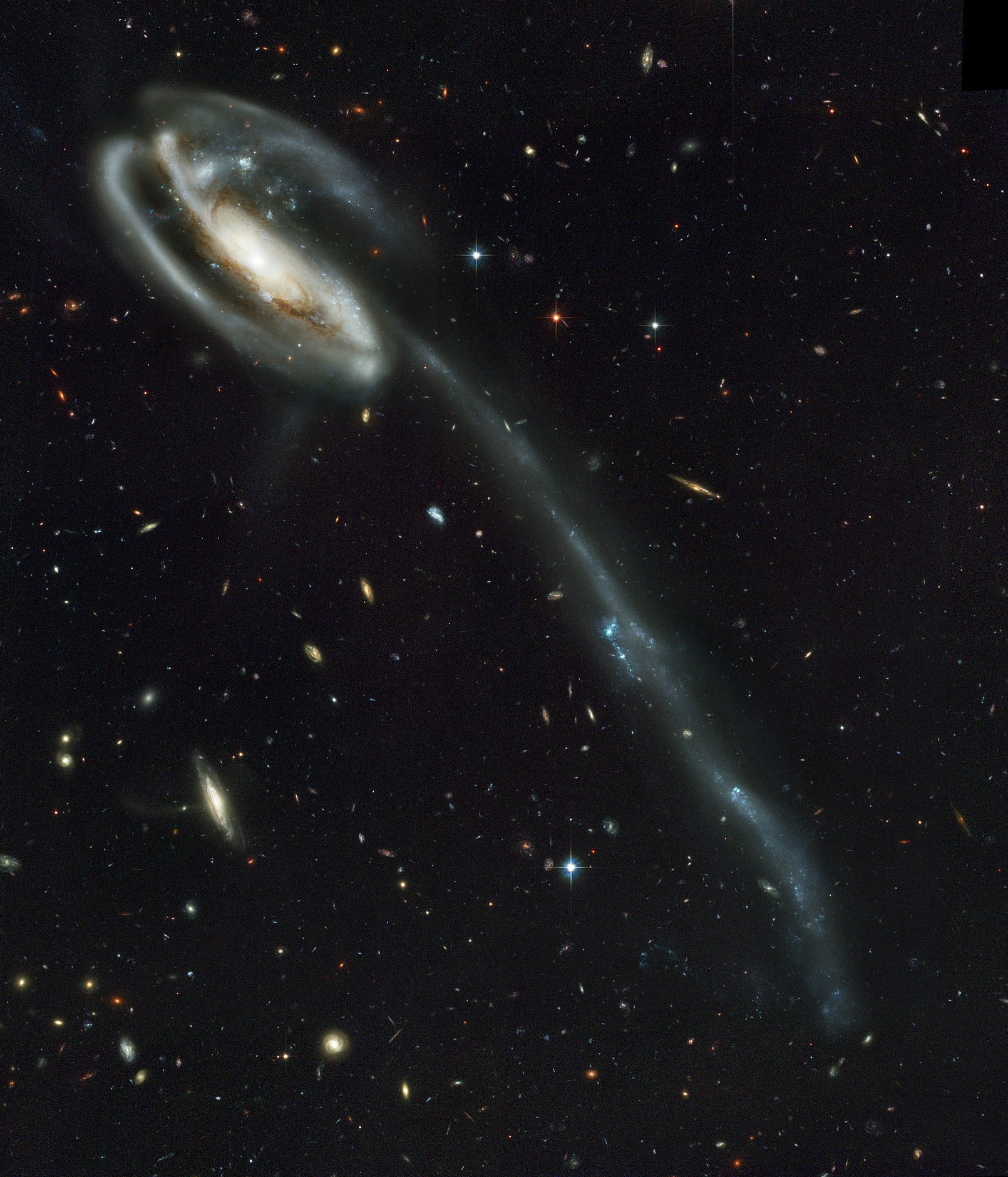
The Tadpole Galaxy, shown here, has an enormous tail to it: evidence of tidal interactions in the past. The gas that’s stripped out of one galaxy gets stretched into a long, thin strand, which contracts under its own gravity to form stars. The galactic element itself is comparable to the scale of the Milky Way, but the tidal stream alone is some ~280,000 light-years long: more than twice as large as our Milky Way’s estimated size. As small galaxies undergo tidal disruption by their larger neighbors, their tightly-bound cores may persist as globular clusters.
Credit: NASA, H. Ford (JHU), G. Illingsworth (USCS/LO), M. Clampin (STScI), G. Hartig (STScI), the ACS science team, and ESA
Only 1-in-10,000 galaxies form rings: the rarest galaxy shape of all.
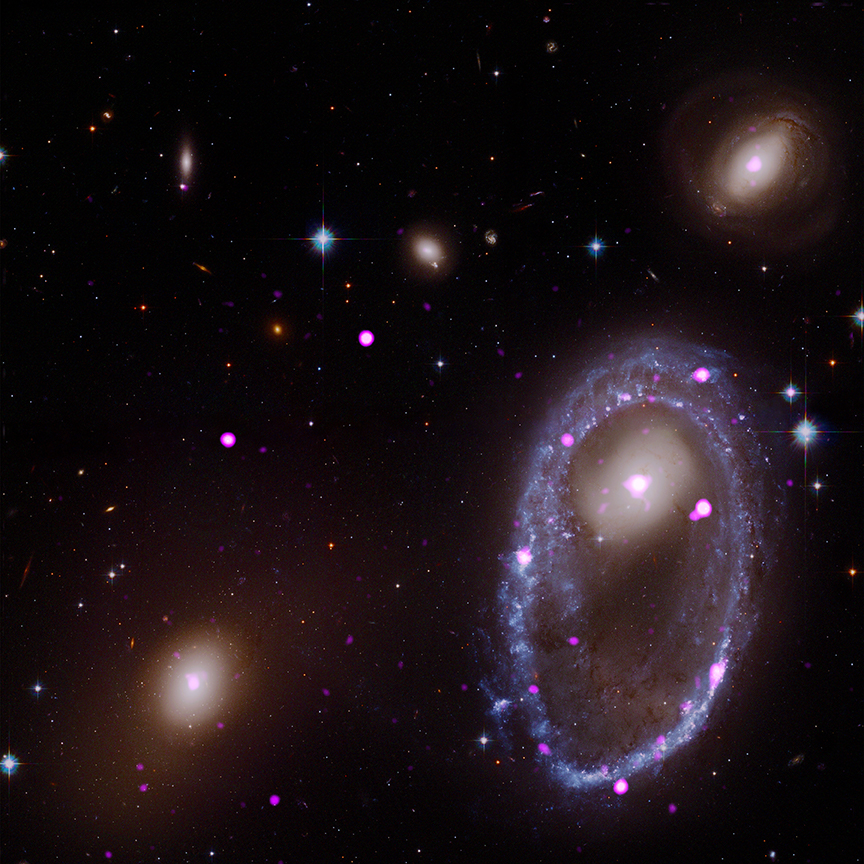
This X-ray/optical composite image shows the ring galaxy AM 0644-741 along with a wide-field view of its surroundings. Below and to the left of this ring galaxy is a gas-poor ellipsoidal galaxy that may have punched through the ringed galaxy a few hundred million years earlier. The subsequent formation and evolution of a ring of new stars would be expected from the propagation of gas away from the center, like ripples in a pond.
Credit: X-ray: NASA/CXC/INAF/A. Wolter et al; Optical: NASA/STScI
Mostly Mute Monday tells an astronomical story in images, visuals, and no more than 200 words.