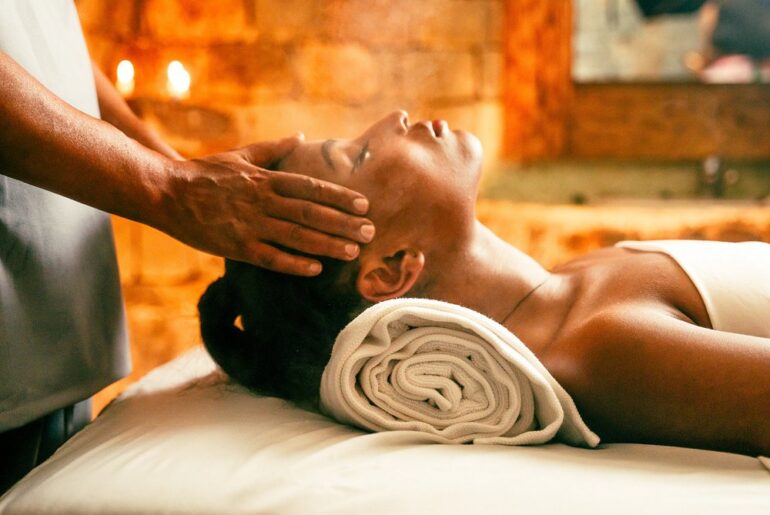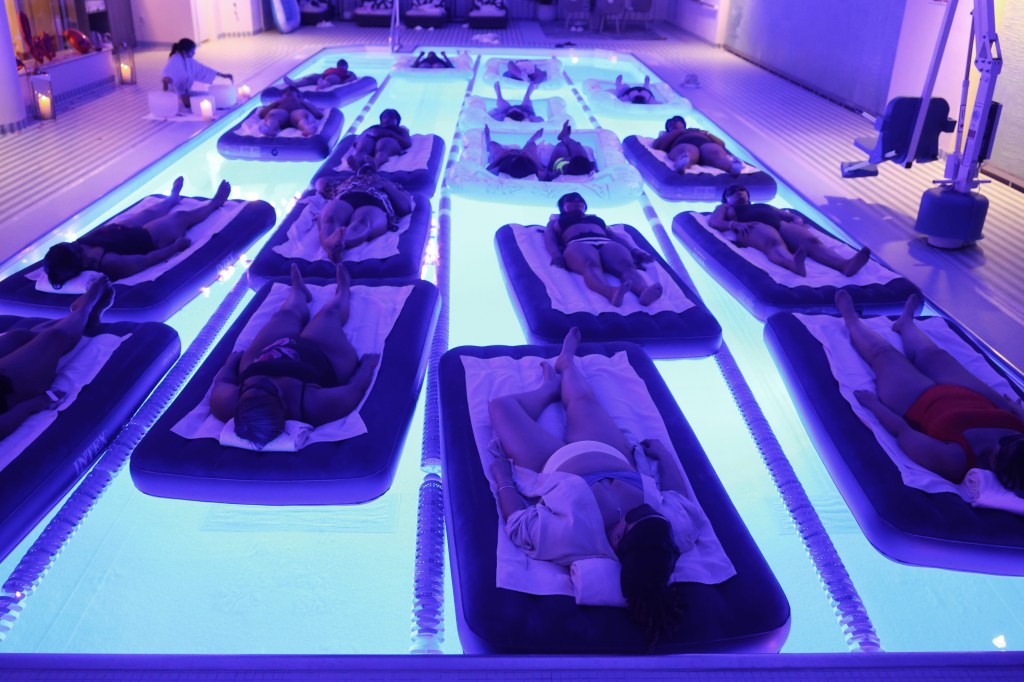
On a Tuesday evening in the Kohler Spa at the Ritz-Carlton in downtown Chicago, a group of around 20 or so people were maneuvering their bodies onto oversized floating beds. In a few minutes, they’ll relax and hopefully enter a restorative meditative state under the guidance of Cherish Hicks, a former special education teacher turned sound healing practitioner.
“I used to teach children, and now I teach adults to relax,” Hicks said. “I’m just up here guiding you. I’m just here to show you a different tool, a different way for you to just get through this life journey.”
Hicks launched her sound meditation brand, Beyond, only a few years ago, but her luxury-oriented environments have become a hit across social media, with a waiting list to attend one of her weekly floating sound meditation sessions. The room, lit with flameless candles and a calming blue light, is the perfect space for folks from all walks of life to decompress in the middle of their hectic work week.
The popularity of her Beyond floating sound meditations speaks to a larger trend of sound healing experiences throughout the Chicago area. Whether taking place in cramped yoga studios or on the serene lawn of the Ravinia Festival in Highland Park, sound healing experiences have become a potent way for audiences to both chill out and get into the zone of good listening.
Sound healing — also known as sound baths, journeys, immersions and meditations — is the use of instruments to move listeners into therapeutic brainwave states. Whether practitioners utilize singing bowls and gongs or synths and chimes, they aim to help participants enter their mind’s “good idea” zone.
“Sound healing is essentially using sound, very literally, to vibrate one’s being,” said Davin Youngs, a musician and the creator of The RESET, a popular immersive sound healing experience. “It’s a pretty fast path to move beyond the thinking mind.”
Many have turned to the transformative power of sound healing because of its ease of entry.
“You don’t necessarily have to have a calmed mind to do it,” said sound meditation facilitator Mecca Perry of Mecca Elevated. “You just have to show up.”
Perry has more than 10 years of personal practice experience and has trained around the world. She has taken her work beyond the studio through a partnership with Healing Arts Chicago, a city pilot program from DCASE and the Department of Public Health to bring sound meditation into mental health clinics — and she’s pursuing a clinical mental health grad program to bring the practice into hospitals and other health care settings.
But sound healing is more than just decompressing. For many practitioners, it’s an extension of their musical and artistic practice. Youngs studied classical voice at the Oberlin Conservatory for Music and has performed at venues like Orchestra Hall, Nashville’s Schermerhorn Symphony Center and The Kennedy Center. He believes his musical background ultimately provides listeners with a more interesting and powerful experience.
“I’m actually only concerned with creating great art, because if I can tap into that spirit, the healing is a natural byproduct of that,” Youngs said.
Everything is improvised in his practice. Youngs live-loops his singing voice using techniques he learned from Bobby McFerrin’s Circlesongs workshops. Later, he adds gongs, singing bowls and tuning forks, as well as his own pre-programmed electronic beats, which he manipulates in real time. He aims to create a one-of-a-kind musical experience that also leads audiences into a welcoming environment for escape.
“It sort of disorients the brain a little bit when you’re hearing sound coming with these different qualities and seemingly from different directions,” Youngs said. “This allows you to let go of your need to focus attention, and it allows for the magic of sound healing to work, where the mind just sort of expands and thoughts, feelings, emotions, dreams, and space start to enter in.”
Thair Thompson, another musician, also credits their musical background with helping establish their sound healing career. Thompson studied jazz voice at Roosevelt University. Their vocal training is the foundation of their somatic and breathwork sound healing instruction, which they teach for kindergarten through third-grade children at Ravinia. Their sessions incorporate chanting and different musical exercises, similar to what Thompson practiced in school. “Just aimed a little differently,” they added.
Hicks begins her sound sessions with breath and guided meditation work before diving into the sound journey. She takes an improvisational approach, with no session sounding the same as the last. She may bounce between a bigger bowl to create a larger vibration and then switch to a smaller one, all in the practice of creating a session that flows together.
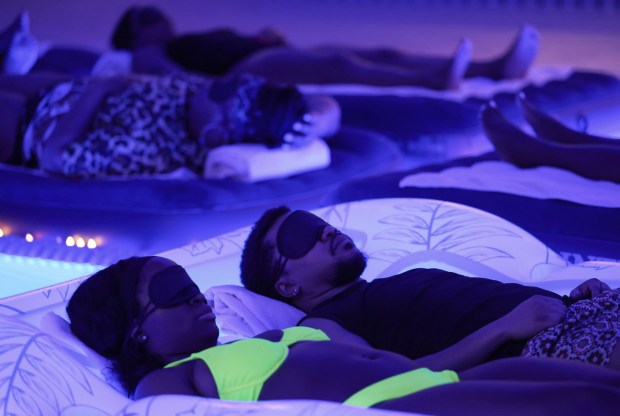 Yele Ajayi, left, and Cameron Dandridge lie on a raft in a pool during a sound healing session with wellness practitioner Cherish Hicks at the Ritz-Carlton spa, Feb. 11, 2026, in Chicago. (John J. Kim/Chicago Tribune)
“It is very intuitive,” she said. “Once you hit those bowls, once we go into that sound session, it’s literally just intuitively playing. And to me, that’s what makes it so special.”
Perry, who has her own studio, Elevated Meditation Studio, takes participants on a journey of sound.
“I like to ease them into the sound,” Perry said about her sessions, which typically begin with chimes and handheld bowls. “There’s various notes that I may use. I may use a D note or F note. And those notes are associated with various energy points within our body. The F note usually activates our self-love, our heart space area. And it just lightens the load, right?”
Later, she builds on her sound, using gongs and ocean drums for deeper states of listening.
“The idea is to create an introduction and then go a little bit deeper within a story and then go a little bit heavier, come back light, and then just end it on a lighter note,” she added.
If all of this sounds a little heady, that is the point.
Although sound healing has existed in some form for decades (if not hundreds or thousands of years), it became a cultural phenomenon around the country and in Chicago within the last few years.
“Without question, COVID was like pouring gas on the fire,” Youngs said about sound healing’s rising popularity. The destabilization of the pandemic and its social and cultural isolation drove folks of all ages and backgrounds to discover new tools for self-regulation. And while screen addiction became entrenched in many of our lives, sound healing became an alternative practice for folks looking for an escape from doomscrolling.
In providing that space for both music and wellness, sound healing brings audiences into a collective world for escape from both the external strife of the world and their own messy interiority.
“I turn on the news. It’s stressful. I go to work. It’s stressful,” Hicks said. “I just want to find some peace.”
Youngs agreed, adding: “People want desperately to set their phones down. They want desperately to be in connection, but it’s hard to create space in your life for that.” Gathering people’s attention requires complete immersion, and sound healing does just that.
The ongoing popularity of sound healing also speaks to a larger cultural shift toward immersive experiences. Younger audiences, especially millennials and Gen Z, who are fueling the growth of sound healing, are looking for ways to connect with other people that don’t involve extra late nights and copious amounts of substances.
It’s no surprise that major sound healing sessions have begun to find a home here in Chicago, where Midwestern sincerity and urban practicalness reign supreme. Many Chicagoans see sound healing sessions not as woo-woo, but as a part of one’s toolkit for well-being.
“I always say that doesn’t mean we are ignoring what’s going on outside, but we are simply allowing ourselves to get through it,” Hicks added.
Rather than framing sound healing as a trend, its rise in popularity speaks to a deeper cultural understanding of what healing can look like. Chicagoans, in their practical and grounded approach to life, may have found one more way to gather folks from all walks of life and let them exhale.
“This is actually where the art is,” Thompson added about using the practice for healing over performance. “This is where the heart and the art of this medium is.”
Britt Julious is a freelance critic.