Global alliances like the Global Roundtable on Marine Ingredients are proving essential to improving sustainability in the fishmeal and fish oil sector by aligning stakeholders, strengthening fisheries management, and maximizing the value of marine resources.
At the Marine Ingredients Innovations session, held on March 3, 2026, at the North Atlantic Seafood Forum (NASF) in Bergen, the role of marine ingredients in fish growth and welfare was discussed.
“Innovation is happening at a technical and nutritional level, with hidden value being explored. But it is also happening at the social and governance levels, with new alliances being formed to protect local livelihoods and regulations being strengthened to safeguard the biomass,” Petter Martin Johannessen, IFFO’s Director General, highlighted.
“Responsible sourcing of raw materials is well recognized as driving sustainability in the aquafeed sector,” IFFO said, citing a recent peer-reviewed article. It is the willingness to increase the availability of responsibly sourced marine ingredients and drive positive change in key fisheries globally that led IFFO and Sustainable Fisheries Partnership to create the Global Roundtable on Marine Ingredients in 2021, alongside value chain stakeholders.
Global Roundtable drives change in key fisheries
Although its ambition is long-term, the Global Roundtable on Marine Ingredients was quickly recognized (by the World Economic Forum and Science Advances) as providing a single value chain contact point to address environmental and social challenges in the fishmeal and fish oil sector.
The Global Roundtable on Marine Ingredients started with West Africa, where the fishmeal and fish oil were expanding rapidly. “IFFO is a membership association representing marine ingredients stakeholders who have joined voluntarily. Members producing marine ingredients make up 50% of global volumes. As IFFO does not have members producing fishmeal and fish oil in the region, there was a need to engage with the value chain and understand the region’s socio-economic dynamics”.
The West African subregion faces declining fish stocks due to overfishing and climate change, as well as economic competition and shifting consumer preferences. The region needs strengthened regional institutional cooperation.
Mauritania case highlights impact of coordinated action
In the fisheries sector, Mauritania’s cooperation with the EU dates back to the late 1980s. The current Sustainable Fisheries Partnership Agreement between Mauritania and the EU sets the terms for European vessels operating in Mauritanian waters and the management of fish resources. However, the main export market for the country’s fishmeal is not Europe but China.
In Mauritania, the expansion of fishmeal and fish oil factories led to overcapacity. Alongside other stakeholders, the Global Roundtable on Marine Ingredients engaged with Mauritania’s authorities and contributed to a consultation to design a national management plan for small pelagics. This plan, which came into force in November 2022, led to the implementation of new fishing zones and made it mandatory for vessels and factories to be equipped with freezing units.
Export data from 2025 showed that exports of fresh and frozen products from Mauritania increased (from 594,000 tonnes in 2020 to 677,000 tonnes in 2024), while fishmeal and fish oil production more than halved between 2020 (165,000 metric tonnes) and 2024 (66,000 metric tonnes).
Fishery improvement projects strengthen data and governance
Before the Global Roundtable was set up, the value chain had initiated a Small Pelagics Fishery Improvement Project (FIP) in Mauritania, involving a wide range of companies and partners. Its aim is to improve practices and enhance the management of fisheries, and ultimately meet the standards required by the Marine Stewardship Council (MSC) and MarinTrust.
The FIP was accepted within the MarinTrust Improver Programme in 2019. It has focused on working with scientists to improve data collection on the fishery, landings and stocks, in order to improve the knowledge of stock status and hence enable management to make informed decisions. The FIP has supported data collection on board, at landing sites and in the participating factories. It has also contributed to the national fishery management plan and encouraged strengthened collaboration with neighboring countries to achieve coordinated stock management, particularly for sardine and sardinella, which are shared with Morocco and Senegal. The FIP is currently working on a social component to ensure the fishery has a positive social impact as well as an environmental one.
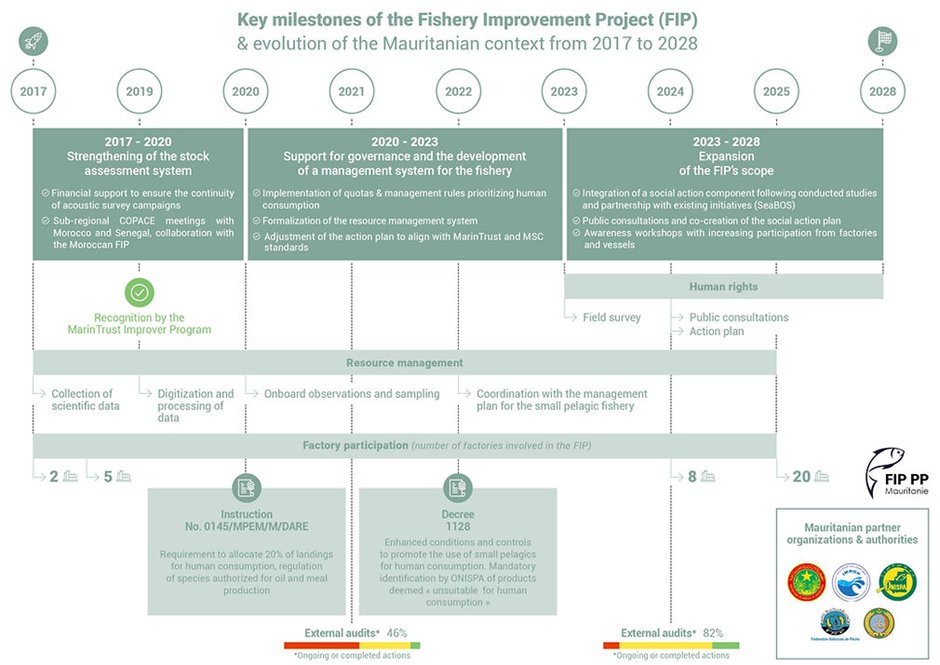
Source: The Small Pelagics FIP in Mauritania
The FIP’s social component is building on a human rights impact assessment, which the Global Roundtable on Marine Ingredients commissioned to a third-party NGO, Partner Africa, in 2022. This assessment was an encouragement for the Global Roundtable to use its leverage to convene stakeholders from the region to share data, align on management measures and infrastructure development.
Maximizing value from marine resources
Small pelagic species are highly seasonal and perishable, requiring rapid processing through freezing or canning when not destined for fresh consumption. In regions where such infrastructure is limited, fishmeal and fish oil production play a critical role in preserving nutrients and maintaining their value within the food chain.
From a global perspective, the majority of fish resources are still directed toward human consumption, accounting for 89% of total use, significantly higher than grains, of which only 38% are consumed as food, according to the 2023 OECD-FAO report.