Report Overview
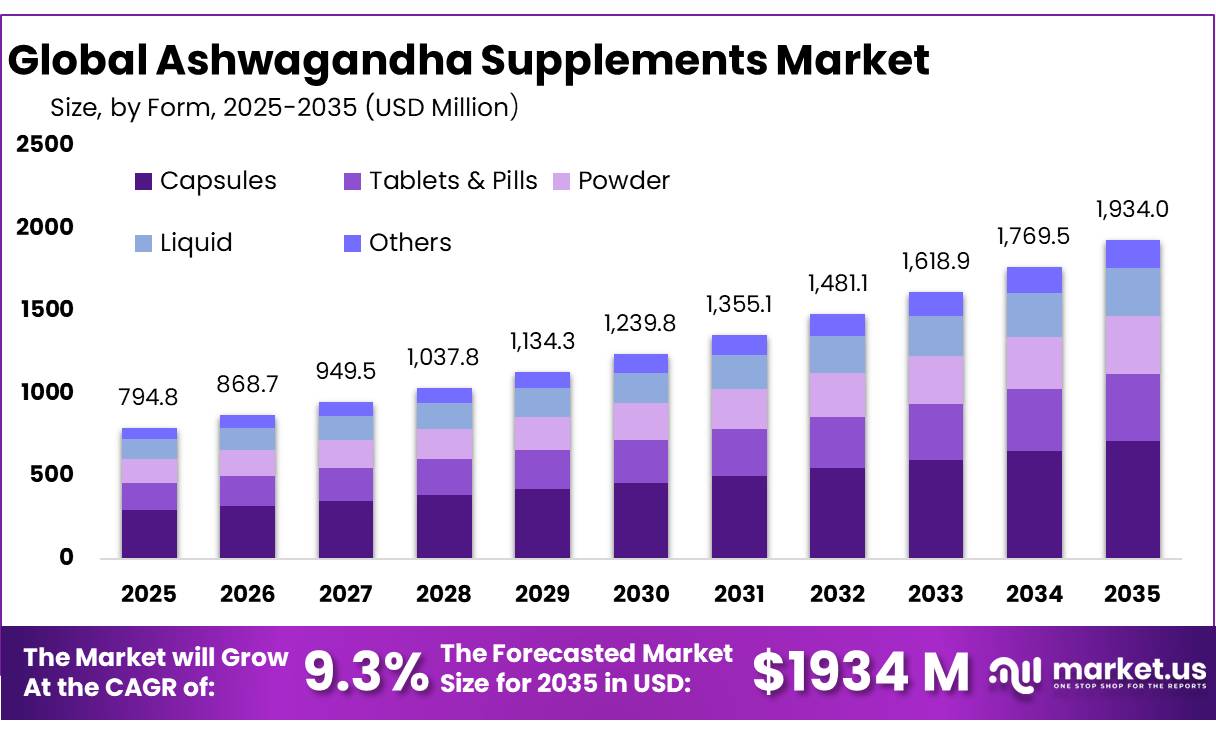
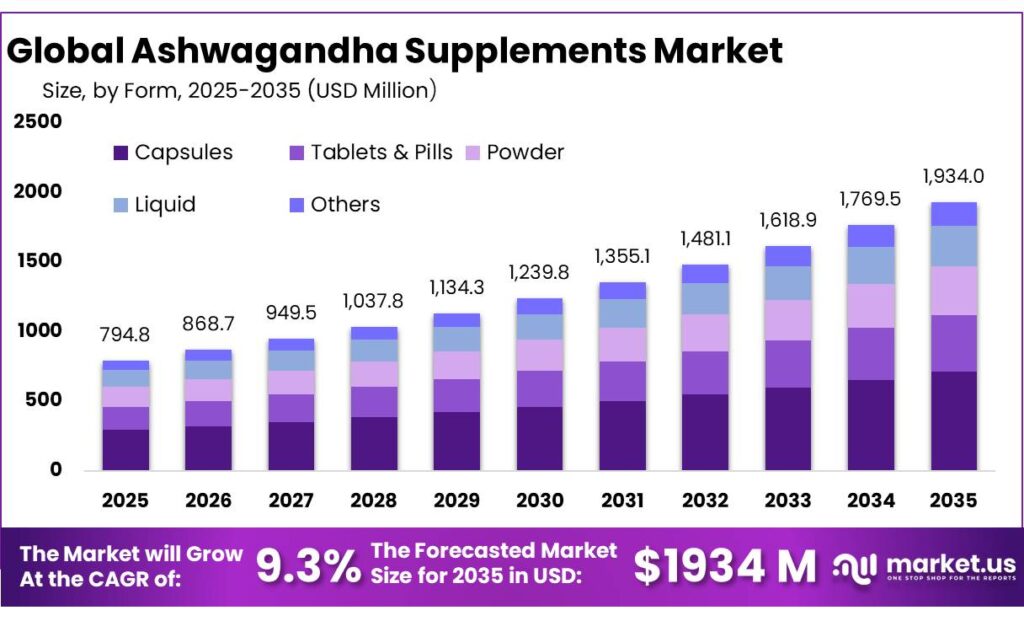
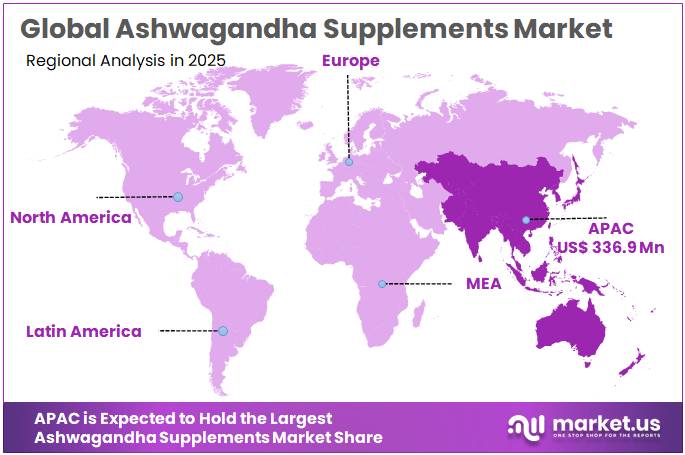
The Global Ashwagandha Supplements Market size is expected to be worth around USD 1,934.0 Million by 2035, from USD 794.8 Million in 2025, growing at a CAGR of 9.3% during the forecast period from 2026 to 2035. In 2025, Asia Pacific held a dominant market position, capturing more than a 42.4% share, holding USD 336.9 Million revenue.
Ashwagandha supplement products occupy a specialized but increasingly visible position within the broader botanical and dietary supplements industry. Ashwagandha, botanically known as Withania somnifera, is widely commercialized for stress, anxiety, sleep, male fertility, and athletic performance support, while most products are marketed in root, leaf, or root-and-leaf extract formats.
In the United States, category relevance is supported by mainstream supplement adoption: the Council for Responsible Nutrition reported that 75% of Americans use dietary supplements, indicating a large consumer base into which adaptogenic products such as ashwagandha can scale. At the evidence level, the NIH Office of Dietary Supplements noted that human studies on sleep used 250–600 mg/day for 6–12 weeks across 372 adults, showing the dosage range that now shapes product design, label standardization, and consumer expectations.
From an industrial scenario perspective, the category is moving from traditional Ayurvedic positioning into regulated, branded, and standardized supplement formats. NOW Foods reflects this transition clearly: the company states that it offers nearly 900 nutritional supplements overall and sells an Ashwagandha product at 450 mg in a pack of 90 veg capsules. Swanson similarly markets Full Spectrum Ashwagandha at 450 mg with 100 vegan capsules.
The main growth drivers are therefore threefold: consumer acceptance, clinical relevance, and policy support. Clinically, NIH highlights studied dosage ranges of 240 to 1,250 mg/day of extract and notes that ashwagandha is commonly promoted for stress, anxiety, and sleep support. Commercially, the presence of dosage-differentiated products from established brands such as NOW Foods and Swanson indicates that companies are targeting both entry-level users and higher-potency, performance-oriented buyers.
On the regulatory and supply side, India remains strategically important because it anchors Ayurveda-linked ingredient legitimacy and policy support. The National Medicinal Plants Board states that it supports growth of medicinal-plant trade, export, conservation, and cultivation. Under its central sector scheme, support norms include ₹20,000 per hectare for setting up medicinal plants conservation and development areas, with an average area coverage of 200 hectares.
Key Takeaways
Ashwagandha Supplements Market size is expected to be worth around USD 1,934.0 Million by 2035, from USD 794.8 Million in 2025, growing at a CAGR of 9.3%.
Capsules held a dominant market position, capturing more than a 37.9% share.
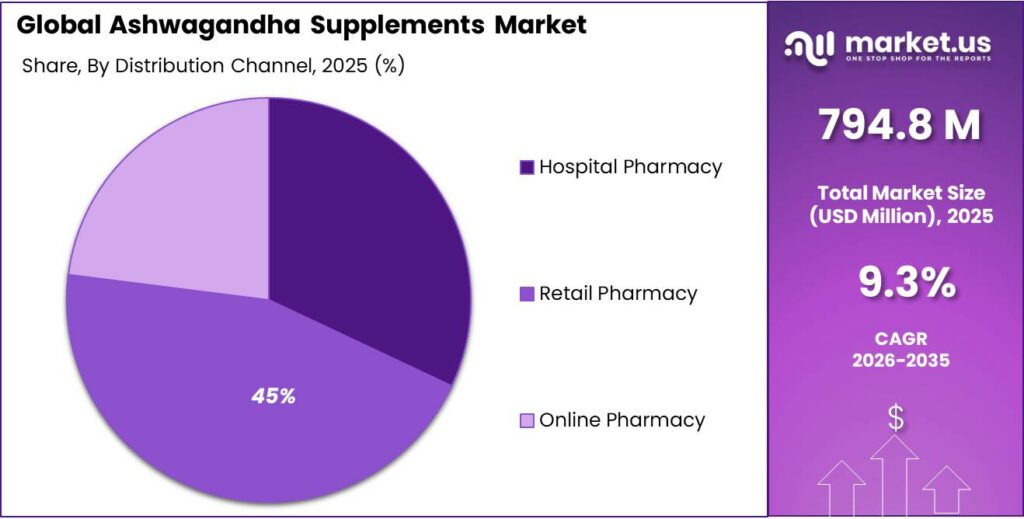
Retail Pharmacy held a dominant market position, capturing more than a 45.6% share.
Asia Pacific emerged as the dominant region in the Ashwagandha Supplements Market, accounting for 42.4% share and reaching nearly USD 336.9 Mn.
By Form Analysis
Capsules dominate with 37.9% share due to convenience, accurate dosing, and strong consumer preference
In 2025, Capsules held a dominant market position, capturing more than a 37.9% share in the ashwagandha supplements market by form. This strong position was mainly supported by the convenience capsules offer to everyday users. Consumers increasingly preferred capsule-based supplements because they are easy to carry, simple to consume, and fit naturally into daily wellness routines. Unlike powders or liquid forms that may require measuring or mixing, capsules provide a fixed dosage, which builds confidence among users looking for consistency in their intake. This ease of use made capsules especially popular among working professionals, fitness-focused consumers, and individuals adding herbal supplements into busy lifestyles.
By Distribution Channel Analysis
Retail pharmacy leads with 45.6% share driven by trust, easy access, and pharmacist guidance
In 2025, Retail Pharmacy held a dominant market position, capturing more than a 45.6% share in the ashwagandha supplements market by distribution channel. This leading position was largely supported by strong consumer trust in pharmacy-based purchases, especially for health and wellness products. Many buyers preferred retail pharmacies because they associate these outlets with product authenticity, proper storage conditions, and dependable quality. The availability of trained pharmacists and store staff also helped consumers feel more confident when choosing ashwagandha supplements for stress relief, sleep support, or general wellness needs. This trust factor played a major role in keeping retail pharmacies ahead of other sales channels throughout 2025.
Key Market Segments
By Form
Capsules
Tablets & Pills
Powder
Liquid
Others
By Distribution Channel
Hospital Pharmacy
Retail Pharmacy
Online Pharmacy
Emerging Trends
Gummies and functional wellness drinks are the latest trend shaping Ashwagandha supplements
One of the latest trends in the ashwagandha supplements market is the fast shift toward gummies, powders, and functional wellness beverages. Consumers in 2025 and 2026 are moving away from only traditional capsules and tablets and choosing more lifestyle-friendly formats that fit daily routines. Gummies are becoming especially popular among younger consumers because they are easy to consume, taste better, and feel closer to a wellness snack than a supplement.
Stress-relief drink mixes, bedtime beverages, and adaptogen lattes with ashwagandha are gaining strong traction in urban wellness markets. India’s Ministry of Food Processing Industries highlighted this movement in its 2025 nutraceutical sector profile, where functional beverages, mental wellness solutions, and performance nutrition were identified as major emerging trends.
Clean-label and personalized stress nutrition is becoming a strong consumer trend
Another major latest trend is the rise of clean-label and personalized stress-management nutrition. Consumers no longer want only generic herbal products; they are now looking for clinically positioned blends targeted for sleep, women’s wellness, workplace stress, and fitness recovery. This is pushing brands to combine ashwagandha with magnesium, melatonin, mushrooms, or probiotics in customized formulas. A 2026 industry update noted that plant-based formulations, innovative formats such as gummies and functional beverages, and personalized nutrition are among the strongest nutraceutical trends in India.
Drivers
Rising government-backed Ayurveda adoption is a major growth driver for Ashwagandha supplements
In 2025, one of the strongest driving factors for the ashwagandha supplements market is the rising institutional support for Ayurveda and herbal wellness from government and global health bodies. India’s Ministry of AYUSH has continued to expand awareness, research, and commercialization efforts around traditional herbs, making ashwagandha more visible in both domestic and export markets. The government’s continued policy push around evidence-based traditional medicine has helped improve consumer confidence and wider retail acceptance. According to the Ministry of AYUSH’s 2025 report, India now has more than 1,000 registered AYUSH manufacturers in Madhya Pradesh alone, showing how quickly the herbal ecosystem is scaling with infrastructure and production support.
Global trust in traditional medicine is increasing supplement consumption
Another major growth driver is the growing acceptance of traditional and complementary medicine worldwide. The World Health Organization has continued to strengthen its focus on traditional medicine frameworks, helping herbs like ashwagandha gain scientific and regulatory attention across markets. This has encouraged food supplement brands and nutraceutical companies to launch more stress, sleep, and immunity products containing ashwagandha. In 2025, this support became even more visible when global experts discussed ashwagandha safety and therapeutic use at the WHO Global Traditional Medicine Summit in New Delhi.
Restraints
Safety concerns and rare liver-related side effects remain a key restraint for Ashwagandha supplements
One major restraining factor for the ashwagandha supplements market is the growing concern around rare but serious liver-related side effects, which is making some consumers and healthcare professionals more cautious. While demand for herbal wellness products remains strong, safety-related headlines and medical case reports are slowing wider adoption, especially among first-time users and people with pre-existing liver conditions. The U.S. National Center for Complementary and Integrative Health notes that although rare, a number of liver injury cases have been linked to ashwagandha supplements.
Limited long-term clinical safety data reduces confidence in wider use
Another major restraint is the lack of strong long-term human safety data from trusted public health bodies, which directly affects consumer confidence and product recommendations. According to the NIH Office of Dietary Supplements, a 2021 systematic review covering 7 clinical studies and 491 adults found benefits for stress and anxiety, but the trials mainly lasted only 6 to 8 weeks, with doses ranging from 240 to 1,250 mg/day.
This means there is still limited evidence around prolonged daily use, even though many consumers now take ashwagandha as part of long-term wellness routines. The same NIH source also highlights that most reported benefits appear at 500 to 600 mg/day, yet safety beyond short-term use remains less clearly established.
Opportunity
Expansion into functional foods and daily wellness beverages creates the biggest growth opportunity
One of the biggest growth opportunities for ashwagandha supplements is its fast expansion beyond traditional capsules into functional foods, beverages, and daily nutrition products. Consumers now want stress relief and sleep support in formats that feel easy and familiar, such as protein blends, herbal drinks, gummies, nutrition bars, and ready-to-mix powders. A recent industry-backed nutrition report noted that the global nutraceutical market increased from US$500.62 billion in 2025 to US$547.68 billion in 2026, showing how quickly science-backed wellness foods are scaling worldwide.
Government and regulatory support is also making this opportunity stronger. India’s FSSAI and Ministry of Food Processing Industries continue to promote nutraceutical innovation, standardization, and food-based preventive health systems, creating a safer route for branded botanical ingredients to enter mainstream food applications.
India’s nutraceutical innovation ecosystem is opening room for premium Ashwagandha formats
A second major growth opportunity lies in premium delivery formats and personalized nutrition solutions. The nutraceutical industry in India is moving rapidly toward advanced formats such as liquid shots, gummies, dissolvable powders, and clinically standardized herbal blends. This trend directly benefits ashwagandha because the herb already has strong recognition in stress, sleep, and mood support. At Vitafoods India 2025, the industry’s momentum was visible with 136 domestic exhibitors, 23 international exhibitors, and more than 8,000 expected visitors, highlighting how fast innovation partnerships are growing in the supplement and functional food ecosystem.
For ashwagandha brands, this creates room to move into premium science-led categories such as women’s wellness, sports recovery, healthy aging, and workplace stress management. Government-led initiatives around preventive healthcare and nutrition security are also encouraging manufacturers to build evidence-backed botanical products with better traceability and quality systems.
Regional Insights
Asia Pacific dominates the Ashwagandha supplements market with 42.4% share, supported by strong Ayurveda roots and regional manufacturing strength
Asia Pacific emerged as the dominant region in the Ashwagandha Supplements Market, accounting for 42.4% share and reaching nearly USD 336.9 Mn. The region’s leadership is strongly supported by deep cultural acceptance of Ayurveda, easy raw material availability, and large-scale herbal manufacturing ecosystems, especially across India, China, Japan, South Korea, and Australia.
India remains the core growth engine within the region because ashwagandha is widely cultivated, processed, and consumed as part of traditional wellness and preventive healthcare routines. The strong domestic supply chain keeps production costs competitive and helps brands scale across capsules, powders, gummies, and liquid extracts. In addition, the rise of middle-income consumers and growing spending on natural stress-management products further strengthened regional demand through 2025.
Key Regions and Countries Insights
North America
Europe
Germany
France
The UK
Spain
Italy
Rest of Europe
Asia Pacific
China
Japan
South Korea
India
Australia
Rest of APAC
Latin America
Brazil
Mexico
Rest of Latin America
Middle East & Africa
GCC
South Africa
Rest of MEA
Key Players Analysis
Swanson holds a strong competitive position through value-based herbal supplementation and wide online consumer reach. Its KSM-66 250 mg, 60 veggie capsule format remains one of the brand’s key numerical strengths, especially in the stress-support category. The company benefits from aggressive pricing, frequent promotions, and strong direct-to-consumer sales. In 2025, Swanson continues to attract cost-conscious supplement users looking for clinically recognized extracts at affordable price points. Its ability to maintain strong unit sales in the 60-capsule and 120-capsule wellness segment keeps the brand highly relevant in the mid-priced ashwagandha category.
Nature’s Bounty remains a major player due to its strong consumer familiarity in stress and mood support supplements. The company actively uses KSM-66-based 50 tablet and gummy formats, giving it strong numbers in convenience-led wellness. Its product strategy often combines stress relief positioning with broader herbal health branding, which improves repeat buying among lifestyle users. In 2025, the brand benefits from wide supermarket, pharmacy, and digital retail placement, helping maintain strong volume movement. Its focus on clinically studied ingredients, 50-count packs, and mood-support combinations gives it a measurable competitive edge in the premium stress-support segment.
Top Key Players Outlook
NOW Foods
Swanson
KSM-66
Nature Made
Nature’s Bounty
Himalaya Wellness Company
Dabur
Solaray
Gaia Herbs
Four Sigmatic
Recent Industry Developments
In 2025, NOW Foods continued to strengthen its position in the ashwagandha supplements sector through a wide numerical product portfolio and strong global supplement reach. The company’s ashwagandha line is led by its 450 mg Veg Capsules, along with premium KSM-66 capsule variants, allowing it to serve both value and clinically positioned users.
In 2025, Swanson continued to build a strong position in the ashwagandha supplements sector through its value-driven herbal portfolio and clinically recognized extract formats. From a market research perspective, the company’s biggest strength is its clear numerical SKU structure, led by KSM-66 250 mg with 60 veggie capsules, a format widely preferred for daily stress and relaxation support.
Report Scope