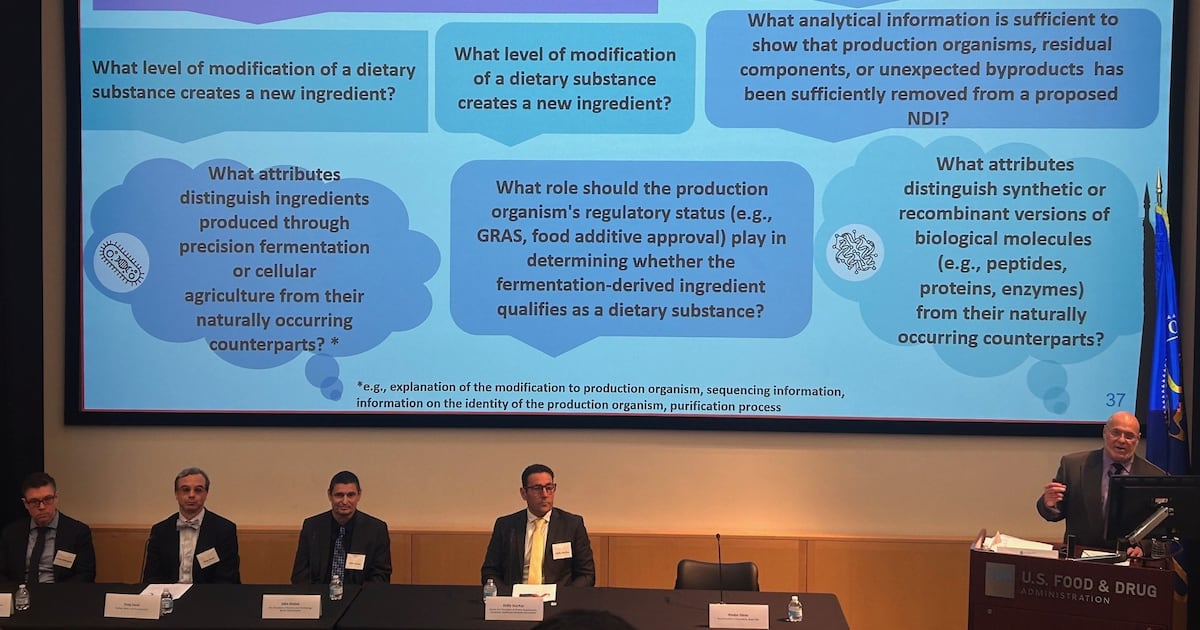
Stakeholders from industry, academia, government and consumer groups met in Washington, D.C. last week for the FDA Public meeting to explore the scope of dietary supplement ingredients.
In his opening remarks, Kyle Diamantas, deputy commissioner for human foods at the U.S. Food and Drug Administration (FDA), told the audience that the dietary supplement industry is a great example of a healthy industry with annual sales that have increased impressively year after year.
The category has grown from approximately $4 billion in 1994 when the Dietary Supplement Health and Education Act (DSHEA) became law to over $60 billion today, he said. FDA estimates that over 75% of American adults use dietary supplements, which reflects a fundamental shift in how Americans approach their own health and wellness.
“We’re interested in taking a hard look at our own regulatory framework,” he said. “The industry has grown and changed tremendously in the last 30-plus years, yet the regulatory framework has largely stayed the same and has not adapted to the change in your level of innovation.”
Diamantas said the agency wants to understand how potential changes to the Generally Recognized as Safe (GRAS) framework would impact dietary supplements, and more specifically, how companies currently navigate the intersection between GRAS determinations for food ingredients and New Dietary Ingredient Notifications (NDINs) for dietary supplement ingredients.
“What challenges do you face in determining the appropriate regulatory pathway for innovative ingredients, and how can we design a system that provides clear guidance while best supporting innovative approaches?” he asked. “We hope to identify concrete opportunities for improving our processes to better serve both public health and innovation.”
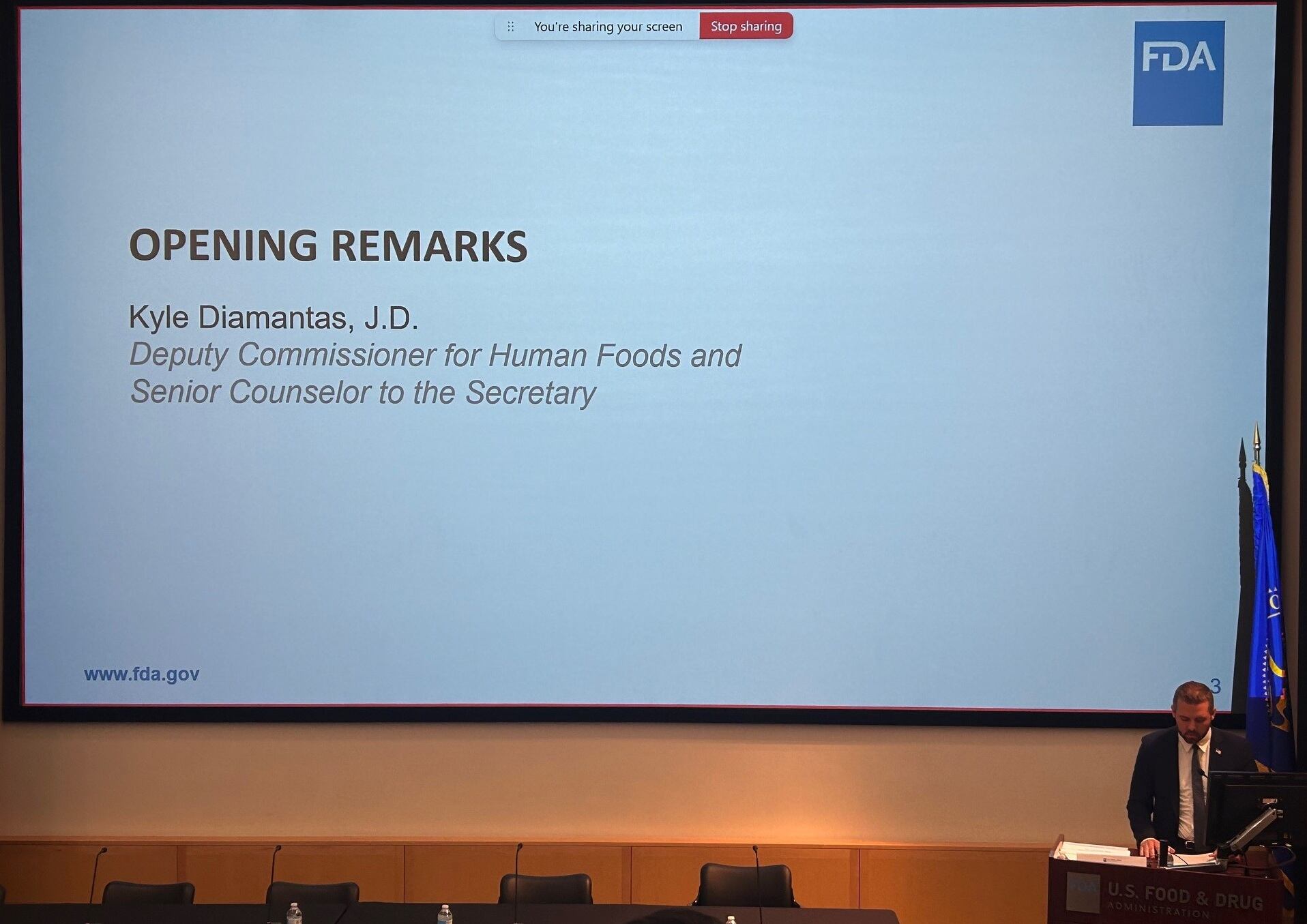 Kyle Diamantas, deputy commissioner for human foods at the U.S. Food and Drug Administration (FDA), delivering his opening remarks at the March 27, 2026 public meeting (NutraIngredients)The definitional question
At its core, the issue is about the definition of a dietary supplement, which can include a “dietary substance for use by man to supplement the diet by increasing the total dietary intake” (Section 201(ff)(1)(E)) and whether this phrase can include substances that have never been part of the diet.
Dr. Cara Welch, director of FDA’s Office of Dietary Supplement Programs, noted that the agency has long maintained that a dietary substance cannot simply be added to a supplement and then could be considered part of the diet.
“That would be a loophole,” she said. “So, we are looking at substances in conventional foods or in foods, and I think for a long time this working definition worked, right?”
Architects of the law have previously argued that this limitation to the food supply was never the intent and that FDA’s interpretation was incorrect.
“We didn’t know what would be invented in the future,” Scott Bass, principal at Scott Bass Life Sciences LLC, told NutraIngredients recently. “We were 100% clear that 201(ff)(1)(E) was the innovation door of DSHEA, but FDA kept it locked until now.”
During open comments at the end of the day, Ivan Wasserman, managing partner at Amin Wasserman Gurnani, quoted a 1995 Supreme Court ruling on consistent usage, which stated that a word or phrase bears the same meaning throughout the statute.
The drafters of DSHEA chose the words “dietary substance” with no mention of the food supply for 201(ff)(1)(E), he said, but those same DSHEA drafters did state in the New Dietary Ingredient part of DSHEA (413(A)(1)) that an NDI notification is not required if the dietary supplement contains “only dietary ingredients which have been present in the food supply as an article used for food in a form in which the food has not been chemically altered.”
“From this, we know that the drafters knew the phrase ‘present in the food supply’, and they chose to use it in 413, and they chose not to use it in 201, opting instead to use the phrase ‘dietary substance’,” Wasserman said. “Therefore, reading ‘dietary substance’ to have the same meaning as ‘present in the food supply’ is against the canon of statutory interpretation that quote a material variation in terms suggests a variation in meaning. It has to have a different meaning.”
Expanding science and production methods
Dr. Daniel Fabricant, CEO and president at the Natural Products Association (NPA) and director of the FDA’s Division of Dietary Supplement Programs during the Obama administration, agreed that no one in 1994 could have anticipated the rapid pace of scientific advances in ingredients and production methods.
“We know lawmakers had a bold vision to make supplements widely available to the American public, because they said so,” he said. “What’s changed the most over the last three decades is, of course, the science.”
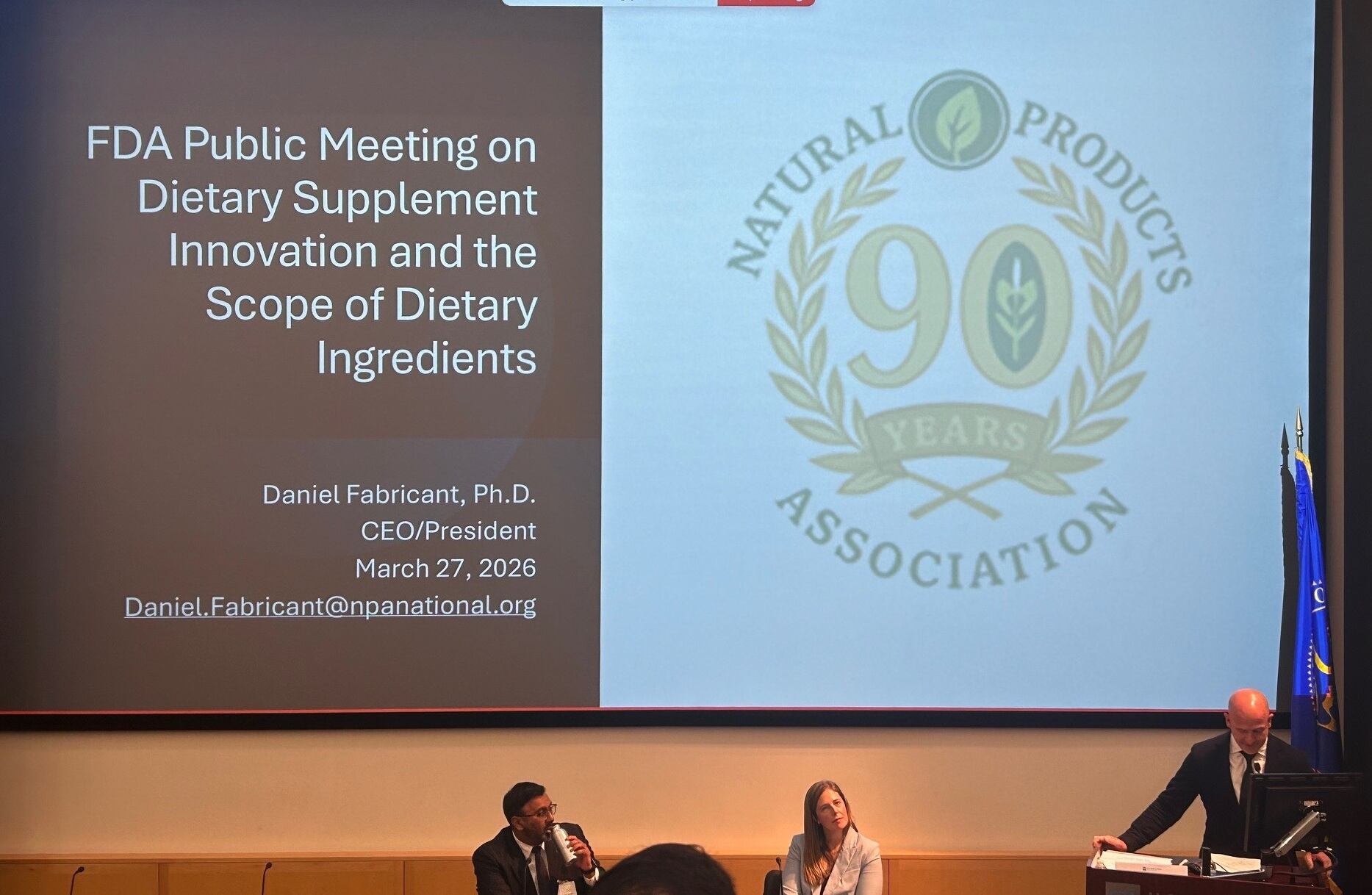 Dr. Daniel Fabricant, president and CEO of the Natural Products Association (NPA) at the podium delivering remarks during the FDA’s public meeting on March 27, 2026 (NutraIngredients)
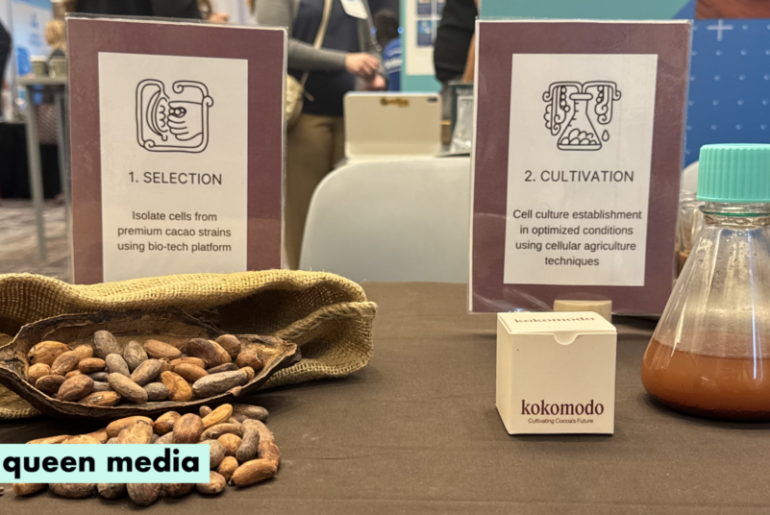
These advances are now opening ways to manufacture existing ingredients using novel methodologies, such as plant cell culture to produce botanical ingredients.
Dr. Weslee Glenn, vice president of innovation at plant cell culture player Ayana Bio, explained that plant cell cultivation is essentially taking a biopsy of a plant or different plant tissue, putting it onto a media, creating a cell line, exposing that to a variety of conditions, scaling it up and producing the exact desired final composition.
“We can produce the same composition every single time for months and years to come,” he said.
In response, the American Herbal Products Association (AHPA) commented that consumers have a right to transparency regarding the origin of their ingredients.
“For example, ingredients that are chemically equivalent to those found in nature, but not actually extracted from botanicals, must not be labeled in a manner that misleads consumers about their source or identity,” said Graham Rigby, president and CEO of AHPA. “This approach encourages technological advancement while protecting the farmers and stakeholders who honor the millennia-long traditions of cultivating and preparing herbs.”
Discussing the rise of precision fermentation as a means of producing ingredients, Anthony Pavel, partner at Keller and Heckman and the current executive director of the Precision Fermentation Alliance, said the manufacturing method should not matter, “if and when the appropriate evaluation has been done on that ingredient and the manufacturing method.”
The Dietary Supplement Health and Education Act was not intended to prohibit advances in science, said Dr. Duffy MacKay, senior vice president of dietary supplements at the Consumer Healthcare Products Association (CHPA). This includes new and evolving ingredients, as well as manufacturing changes that may enhance purity, consistency or improve safety. It does not bar more efficient manufacturing methods or processes that are more environmentally responsible.
Focusing on chemical and enzymatic synthesis, Dr. MacKay highlighted the case of omega-3 advances and how synthesis has enabled higher EPA and DHA omega-3 ingredients to launch onto the market.
“Fish oil in 1994 was mainly fish body oil, cod liver oil squeezed directly from the fish in the natural triglyceride form,” he said. “Fast forward in time and today, we have many concentrated ethyl ester EPA products on the market. These products, when they were developed and people submitted NDI notifications, these notifications focused on the higher amounts of EPA and DHA that would be consumed, and the new chemical form of being ethyl ester. They did not focus on whether ethyl ester fatty acids were already in the diet.”
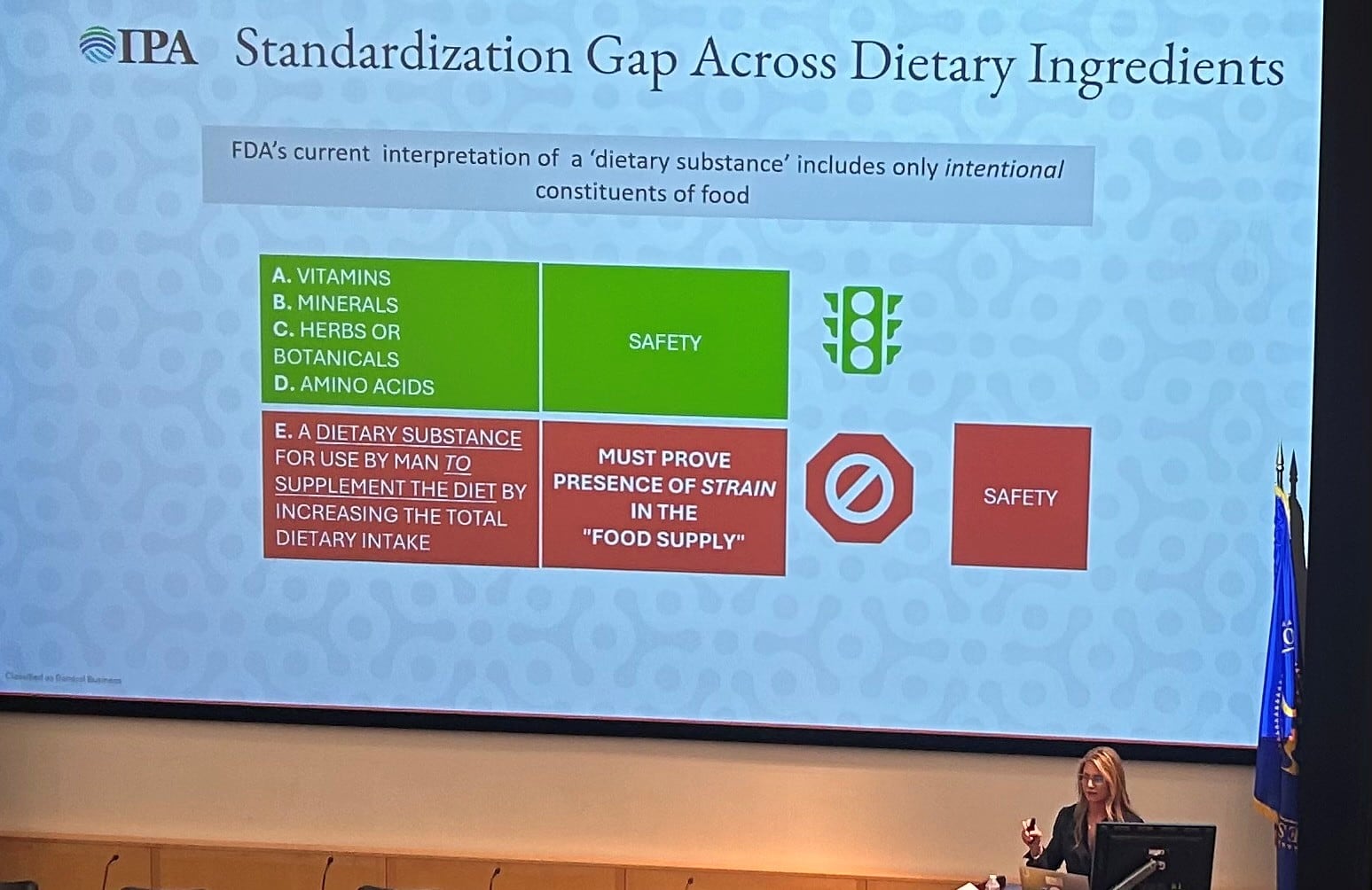 Dr. Amy Smith, senior director of medical affairs for Kerry North America within Pro Access Health and the current president of the International Probiotics Association (IPA), presenting at the FDA Public Meeting (NutraIngredients)Probiotics, front and center
The last session turned its attention to identity attributes for ingredient types such as proteins/ peptides, enzymes and probiotics (microbials, in FDA terms).
Dr. Amy Smith, senior director of medical affairs for Kerry North America within Pro Access Health and the current president of the International Probiotics Association (IPA), noted that live microbials have a long history of consumption via products such as cheese and beer. Microbials are not mentioned in Section 201(ff)(1)(E), Dr. Smith said, adding that probiotics were not defined until 2001.
“The ask is for ‘dietary substance’ to include those substances that are appropriate for use in dietary supplements, and this would recognize subpart E as it was intended to be an innovation clause,” she said. “The second half is for a technical amendment to list probiotics as a recognized dietary ingredient within subpart E of 201.”
Incentivizing the NDI process vs ‘secret’ GRAS
While the majority of the speakers at the meeting were industry stakeholders and singing from the same hymn sheet, Jensen Jose, regulatory counsel at the Center for Science in the Public Interest (CSPI), struck a different tone.
He noted that although the goal to expand the definition of dietary substances to include ingredients like peptides, proteins, enzymes and microbials is in line with Secretary of Health and Human Services Robert F. Kennedy’s efforts to challenge the FDA’s stance toward alternative medicine, stem cells, vitamins and peptides, this could result in risky and fraudulent products hitting the market.
According to Jose, such a system would also stifle drug innovation. As more ‘drug-like chemicals’ enter the market as supplements, there would be less incentives for companies to embark on the extensive and expensive research programs necessary to achieve drug approval.
“We need these experimental drugs to go through the FDA drug approval process,” he said. “Through GRAS [self-affirmation], any chemical can become a dietary ingredient without FDA’s knowledge. FDA needs to know what chemical ingredients are in dietary supplements.”
“I don’t think that industry will stop using GRAS just because FDA expands the scope of ingredients,” he added. “Regardless of the scope, this loophole needs to be closed. If and when FDA releases its proposed GRAS rule, the agency should be clear that GRAS is not the appropriate pathway for new dietary ingredients.”
Responding to the CSPI’s statements, Robert Durkin, partner at Amin Wasserman Gurnani and former deputy director at FDA’s ODSP, said: “It seems pretty clear that you don’t think that substances that are not in food supply should qualify under 201(ff)(1)(E). And then I heard you say that GRAS should be reformed to exclude things like probiotics, enzymes and proteins. If you did that, you would eliminate a pathway to market for those ingredients. They wouldn’t be under (E), and you wouldn’t be able to do a GRAS determination. You cut them out of market.
“The other thing CSPI has been saying is that they don’t like whatever this ‘secret’ GRAS dossier is. If you opened up (E), and you allowed substances into (E) that are not in the diet, they would arguably all be new dietary ingredients. The only way a dietary ingredient can go to the market is to be present in the food supply in a form that has not been chemically altered, which these wouldn’t be, so these ingredients would have to submit NDINs to the agency, and their basis for safety would have to be reviewed. Their basis for manufacturing would be reviewed. Their identity would be reviewed. It would actually accomplish what you say your biggest concern is.”
Comments
A comment period will remain open for 30 days. Electronic comments should be submitted to www.regulations.gov at docket number FDA-2026-N-2047.
In addition, FDA has provided the following Memo to the Docket FDA 2026-N-2047-0001
A recording of the full public meeting can be viewed on YouTube.