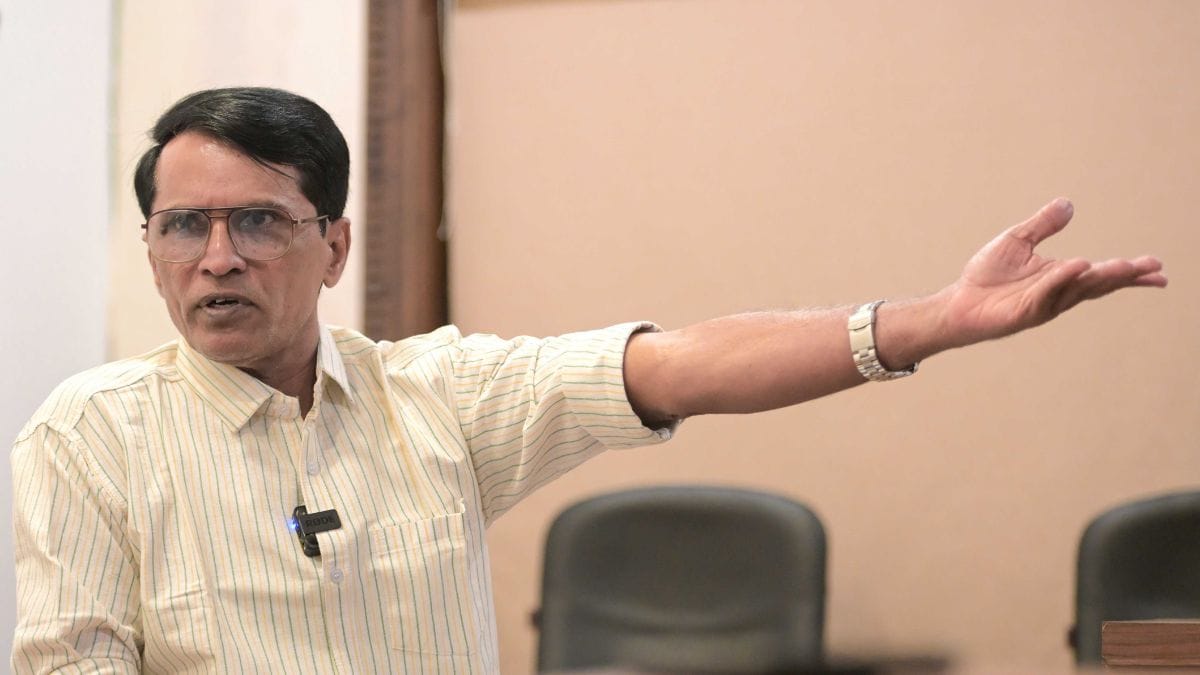
Gadchiroli: Predominance of the military over political leadership, failure to adapt to constant changes in the outside world, and lack of direction were among the broad factors behind the collapse of the Maoist movement in the country, according to former chief of its political wing, Mallujola Venugopal.
In a detailed interview to ThePrint, Venugopal—who also went by the names ‘Abhay’ and ‘Sonu’ during his time with the outfit—said the movement had departed from the foundational principle that the political party would guide the actions of its military wing.
“The developments in the world were on one side, and we were on the other side. We were going contrary to the developments in the world, and it has resulted in the near collapse of the movement,” he told ThePrint at the Gadchiroli district police headquarters, where he has been residing under observation of Maharashtra Police.
Show Full Article
The police headquarters is in the heart of town, with several annexes, including one housing the elite C-60 commandos whose role has proved to be a decisive factor in state’s anti-Naxal campaigns over the years.
Sonu, along with 60 other Maoist cadres, had surrendered before the Maharashtra Chief Minister Devendra Fadnavis and other senior officials in Gadchiroli district in October last year—the first one in the Politburo to do so.
He is one of the 96 Maoist cadres kept at the police facilities as officials wait for documentation and other processes required for their financial rehabilitation.
“Politics should and must guide the army, but that did not happen. The army had an undeclared control over the party’s decisions which has resulted in the current situation,” he further said.
Sonu added that the economic situation in the country, including regions such as Mar—that includes Bastar—which were previously downtrodden areas, had evolved from a feudal system to a commodity economy.
“I have observed that tribal farmers in Gadchiroli are selling the rice in the market at Rs 30-40 per kilogramme, and they are buying good quality rice after selling the rice they cultivated,” he said. “We had been observing the changes in the world, writing among ourselves and doing analysis about changes in the system in Russia and the United States. However, we have not been able to implement it in the party for evolution.”
“The reality dawned upon me that we cannot proceed with an armed movement in the country anymore because the underlying situations have changed drastically all across the world, including India. For example, the LPG (Liberalisation, Privatisation, and Globalization) policy was introduced worldwide and later adopted in India. We were lagging behind in observing the changes brought about by these policies.”
“We could see the changes, wrote about it in our discussion at the party, but it was never implemented.”
Also Read: Surrender, eliminate, develop: Fall of the Red Corridor, ending 6 decades of Maoist insurgency
‘A 22-page draft’
Far from one of the most underdeveloped areas in the country, where Sonu first appeared as a commander of the banned outfit in 1984, the picture of Gadchiroli has changed quite a bit over the last few decades.
Asked if he wanted to go back to his native, Sonu paused and offered a measured response. “It’s up to the police and their decision-making,” he told ThePrint. He watches the news, reads newspapers, and takes a keen interest in developments unfolding in Bastar, Telangana and other parts of the country, not far from his role with the Maoists where he oversaw the formulation of political strategy and analysis of the outside world which required a lot of reading.
Sonu said that his role has evolved since his surrender. He says he is still the face of the Maoist cadres as he helps cadres living with him after surrender in getting to hospital for treatment and talking to the authorities about specific requirements.
His surrender in Gadchiroli came as a life coming to a full circle, as his induction as a Maoist commander took place here. Sonu was the first member of the Politburo to have surrendered before the government in October last year—earning the tag of traitor from his fellow Maoist leader Thippiri Tirupathi or Devujee.
“I have been termed a traitor,” Sonu said, adding that the move saved the lives of so many of the Maoist cadres who were working in his direction. Sonu said that he was not alone in considering the path of surrender, and there were several at his level but they faced a dilemma of who would take the unpopular step at the time.
Sonu said that he had been considering the direction the movement was heading since 2004, a few years after the Communist Party of India (Maoist) formed a full-fledged military unit called the People’s Liberation Guerrilla Army (PLGA). He further said that he had a fundamental disagreement with Devujee over the point of the changes happening in the outside world. “His view was contrary to mine that things have changed drastically, and he always maintained that the basic issues had still not been resolved.”
Sonu was the spokesperson for the political wing of the outfit and was pitted for the general secretary role in the wake of the encounter of Basavraju in May 2025. However, as his inclination for became public, it led to a split in the party with Devujee and leaders aligned with his approach on one side and Sonu and other cadres on the other.
(Edited by Nardeep Singh Dahiya)
Also Read: Basavaraju, Sonu, Devuji: How Maoist top leadership was whittled down after Amit Shah set deadline