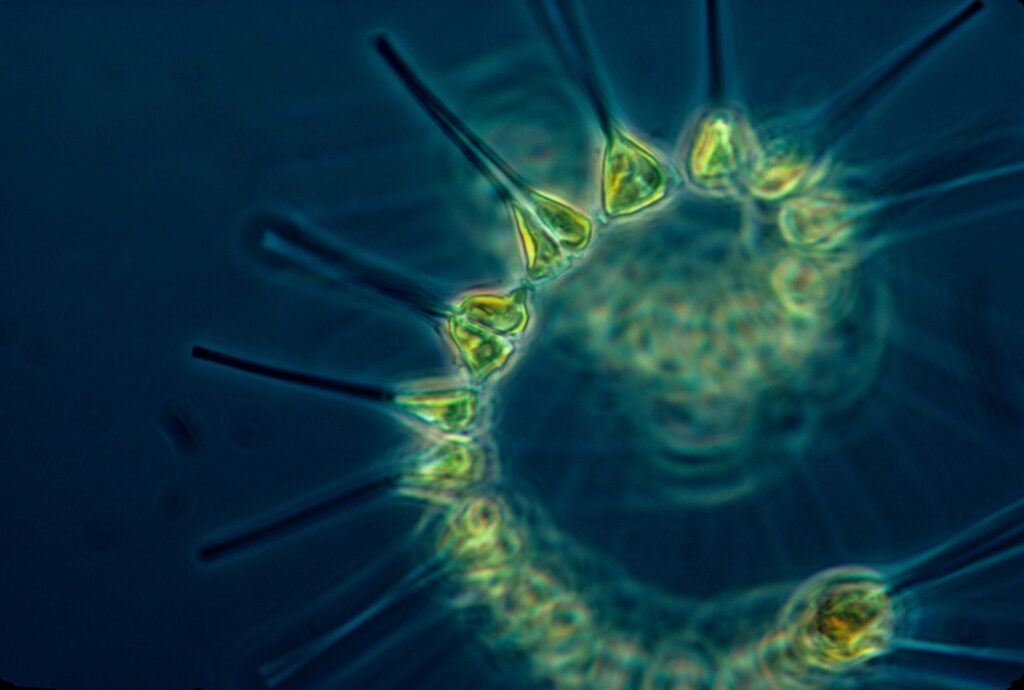
Phytoplankton, the microscopic algae that form the foundation of almost all marine food chains, will undergo a significant shift in nutritional quality as the ocean warms, according to new research published in Nature Climate Change.
New research published in Nature Climate Change by scientists at the Massachusetts Institute of Technology has found that rising ocean temperatures will significantly alter the nutritional composition of phytoplankton, with consequences that could ripple through the entire marine food web.
Using a model that simulates phytoplankton composition in response to changes in ocean temperature, circulation, and sea ice coverage, the team found that under a scenario in which greenhouse gas emissions continue unchecked through 2100, the balance of proteins to carbohydrates and lipids in phytoplankton will shift by approximately 20%. The most dramatic changes are projected to occur in polar regions.
At the poles, sea ice currently limits the available sunlight, and phytoplankton have long adapted by producing extra light-harvesting proteins. As that ice retreats under projected warming of 3°C, those adaptations become redundant.
Protein levels in polar phytoplankton could decline by up to 30%, replaced by carbohydrates and lipids. Lead author and MIT postdoc Shlomit Sharoni describes the trajectory bluntly.
“We’re moving in the poles toward a sort of fast-food ocean,” she says. “Based on this prediction, the nutritional composition of the surface ocean will look very different by the end of the century.”
In subtropical regions, the picture is different but no less concerning. As warming slows ocean circulation, the supply of nutrients rising from the deep will diminish, and phytoplankton populations are projected to fall by as much as 50%. Those that remain may become slightly more protein-rich, but the sheer reduction in population will compound the global decline in nutritional value.