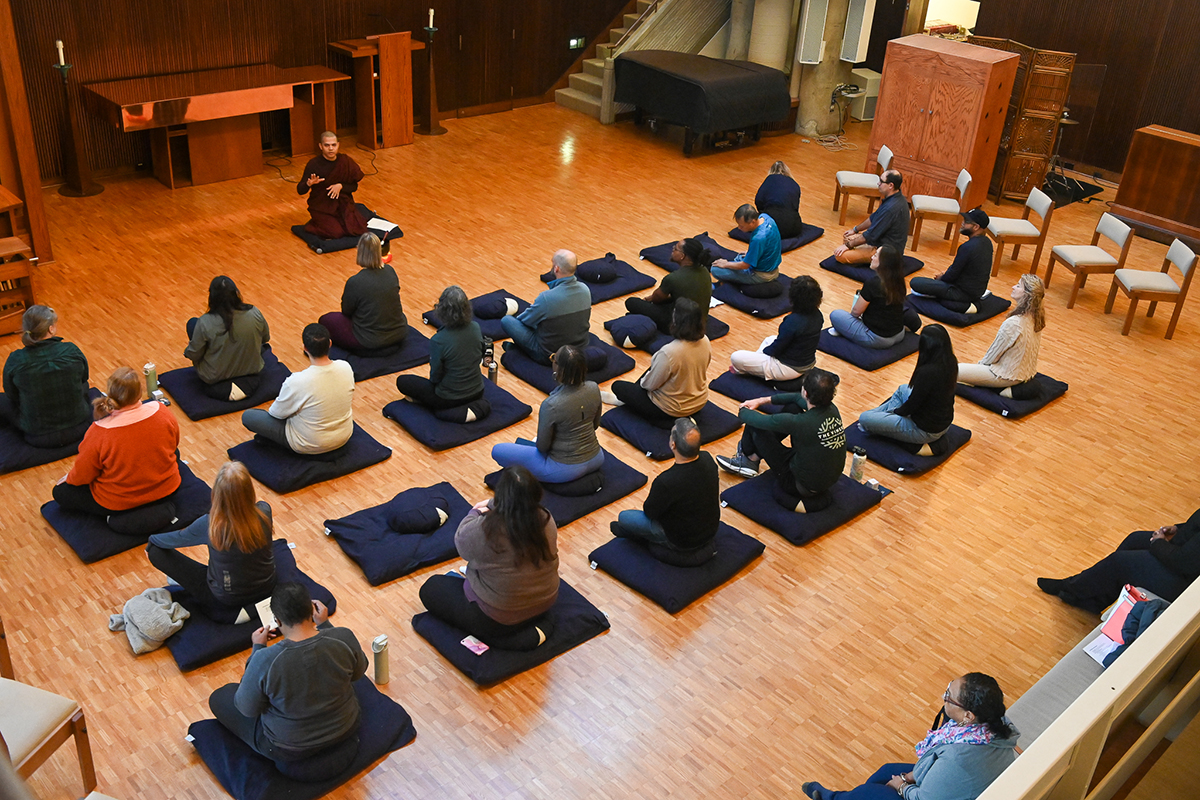
Emory junior Vidhi Tiwary sat calmly at the front of Cannon Chapel as four dozen faculty and staff members mirrored her pose on their yoga mats. The room was filled with a contemplative silence.
“It’s about a sense of focus between your mind, body, breath and environment,” Tiwary says of her yoga instruction. “That starts at a molecular level. I encourage everyone to be aware of each conscious movement and to focus on a certain body part — the way their neck moves, or their elbow or ankle.”
Tiwary, a business major from the Atlanta area, was the only undergraduate student serving as an instructor during the first MindfulEmory Faculty and Staff Retreat in February. Nearly 50 people gathered in the midst of a busy semester to learn and practice methods of mindfulness at Cannon Chapel.
The new MindfulEmory initiative, which represents more than 10 partner offices across the university and is convened by the Emory Office of Spiritual and Religious Life, organized the gathering.
The yoga session was one of 12 events throughout the day, and Tiwary, who is Hindu, was able to infuse the event with her cultural background.
“I led a sun salutation series of poses,” she says, “and in Hindu that’s referred to as suriya namaskar, which literally means saying hello to the sun, but with your movement.
“In Hinduism, yoga is a form of devotion, and it is very connected to meditation and mindfulness,” she adds. “I’ve been practicing since I was seven years old, and it was meaningful for me to share this tradition at the retreat.”
The Rev. Dr. Gregory McGonigle, university chaplain and dean of religious life, is one of the leaders of the MindfulEmory steering committee. He says the goal of the initiative is to connect the many existing mindfulness resources across the university, and to add new ones — like the retreat.
“There have been several important offerings that focus on mindfulness — for students, faculty and staff alike — and we realized that many of us were working toward the same goal but weren’t in regular conversation with one another,” McGonigle says. “MindfulEmory is an endeavor to bring all those offerings together in an interdependent web.”
Now, events put on by various offices — like Monday Mindfulness Circle at the Interfaith Center and the Faculty and Staff Assistance Program’s Midweek Meditation — can be planned and promoted in tandem with one another and will also be as easier to find.
Following the faculty and staff retreat’s success, MindfulEmory is expanding its reach by hosting a student retreat later this spring on April 24. Advance registration is required, and space is limited.
MindfulEmory is also accepting applications for its new Mindfulness Fellows Program, which will officially launch in fall 2026. Selected students will connect their peers with relevant campus resources and incorporate contemplative practices into everyday life at Emory. McGonigle says the role does not require previous meditation experience, only a desire to learn and share with the Emory community.
More information about the student retreat and fellows program — as well as a full list of current programs — can be found on the MindfulEmory webpage.
“As we approach the end of the semester and encounter all the stressors that exams can bring,” McGonigle says, “mindfulness can be an especially useful tool for balance and self-care.”
The science of the mind
Tibetan monks have a special term for a restless brain: the monkey mind.
Andy Kazama, director of undergraduate research and associate teaching professor in the Department of Psychology, is a member of the MindfulEmory steering committee.
He also works with the Emory-Tibet Science Initiative, helping monks publish scientific research on practices aimed at quieting the clangor of the monkey mind.
“Mindfulness practices like meditation can reduce activation in an area of your brain called the amygdala, which is responsible for fear, anxiety and threat detection,” Kazama says. “People who meditate are less emotionally reactive, especially to negative things in life.
“There are also what we call ‘interoceptive’ areas of the brain that allow you to become aware of your own body states,” he adds. “And meditation activates those areas and helps you control them.”
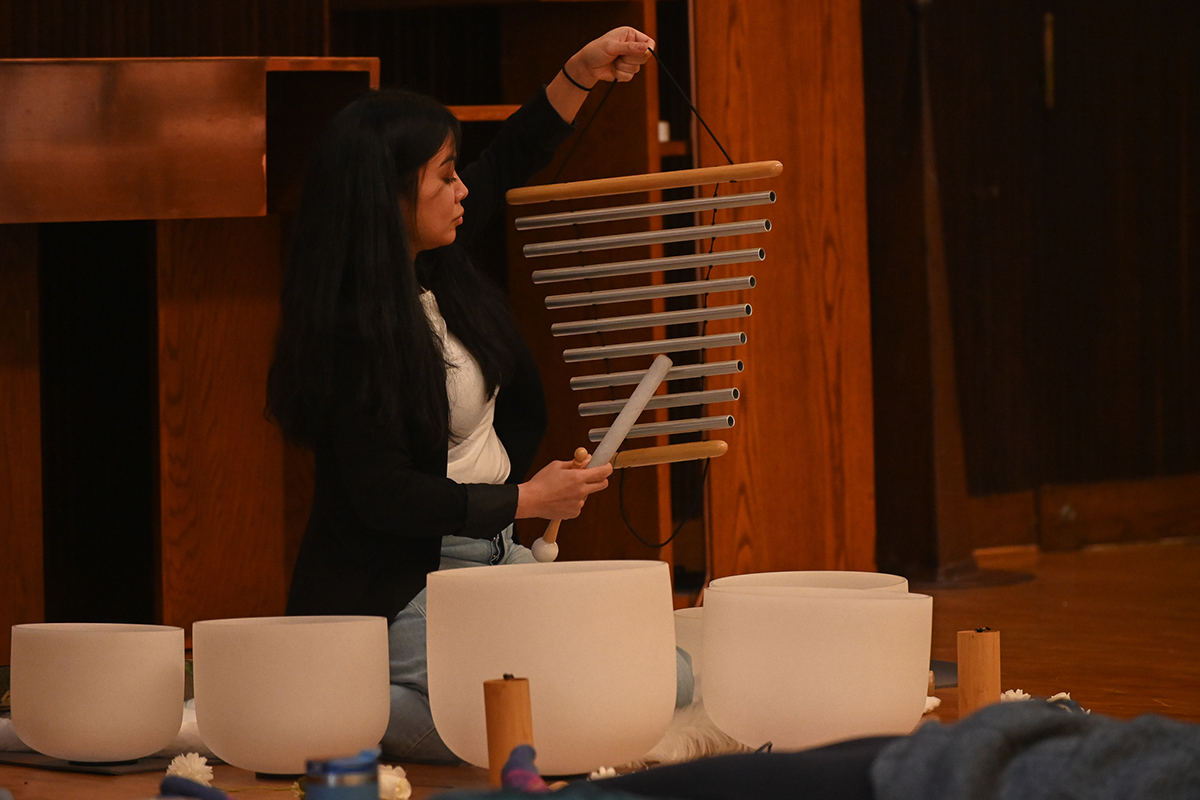 With these benefits in mind, Kazama begins his Labs in Experimental Methods psychology course by gently striking a Tibetan singing bowl with a wooden mallet. The bowls, traditionally made of bronze, have been used for centuries in Himalayan cultures for their calming, resonant sounds that inspire meditative states. Kazama lets the bowl ring and allows for five minutes of silence and contemplation.
“It’s just an anchor for our minds,” he says. “I have my students get into a relaxed, stable posture, then I ring the bowl and have them imagine those soundwaves permeating the room, as the vibrations push out the rest of our day and all we have to do.”
For Ginna Nebrig, a sophomore majoring in psychology and film and media, the singing bowl literally sets the tone for learning.
“Taking the time to recenter my thoughts and intentions for what I want to learn from each class has been beyond meaningful for my education and overall well-being,” explains Nebrig, who is from Charlotte, North Carolina. “It not only calms my busy mind, but it reminds me that I have the privilege of sitting in a classroom every morning and listening to passionate professors speak about topics that are inspiring to me.”
After each experimental methods class, she says she moves through the world a little slower, a little more attentive. She notices new things on walks around the Quad, and she listens more carefully to her friends.
The experience has led to her sharing mindfulness techniques with fellow students.
McGonigle says the MindfulEmory initiative plays a crucial role in expanding awareness for mental health and stress reduction techniques on campus.
While the Office of Spiritual and Religious Life’s programs are open to everyone, the perceived religious affiliation can act as a barrier for some students, McGonigle says. But MindfulEmory, is an attempt to help serve the “spiritual but nonreligious people who might be looking to explore contemplative practices.”
The Venerable Priya Sraman, Emory’s Buddhist chaplain and one of the leaders of MindfulEmory, leads the weekly Mindfulness Monday Circle, where he guides students in meditation. It is a popular program for both Buddhist students and those curious about secular meditation.
“These programs act as a reminder to students that your mental and emotional health matter,” he says. “We’re here to help you take time to attend to yourself.”
‘Magnetic’ mindfulness
Yoga, sound bathing, mindful eating — the programs at the inaugural MindfulEmory Faculty and Staff Retreat gave attendees the rare chance to slow down and receive instruction, rather than deliver it.
“It’s so important to create spaces of care for caregivers,” says Sraman, one of the retreat’s lead organizers. “We had deans and chairs of different departments in attendance, and we had other faculty and staff — and they just came to let go of their administrative hats.”
Sraman led a session on mindful eating, which he describes as a Buddhist practice that involves “paying attention to the experience of consumption, completely and silently.” The menu was a Malaysian medley of rice, vegetables and noodles.
“It’s being mindful of the whole process,” he explains. “That includes how I’m biting, chewing, swallowing and tasting. How does that make me feel about the food I’m eating and how it’s sustaining me? What are the different natural elements connected to this food in front of me, and how do those give me a broader understanding of interconnectedness in the world?”
Kazama, who also helped organize the retreat, designed a 30-minute “awe walk” through campus.
He says he particularly enjoyed the retreat’s sound-bath session, in which participants laid on the chapel floor, closed their eyes and listened to the vibrations of singing bowls struck by a practitioner — a more advanced version of what he does in his own class.
But the most meaningful exercise for Kazama was the “labyrinth walk,” which takes the participant through a meandering path within a circular boundary that leads to its center, and then back out again.
“You bring a thought to the center and then ponder it as you weave your way outside,” Kazama says. “I was meditating on the different cycles of life we have with our family, and it was this deep appreciation for the time you spend wandering through your relationships in these various stages. My son is a freshman at Emory, so the timing was great to think about him leaving the nest and flourishing.”
Tiwary — the lone undergraduate at the retreat — says the labyrinth walk helped “me reflect on my needs and how to prioritize them.” She adds that she’s seen an uptick in mindfulness programming across the university over her three years on campus.
“Emory does a wonderful job creating opportunities to practice mindfulness,” she says. “They can be in niche or specialized areas, but MindfulEmory is helpful because it will make it easier to know about and access them.”
She is confident the initiative will continue to impact student life and bring people together. For many, Tiwary explains, it is meaningful to experience mindfulness as a group.
“There’s a word for it in Sanskrit,” she says. “It’s called a sangha, which is basically a community holding together a shared collective consciousness. There’s a magnetism that comes from being intentionally present together. It really rubs off on everyone and creates a sense of belonging. It makes me feel not alone.”
Photos by Becky Stein.