
Notes from the Front Lines of a Consumer Revolution
For years, I have been fascinated by the daily sacrament of consuming products, or literally placing a finished good on or in our bodies, since my earliest days working in beer in 2017. Now, having personally taken a 180-degree pivot from my consumer alcohol phase (I stopped drinking entirely when I started at HBS in 2024), I have spent the better part of this academic year immersing myself in the world of consumer wellness. This was not done through a Bloomberg terminal, but rather from my happy place, on the ground: walking the floors of Expo West in Anaheim, having 1:1s with founders and operators at all hours, tasting creatine martinis (also known as “creatinis”) in a Venice Beach loft at an emerging consumer brand party, and sitting in rooms with some of the most consequential founders in the CPG space through HBS’s “Moving Beyond DTC” intensive course. All this to say—this journey has left me with a growing conviction that what I have been witnessing is not a trend. It is something more profound and more urgent. It is a revolution.
We Are What We Have Been Fed
The story of American food is, in many ways, the story of American industry. It begins simply enough—grain, corn, meat, crops, the staples of a continent whose early inhabitants (and later early settlers) made things from scratch and ate what the land produced. Then industrialization arrived and with it the capacity to produce food at scale. For a time, this was a genuine triumph.
But somewhere along the way, scale became its own imperative. We did to our food what we have always done with our most sacred and cherished substances: we took something relatively benign and distilled it into something far more potent. Just as we refined the poppy into heroin, the coca leaf into cocaine, and fermented alcohol (beer) into distillates (liquor), so too did we engineer the raw materials of American agriculture into products that are cheaper, more shelf-stable, more palatable, and increasingly, more damaging. The critical difference, of course, is that we need to eat. There is no opting out.
The result is a country where roughly 60% of total calorie intake now comes from ultra-processed foods, with consumption linked to obesity, type 2 diabetes, and cardiovascular disease. In a recent survey, 92% of Americans said they believe these products are engineered to be hard to stop eating; nearly half support regulating them like tobacco or alcohol. The language people are reaching for—”engineered environments,” “systemic accountability”—is not the language of dietary preference. It is the language of betrayal.
What I witnessed this year at Expo West (which, for the uninitiated non-CPG-wonk, is the largest natural consumer product trade show in the world) was not a consumer wellness convention in the traditional sense. It was the bell toll for the future of consumption, the vanguard of a cultural shift. Creatine, once the province of bodybuilders, was showing up in gummies, cocktails, ready-to-drink formats, and kefir shots. Beef-based snacks were reimagining the Cheeto. Dates were everywhere, positioned as nature’s candy. Brands were deconstructing the foods Americans grew up loving and rebuilding them with ingredients people can actually trust (and pronounce). This month, a startup called Yough! launched Greek yogurt-based frozen pizza in nearly 2,000 Target stores—rethinking not the toppings or the marketing fluff, but the dough itself, the actual foundation of the product, to deliver protein and clean ingredients inside a nearly $7 billion category whose fundamental formula has not meaningfully changed in decades. That is not product innovation. That is a value statement.
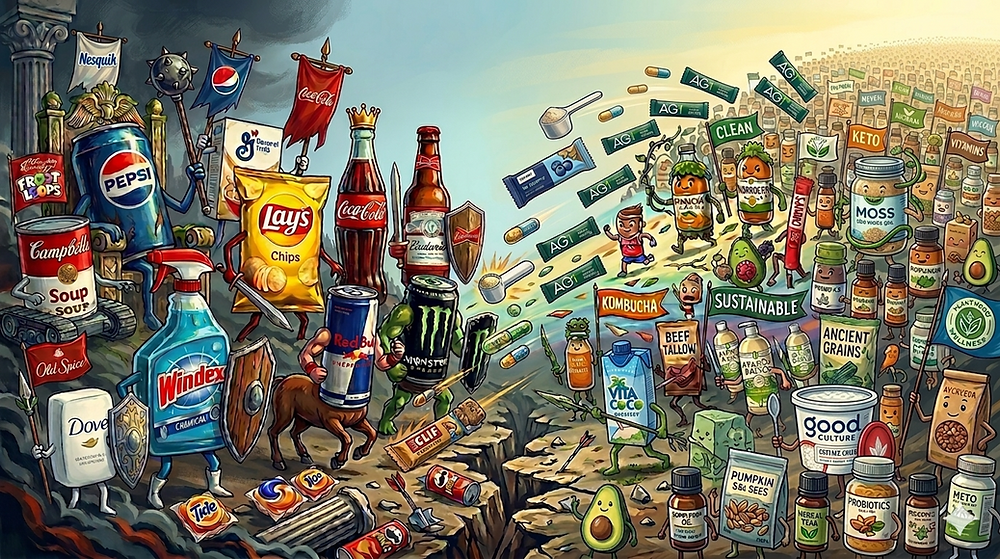
The numbers confirm what the convention felt like. According to Bain’s 2026 Insurgent Brands report, 113 young challenger brands drove 36% of all growth in the fast-moving consumer goods sector last year, with 44% touting better-for-you claims and 40% leading with protein. These insurgents grow ten times faster than the category average and are projected to drive up to half of all FMCG growth over the next five years. Legacy CPG is not leading this movement. It is acquiring it: Siete, Poppi, Simple Mills, all scooped up as fast as the incumbents can identify them.
Meanwhile, Yuka, the ingredient-scanning app, now counts over 20 million American users, with 25,000 new sign-ups every day, driven in no small part by Gen Z, who are scanning their cereal boxes and beauty products with the same skeptical eye they bring to everything else. The consumer is no longer willing to outsource trust to a brand simply because that brand has been around for fifty years. In the minds of a growing and vocal cohort, General Mills and Perdue have become the new Marlboro. This is not hyperbole. It is a value shift, and it is accelerating.
The political class has taken notice too. The Make America Healthy Again movement, now institutionalized through the Department of Health and Human Services (HHS), has brought the ultra-processed food debate into the highest levels of government for the first time in modern American history. Whatever one thinks of the full MAHA platform—and it is not without serious controversy—its focus on food dyes, seed oils, and the industrial food complex has given mainstream political legitimacy to conversations that wellness advocates and “fringe” brands have been having for years. When the Secretary of HHS is publicly endorsing an ingredient-scanning app, it is a signal of just how far this cultural shift has traveled—from the health food co-op to the White House.
So what is driving this revolution? At its core, I believe this is about agency and meaning making. We live in a moment of profound institutional distrust—economic, political, environmental—in which the systems we were told to rely on have revealed themselves to be something other than reliable. Consumer goods is one of the few domains where individuals can actually act in a way that can meaningfully impact our quality of life, and ultimately happiness. The democratization of information—podcasters (e.g., Huberman, Hyman, Shetty, and Robbins—all of whom have their own wellness ventures or joint ventures), ingredient scanners, Reddit threads, an entire ecosystem of voices outside the corporate marketing machine—has given people the tools to do so. Consumer dollars are yearning for new places to flow.
The Overlooked Bottleneck
This new flow of dollars is running up against a tension: consumer demand for “better-for-you” products has never been higher, and yet the brands creating those products still struggle to reach the people who want them.
This past January, I had the opportunity to sit with founders and operators behind some of the most dynamic brands in the space—AG1, Eight Sleep, Magic Spoon, David Protein, Shopify, Immi, Swoon, and others—through HBS’s “Moving Beyond DTC” intensive, now in its seventh year and led by consumer investor Matt Higgins, as well as HBS Profs. Len Schlesinger and Ayelet Israeli. The throughline across nearly every conversation was this: the distribution problem is the central problem. A decade ago, the removal of manufacturing barriers combined with the rise of social media gave a new generation of founders the ability to build brands and reach consumers directly. Customer acquisition was cheap, the audience was attentive, and the window was wide open. Apple’s privacy changes, platform saturation, and the sheer volume of competing content have since transformed that window into a wall. Social media is now a bottleneck, not a solution. The brands that found their first hundred thousand customers on Instagram cannot rely on the same playbook to find their next million.
Traditional retail, to its credit, is catching up. Target just expanded its wellness assortment by 30%, launching a national campaign with in-store sampling events and a Times Square billboard. And it is still not enough. The most sophisticated founders today understand that distribution is not a downstream concern. It is the strategy. Being where your consumer already is—with the right product, at the right moment, in the right context—is the variable that separates brands that break through from those that burn out on paid social. Every new point of presence is also a new source of insight about who is buying, why, and what they reach for next.
The consumers most aligned with these products are not primarily discovering them in the mass-market aisle. They are discovering them in motion, in community, in the high-intent moments that define their routines. Consider this: HYROX, the fitness competition format, expects 1.5 million participants this year across 8,500 affiliate gyms in twenty-two countries, with its co-founder describing the ambition not as a sport but as “a lifestyle.” The person leaving a HYROX event or a boutique studio class is in a fundamentally different frame of mind than the person pushing a cart down a grocery aisle. They are primed. They are looking. They are ready to try something new. The brands that show up in those moments—authentically, with something worth trying—build the kind of community-anchored loyalty that no amount of paid media can manufacture.
Alcohol solved this problem generations ago. Bars exist not merely to sell drinks but to create the context in which discovery, trial, and loyalty are built in the same moment. I witnessed this and tapped into it firsthand when I was selling craft beer bar to bar in New York back in my Anheuser-Busch days. Wellness, as a category, has no equivalent.
The brands that survive this moment will be those that get creative about where and how they show up, that treat distribution not as logistics but as an expression of brand identity. For legacy CPG, the window is narrowing. The choice is binary: acquire aggressively or face death by a thousand cuts. A wave of consolidation has already begun. It will intensify.
For investors, the opportunity is real, but it requires a different mental model. The power law logic of traditional venture capital may not fully apply here. This space is producing durable, category-defining businesses that do not need to be unicorns to matter, and that are often better served by patient, operationally-engaged capital than by the growth-at-all-costs mandates of a ten-year fund that needs one 100x return to work out. Platforms like Founders Row, launched last year by SweatHouz founder Jamie Weeks explicitly to back founders in their earliest, most capital-intensive years with both capital and, critically, hands-on operational support, represent a signal that some smart money is already rethinking its approach. Indeed, unlike most investment firms you’ve heard of, Weeks intentionally put the word “founder” in the name. This signals his intent to holistically support early-stage ventures, where founders are often brand new to the space or entrepreneurship altogether. Notably, Founders Row recently backed Yough!, the same clean-ingredient, values-forward Greek yogurt pizza startup that opened this piece. This throughline is not coincidental. It is the thesis made tangible: patient capital, founder-friendly structure, and a consumer who has already decided they want something better. There is a real and underserved need for more of it.
But the biggest story, ultimately, is the consumer. They have woken up. They are scanning labels, listening to podcasts, building routines, doing independent bloodwork analysis through platforms like Function, and spending more on products that align with the conviction that what they put into their bodies is a choice worth making carefully, not to mention spending more on. It is, in its own way, a founding American instinct reasserting itself: the belief that we are entitled to the freedom to know what we are consuming, and to demand something better.
Our new unalienable rights are indeed life, liberty, and the pursuit of wellness, which could also be counted as happiness macronutrients. The floodgates are open, and the brands, investors, and institutions that truly understand and internalize this have an extraordinary opportunity to shape what comes next. For this is indeed, as our founding fathers once penned, a matter of lives, fortunes, and sacred honor.

Name (MBA ‘XX) is the TEMPLATE.