After my first marathon, I thought I’d take a month off to recover. But one month turned into two, and then three, before I finally felt the urge to work out again.
I had been burned out from marathon training, so right after the race ended, all I wanted was to ditch my spandex and spend my free time watching TV. Even when I finally dusted off my running shoes, I didn’t know where I wanted to start or what to train for next.
At first, I told myself I would switch gears and start sprinting for the first time in years. The thought of running fast made me excited to try something completely different from the marathon and gave me a good excuse to spend more time building strength and power in the weight room. But major soreness after a heavy lift and a series of snowstorms derailing my schedule quickly turned me away from that idea. Eager to start somewhere, I searched for a training plan that felt accessible.
I landed on the Runner’s World one-month intermediate maintenance plan that covers about 20 to 25 miles per week, starting with four-mile easy runs.
Related Story
I tried the plan for about a week, but felt wiped after those easy runs, and like I was mentally forced to train, which put me right back into burnout territory.
I decided to start over the following week, after switching to the beginner plan. I started with two-mile easy runs and about 13 to 17 miles total per week. Once I made the switch, training instantly clicked and my love for running promptly returned. I actually wanted to do the two-mile runs, felt recovered between sessions, and didn’t feel any pressure to go farther or faster than I wanted to.
I balanced this plan with the Runner’s World Race-Ready Strength program to support my comeback, reduce risk of injury, and reconnect with strength training. Coupling these plans together helped me make a sustainable comeback to training, without feeling like I was overdoing it in preparation for a race or floating through random runs with no structure.
Here’s why this was the best duo to help me rebuild my fitness and my relationship with running.
Related StoryHow I Made My Comeback With Maintenance PlansShorter Distances Felt Like a Safe Haven
What I needed most to return to running was to really like the training schedule laid out in front of me. Anything longer than two miles looked scary and unappealing, and I felt I couldn’t handle running that far more than once or twice a week.
The beginner maintenance plan calls for two-mile easy runs, one five-mile run with half marathon pace mixed in, and a long run, starting at five miles. This felt way more manageable than the intermediate plan with four-mile easy runs and an eight-mile long run.
I enjoyed every minute of my easy runs, knowing I had 20 minutes of low-stakes cardio to play some of my favorite songs (hello, new Harry Styles album!) and log a few laps around my neighborhood.
Plus, during marathon training, a lot of my maintenance runs were five miles, so a five-mile “long run” didn’t feel nearly as daunting as long runs in the past (I ran as far as 22 miles in marathon training!). I didn’t have to stress about packing gels or carb-loading the night before, so there was less pressure. I felt productive but with minimal effort, so it was a much easier entry point to return to running.
Maintenance Training Plans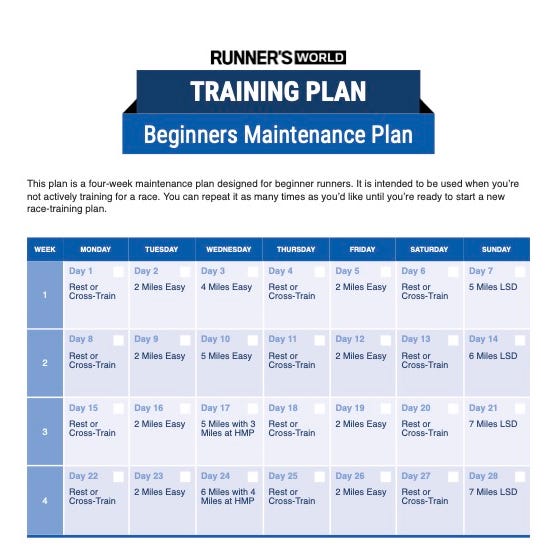 4-Week Beginner PlanRunner’s World
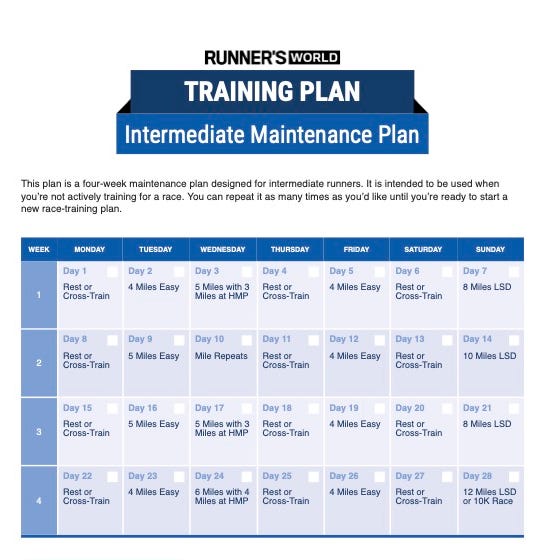 4-Week Intermediate PlanRunner’s World
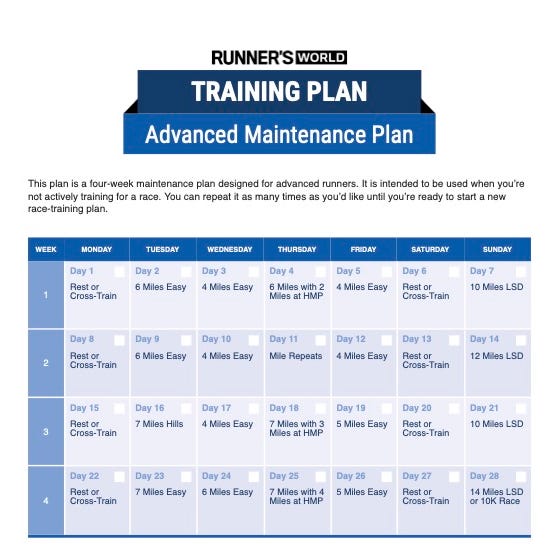 4-Week Advanced PlanRunner’s WorldI Didn’t Feel Pressure to Perform a Certain Way
Last year, I returned to running after a bit of a winter hiatus by training last-minute for a spring half marathon. While jumping into another race is a valid method for coming back to running, I found that not having a race on my schedule gave me the room to love running again without a major goal hanging over my head.
When I trained for a marathon, I constantly thought about my finishing time and hitting specific paces in my workouts. It felt freeing to train without a time goal for once, and I could focus on the desire to simply check off workouts each week.
Related StoryI Picked Plans That Met Me At My Fitness Level
In the past, when I would return to working out after long periods of time away, I would reach for the heaviest “light” weight or fastest “easy” pace I could feasibly do. But with the two programs in place to guide me, I realized what served me best was something that met me where I was at physically, which meant erring on the side of truly light weight and truly slower paces.
When I first ran my half marathon pace run in the intermediate maintenance plan, I ran closer to an 8:00 pace when I knew a more accurate half-marathon pace for me would be between 8:30 and 9:00. Because I was excited to run fast again, I did enjoy the quicker speed… until the next day, when I felt super sore for two days.
For my half marathon pace run in the beginner’s plan, I stuck to an 8:30 to 9:00 pace range, feeling confident that the run would help me build fitness back and recover adequately—and I was right.
Also, when doing the Race-Ready strength plan, I didn’t push myself to grab anything heavier than 10-pound dumbbells. My usual approach would be to hoist a couple 25-pound plates on either end of a barbell for hip thrusts on my first day back and adjust from there. But this time around, I simply focused on learning new movements, mastering my form, and staying consistent. Because I erred on the side of lighter weights, I was able to grab a 20-pound kettlebell for some of the moves in weeks three and four and still recover well the next day.
At the end of the four-week plan, I actually wished it was longer because I felt like I could keep going with the steady progress I had made. Choosing these plans helped me realize that I have to be more honest with myself about where my current fitness level truly lies, even if that means starting from scratch.

Kristine Kearns, a writer and avid runner, joined Runner’s World and Bicycling in July 2024. She previously coached high school girls cross country and currently competes in seasonal races, with more than six years of distance training and an affinity for weightlifting. You can find her wearing purple, baking cupcakes, and visiting her local farmers market.