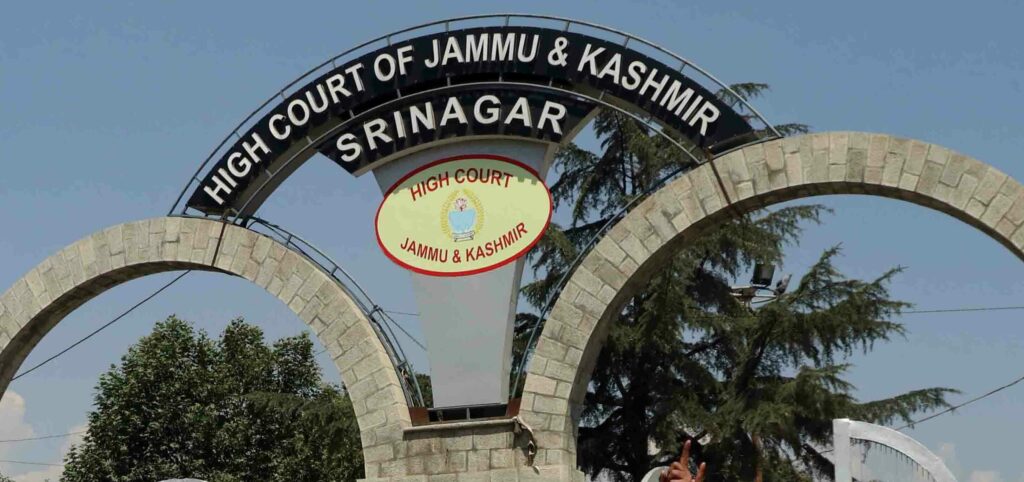
SRINAGAR: The High Court of Jammu Kashmir and Ladakh at Srinagar has dismissed a petition seeking quashing of an FIR in a case involving allegations of assault and attempted rape in Shivpora, holding that no grounds were made out for invoking its extraordinary jurisdiction and directing the police to proceed with the case “without any further delay.”
The judgment in CRM(M) No. 461/2025, along with connected application CrlM (1109/2025), was reserved on March 10, 2026, and pronounced on March 30, 2026, by Justice Moksha Khajuria Kazmi.
The petition, filed under Section 528 of the Bharatiya Nagarik Suraksha Sanhita (BNSS), was moved by Gulzar Ahmad Ganie and others through Advocates Asif Bhat and Arshid Bashir, seeking quashing of FIR No. 40/2025 registered at Police Station Ram Munshi Bagh, Srinagar, for offences under Sections 74, 115(2) and 351(2) of the Bharatiya Nyaya Sanhita (BNS), along with all consequential proceedings. The petitioners had also sought protection from alleged harassment.
The case stemmed from complaints filed by a woman resident of Rose Enclave, Shivpora, who alleged that on May 29, 2025, the petitioners had manhandled, abused and assaulted her following a dispute over parking of vehicles outside her residence. In a separate complaint filed the same day, she further alleged that the petitioners used abusive language and attempted to rape her. Based on these complaints, the police registered FIR No. 40/2025, while another FIR No. 44/2025 was also registered on related allegations against some of the accused.
During the course of proceedings, the petitioners had obtained interim protection, with the High Court on August 6, 2025 directing the police to continue investigation but restraining it from filing the final report and from taking coercive measures. The petitioners had also been granted interim anticipatory bail by the court of 3rd Additional Sessions Judge, Srinagar, on June 26, 2025, which was later rejected on September 25, 2025 after the trial court found that they did not deserve the concession of bail.
Arguing for the petitioners, counsel contended that the FIR was false, fabricated and motivated by personal vendetta arising out of a neighbourhood dispute, and that the complainant had exaggerated allegations to convert a civil dispute into a criminal case. It was also argued that the police had illegally merged two complaints into a single FIR, rendering the proceedings unsustainable. Reliance was placed on Supreme Court precedent to seek quashing of the FIR on this ground.
Opposing the petition, Government Advocate Faheem Nisar Shah and counsel for the complainant, Sajad Ahmad Mir along with Ifra Milad, argued that the allegations disclosed cognizable offences and required full investigation and trial. They submitted that merger of complaints relating to similar transactions was permissible in law and that the petition was an attempt to derail the criminal process.
After hearing the parties and perusing the case diary, the High Court held that the jurisdiction under Section 528 BNSS was to be exercised “cautiously, carefully, and sparingly” and only in exceptional circumstances such as to prevent abuse of process or to secure the ends of justice. The Court observed that none of these conditions were satisfied in the present case.
Rejecting the plea for quashing, the Court noted that the allegations made by the complainant were serious in nature and required adjudication through the normal course of criminal trial. It held that the petitioners’ submissions sought to “obfuscate the real issue” and did not justify interference at this stage.
The Court also took note of the delay in investigation, observing that despite the passage of nearly a year since the incident, “nothing substantial has been done,” and that the accused had not even been properly questioned. It found that the police had misinterpreted the interim order of the Court and had effectively “taken its hands off completely.”
In strong remarks, the Court stated, “It does not, by any stretch of imagination, mean that the petitioners… would enjoy an absolute immunity to the course of law unjustifiably,” adding that allowing further delay in filing the challan would be a “travesty of justice.”
Expressing concern over the manner of investigation, the Court observed, “The majesty of law admits no distinction based on the stature, influence, or standing of the accused,” and cautioned that “any discernible hesitation in pursuing the matter… invites the inference that the investigative agency has not remained entirely impervious to the standing or influence of the persons involved.”
Finding the petition to be without merit, the Court dismissed it and vacated the interim protection granted earlier. It directed the police to present the challan before the competent court “without any further delay,” and asked the trial court to proceed independently, uninfluenced by any observations made in the order.
A copy of the judgment has also been directed to be sent to the Director General of Police for information and necessary action.