B A PARKER, HOST:
Hey, everyone. You’re listening to CODE SWITCH from NPR. I’m B.A. Parker.
GENE DEMBY, HOST:
And I’m Gene Demby.
PARKER: So a couple of days ago, we did an episode about Mar-a-Lago face, which is this very specific aesthetic.
(SOUNDBITE OF ARCHIVED NPR CONTENT)
INAE OH: Dramatic sort of makeup. Heavy on the eyeliner, like, long flowing hair. The outfits tend to be very close to the body, pushing a very sort of, like, hyper-feminine look in traditional conservative senses.
DEMBY: And it’s not just the women that are trying to fit in, right? Like, there was that recent photo of Marco Rubio who was wearing shoes gifted to him by President Trump, and those shoes were too big because the president, I guess, has, like, a – this thing where he likes to guess people’s shoe sizes. And apparently, Trump sees having big-ass feet as a sign of manliness. So now you’ve got the secretary of state walking around in shoes that are way too big for him. And, of course, you got Pete Hegseth, who is obviously obsessed with a very showy masculi2nity, like, to the point – as we talked about recently – he was beefing with the Boy Scouts for being too soft. So, like, Trump world is just kind of generally obsessed with how people perform gender. You know what I’m saying?
PARKER: Yeah. Inae Oh, who we talked to for our first episode on this, says it’s all an intentional play to fit in with the Trump aesthetic ideals.
(SOUNDBITE OF ARCHIVED NPR CONTENT)
OH: Like, this is a look that shows your potential employer, your boss, the most powerful man in the United States, that you are willing to conform and to appeal to his tastes. It’s almost like a – it’s like a line in your resume.
DEMBY: Yeah. It’s kind of a way to brand yourself as loyal to Trump world.
PARKER: Right. And that self-branding also tries really hard to set clear boundaries around gender.
ELIZABETH BRONWYN BOYD: Women who look like women and men who look like men. So they want biological sex and gender to line up in a way that it doesn’t in reality. But there’s a lot of effort to defer to male MAGA power.
(SOUNDBITE OF MUSIC)
PARKER: That’s Elizabeth Bronwyn Boyd. She’s the author of a book called “Southern Beauty: Race, Ritual, And Memory In The Modern South.”
BOYD: It reminds me of drag. It demonstrates the performativity of gender taken to an extreme. The administration insists on real men and real women that can be discerned at a – from a distance, say, a big league rally, right?
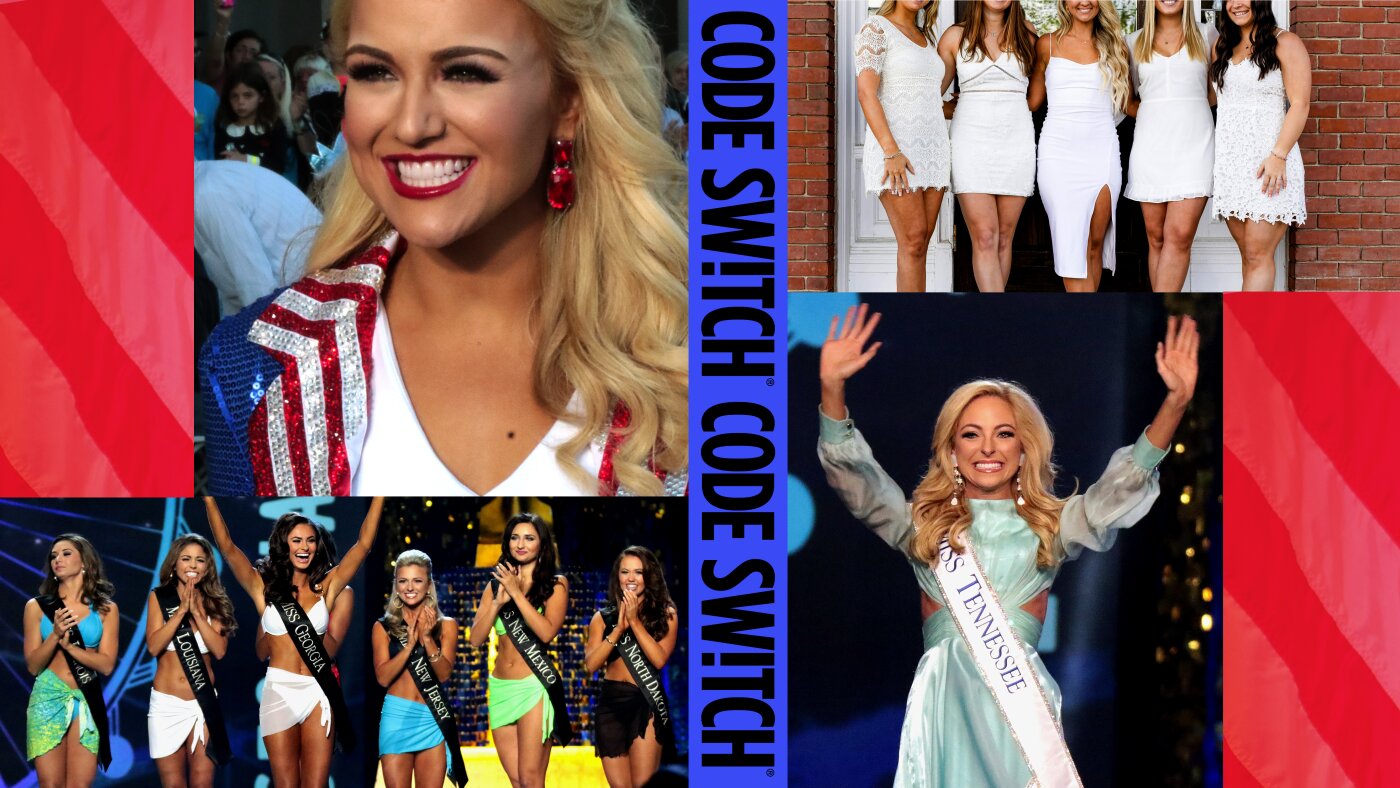
PARKER: Elizabeth traces all of this back to the pageantry of the Confederate South, and she says it’s still prevalent in Southern college sororities now.
DEMBY: Oh, so like Bama Rush?
PARKER: Why it sound like you know what that is, Gene?
DEMBY: (Laughter) I mean, Parker, these TikToks and these IG reels around Bama Rush are such a culturally rich tech. So, if y’all don’t know what Bama Rush is – refers to the University of Alabama, but it expands way beyond that. So every year in the fall, during, like, pledge rush season, all these white sororities at these giant universities have these sort of, like, elaborate choreographed dances. You know what I’m saying? Like, in which all these women who have, like, bone straight, blonde hair, and sometimes, you know, they have some brunettes if they want to feel diverse.
PARKER: Diversity.
DEMBY: Diversity, right. Anyway, they get to have these elaborate dances and these elaborate routines that are meant to signal to other women, like, they should come rush. It is a fascinating look into a subculture which I have no connection to at all. But it’s, like, a very, very, very white space, as everyone has pointed out.
PARKER: Yeah. Perfect synopsis of what that is. But – OK, so, Elizabeth started her research after she went back to her hometown in Mississippi and was immediately struck by the performative nature of beauty and hyper femininity.
BOYD: I couldn’t help noticing that the motto of this podcast is race in your face. Well, this is what it was, Parker. It was whiteness in my face.
PARKER: Yeah.
BOYD: And it was performed by young women in this sort of over-the-top-precision, and not necessarily so much about natural beauty, but it was more about grooming and habits of etiquette than any particular look. About social graces, knowing the correct motions and responses for any occasion. And it was ingrained through years of observation and instruction and practice. This was a conservative standard of femininity.
PARKER: So in today’s episode, I talk to Elizabeth about how Southern rules of femininity have trickled into the right’s approach to aesthetics.
I spoke with author Elizabeth Bronwyn Boyd about her book, “Southern Beauty,” and she hones in on the prevalence of the Southern beauty persona.
BOYD: I had kind of forgotten about it and was totally unprepared for being hit by this sort of wall of femininity. There was a very high-stakes sorority rush system, Greek culture. I kept seeing these rush activities going on on sorority row, and they were so intense and obviously, so high-stakes that I kept thinking, why is it so over-the-top and so precise and so cutthroat, if you heard anyone talk about it? There must be something more going on here than just filling in the next class of the sorority.
And at the time, whiteness was sort of on the ascendancy within scholarship, using whiteness as a category of analysis. And at the same time, there was this understanding among a lot of white Southerners that Southern was equated with white. And Black Southerners were very flabbergasted by this, as well they should be, but there was this notion that when someone said Southern, they meant white Southern.
PARKER: So you’ve argued that women in the South were and are charged with instituting racial supremacy through beauty standards. So what does – like, how does that come to be?
BOYD: I ended up researching three popular feminine performances that a lot of young Southern white women participated in, and they were sorority rush, the beauty pageant and the Confederate pageant of the Natchez, Mississippi, Pilgrimage of Tour Homes.
PARKER: Let’s talk about it.
BOYD: Yeah, we’re going to talk about it. And I end up arguing that in these productions, over time, that the white Southern beauty serves as this key memory mechanism, this sort of focal point that produces region and allows white Southerners to imagine themselves as part of this larger identity across time and space. All right? So she’s embodied commemoration, this sort of nostalgic looking back on this benevolent white South that never was (laughter). But at any rate, there was almost never a time when white Southerners were not nostalgic and were not having a proliferation of different types of pageantry, OK?
So in the Antebellum South, there was not too much about the plantation South that distinguished it from the North, except slavery. And so they crafted this sort of dreamy myth of difference and posited themselves as the heirs of European aristocracy, which is not really borne out in history. And one of the ways that they convinced themselves that this was true was to hold these annual pageants and rituals. They had jousting tournaments and May Day festivals.
PARKER: What?
BOYD: Twelfth Night parties. Oh, yes. And tableaux. And at each one of these, the central feature in the sort of culminating moment was the crowning of white Southern women as queen, right? So each of these pageants had a white queen, and she was this emblem of what the region was supposed to be about, right? She was both the motif of the white South and its rationale. And then in the post-Reconstruction South, after the war, this is where the United Daughters of the Confederacy come in with their Lost Cause movement, sort of redeeming the South through and finding honor in their defeat. So at Confederate veterans’ memorials and monument unveilings and Confederate veterans’ reunions, they would always crown someone and raise up the white lady figure for praise and recognition, because that was why the South had gone to war.
PARKER: How does that trickle down to, like, Bama Rush, where everyone is kind of clamoring to be this queen bee, but not everyone can be, like, lifted up and elevated in that way.
BOYD: Well, so I’m almost there.
PARKER: Yes, ma’am.
BOYD: Yeah. Yes, ma’am. So this is taking place when Reconstruction happens. It’s more like the 1890s through 1920, when the final actual veterans – last one finally dies off. And that’s presenting the Southern lady in pageantry has to move into public festivals and celebrations of civic life. And then the ideal woman moves from the white lady on the pedestal to pageantry. But then also in the mid-20th century South, you have a situation, especially with the rise of massive resistance to desegregation and to civil rights. You have a proliferation, especially on college campuses in the South, of pageantry. And so when you have the prospect of desegregation – and let’s see, Brown v. Board of Education is 1954 – and then you really see this proliferation of pageantry and really stark positing of the difference between the white Southern beauty, serene, silent, with blackface productions, even within sorority rush.
PARKER: Yeah.
BOYD: Right? OK, so there’s nothing quite like blackface to highlight white privilege. So a lot of these pageants are about showing who we are. We’re part of this white southern identity, and we are definitely not this other thing. I think about sorority rush as a feminine stratification ritual where the women do the policing of each other and the sorting and organizing in tiers of affluence and social power, so that the top houses, quote-unquote, “top house,” have the most social power. But it’s interesting because it’s always social power, but it’s not really political power on campus, which is reserved for the fraternity men. So the women are choosing each other based on how the young women that they’re choosing will help improve their brand and their ability to attract the most influential fraternity men. So it’s really a sort of proximity to power rather than true power of its own sake.
PARKER: And so, like, I’m curious about how do you see this kind of historical performance of femininity and racial supremacy that you researched reflected in the aesthetics of the MAGA movement.
BOYD: Yeah. Well, so I’m seeing the same sort of gender conformity and compliance with what it is they think the administration wants or maybe the administration has specifically said (laughter) what they want. It’s all about surfaces.
PARKER: Yeah.
BOYD: If you could look good doing it, then that’s what we want. We don’t really care what your qualifications are. And I think it’s sort of the plasticity of the pageant world. As they say in Texas, all hat and no cattle.
(LAUGHTER)
BOYD: Right?
PARKER: Yeah. ‘Cause, I mean, when I think of pageantry, I think, you know, like, Vaseline on teeth, heavy makeup. The higher the hair, the closer to God, like…
BOYD: Baseball adhesive on your butt.
PARKER: Listen, there’s, like, very (laughter) – but there’s like…
BOYD: Preparation H. I know all of the tricks.
PARKER: All of the tricks. And, like, that is how you’re presenting yourself. But I’m also curious, does President Trump’s history with pageants play a role in this as well?
BOYD: Oh, I think so, for sure. And, you know, the fact that Trump was involved in Miss USA, I think that’s significant, because it was always flashier and sexier than Miss America. Miss America was supposed to be standing in for our national ideals of womanhood, right?
PARKER: Yeah.
BOYD: So Miss America got all cleaned up and became this more virtuous ideal of womanhood. But Miss USA never stood in for anything. She was not some sort of civic sweetheart. She was just there for the flash and the cash, and she was overtly sexy, right? There’s the heavily applied makeup, the exaggerated looks. I guess with TV lighting, there is a different way of applying makeup. But that’s – again, that’s Trump’s whole frame of reference is the TV screen.
PARKER: Yeah.
BOYD: Right? (Laughter).
PARKER: I mean, I think about – this is, like, I’m sharing with myself. When I was a teenager, I was a debutante. And, like – it was like a Black cotillion. Like, I wore pearls. I had a big, puffy, like, white wedding dress. I had to – I couldn’t – had to make sure our backs and our arms were covered in our dress. And I learned…
BOYD: Did you learn the bow?
PARKER: I learned how to bow. I learned – we did a waltz. I was reading Emily Post. And, like…
BOYD: (Laughter).
PARKER: …Learning how, like, to be a lady. All I remember is the dessert spoon is in front of the plate. But there are certain things that – it all seemed performative. It was very much like at 16, the wizard’s behind the curtain. Like, I know that none of this is real, this performative femininity that I was like, where does this come from? Who – like, who is creating these rules? Like, why do I have to wear all of this eye makeup to dance to Anita Baker? I don’t understand any of this.
BOYD: But – and there were cultural rewards, though, weren’t there?
PARKER: Yeah.
BOYD: Weren’t there some familial pressure, probably, to do this?
PARKER: Very much. Oh, my family was very big – there’s a picture of my whole family with me in this big, puffy wedding dress. And I am…
BOYD: Because it’s a class thing. It’s a class thing.
PARKER: It’s very much a class thing.
BOYD: You know, no matter what your race is. That’s right.
PARKER: And I’m ready to go home, and they’re just, like, they’ll, like, take one more picture.
BOYD: Because you’re upholding the standard. You’re bringing glory not only upon yourself but upon your entire family in continuing this tradition. And how did it start? Well, of course, it started out of exclusion because they weren’t permitted to be in other cotillions or debutante societies.
PARKER: Yeah.
BOYD: Just the way sororities were founded when they were excluded from men’s literary societies.
PARKER: Yeah.
BOYD: Right? So exclusion would be your keyword of the day.
PARKER: Exclusion is the keyword. I’m sorry you had to hear that whole thing, Elizabeth.
BOYD: No, I enjoyed hearing that.
PARKER: I really was going through it (inaudible).
BOYD: (Laughter).
PARKER: OK. Can you give us examples of how some women in the MAGA movement perform their gender?
BOYD: There’s a lot of surgery going on.
PARKER: Oh, OK.
BOYD: (Laughter) Flat makeup and sort of an evangelical Christian babe. The men, of course, are…
PARKER: Please, yeah.
BOYD: It’s all about your jaw line, and sort of sculpting your forehead and your jaw, getting those veneers on your teeth, jaw implants, I guess, is what they get. And then smoothing and Botox and sort of fillers and injections.
PARKER: But, like, what is that performance communicating to the broader public?
BOYD: I think that it’s communicating that you need to get on the bandwagon or go home. I think that we also see this nostalgia in MAGA aesthetics.
PARKER: Yeah.
BOYD: The whole idea of MAGA, Make America Great Again, is based on nostalgia for something that never was, because when were we great? Was it during the removal of the first Americans? Was it when we held human beings in bondage? Was it when after World War II that we sent women home and had them give up their job so that men could have employment? You know, they say that thinking about nostalgia, what is it? People think that it’s all about living in the past, but really, it’s about anxiety in the present that improves the view of the past.
(SOUNDBITE OF MUSIC)
PARKER: Elizabeth, thank you so much. This was fun.
BOYD: Oh, this was really fun. Thank you. I’m happy to talk about Southern beauty anytime.
PARKER: And that’s our show. You can follow us on Instagram – @nprcodeswitch. If email is more your thing, ours is codeswitch@npr.org. And subscribe to the podcast on the NPR app or wherever you get your podcasts. You can also subscribe to the CODE SWITCH newsletter by going to npr.org/codeswitchnewsletter.
DEMBY: And just a reminder, friend, signing up for CODE SWITCH+ is a great way to support our show, great way to support public media. You might have heard we need your help. And you get to listen to every episode of CODE SWITCH and a bunch of other NPR favorites, sponsor-free. So please, please go find out more at plus.npr.org/codeswitch.
PARKER: This episode was produced by Christina Cala. It was edited by Leah Donnella and Dalia Mortada.
DEMBY: And we would be remiss if we did not shout out the rest of the CODE SWITCH massive. That’s Xavier Lopez, that’s Jess Kung and that’s Yolanda Sangweni. And as for me, I’m Gene Demby.
PARKER: I’m B.A. Parker.
DEMBY: Be easy, y’all.
PARKER: Hydrate.
Copyright © 2026 NPR. All rights reserved. Visit our website terms of use and permissions pages at www.npr.org for further information.
Accuracy and availability of NPR transcripts may vary. Transcript text may be revised to correct errors or match updates to audio. Audio on npr.org may be edited after its original broadcast or publication. The authoritative record of NPR’s programming is the audio record.