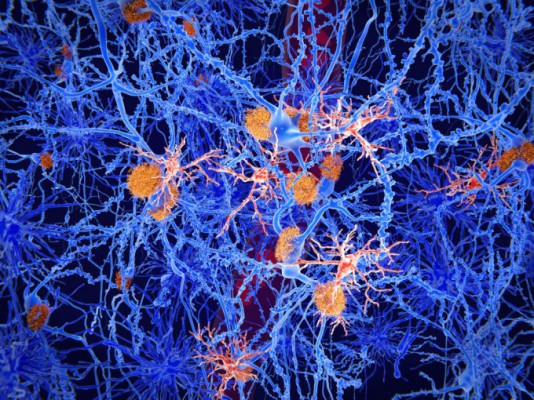
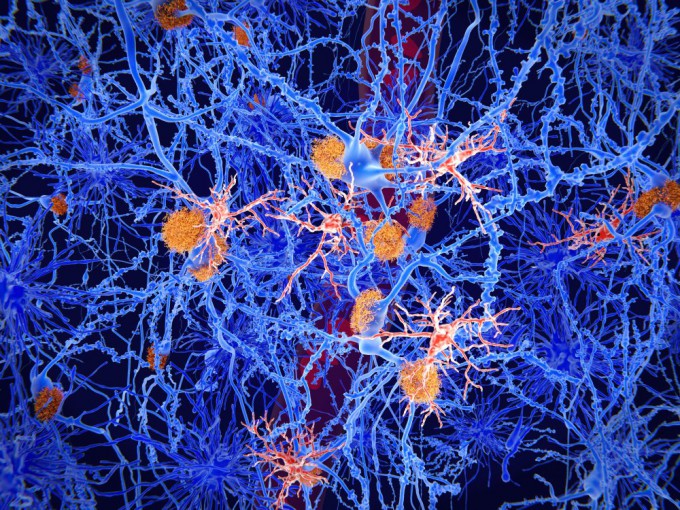
An image of microglia, immune cells that are one of the causes of worsening Alzheimer’s disease. Provided by Getty Images Bank.
A South Korean research team has discovered a way to control the overreaction of brain immune cells that exacerbate Alzheimer’s disease, a major form of dementia. This is gaining attention as it could accelerate the development of a therapeutic by utilizing an already commercialized drug.
Daegu Gyeongbuk Institute of Science and Technology (DGIST) announced on the 6th that a team led by Professor Um, Ji Won of the Department of Brain Sciences and the Center for Synaptic Diversity and Specificity has identified the operating principle of a neurotransmitter that alleviates Alzheimer’s symptoms by controlling immune cells that worsen the disease. The research findings were published in the international journal ‘Brain, Behavior, and Immunity’ on the 26th of last month.
Alzheimer’s disease worsens as waste products called ‘amyloid-beta’ accumulate in the brain, and brain immune cells known as ‘microglia’ become overactivated, causing inflammation. In the early stages of the disease, microglia act as cleaners, removing waste products. However, as the disease progresses, they lose this function and excessively secrete inflammatory substances.
The research team confirmed that the neurotransmitter ‘somatostatin’ helps restore the original function of microglia. When somatostatin was administered to cultured microglia, their phagocytic activity—the process of engulfing waste products—increased, and the secretion of inflammatory substances decreased.
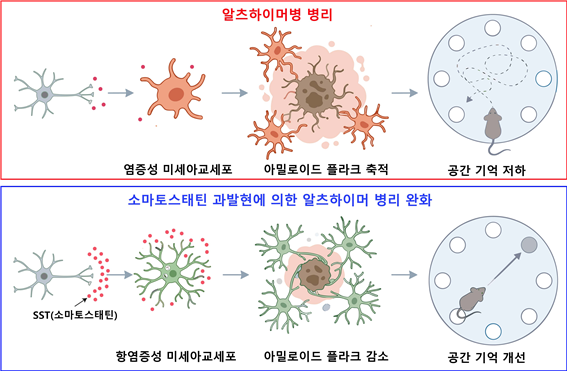
The process of how Alzheimer’s pathology is alleviated through the regulation of microglia by somatostatin. Provided by DGIST.
The same effect was observed in experiments with mice with Alzheimer’s disease. When the amount of somatostatin was increased using a ‘somatostatin receptor (SSTR) agonist,’ the inflammatory response was suppressed, and amyloid waste products were significantly reduced. The mice’s spatial cognitive function also improved, confirming the alleviating effect on Alzheimer’s symptoms.
SSTR agonists are already approved by the U.S. Food and Drug Administration (FDA) as a treatment for other diseases and are in clinical use. The research team expects that this existing drug could accelerate the development of new treatments for Alzheimer’s.
Professor Um, Ji Won stated, “We have demonstrated for the first time that somatostatin can directly regulate the state of immune cells to alleviate dementia pathology,” adding, “This opens up the possibility of rapidly developing a dementia treatment using an existing drug.”
doi.org/10.1016/j.bbi.2026.106563

Professor Um, Ji Won (from left), Dr. Jeong, Hyeji (Postdoctoral Researcher), and Hyun, Gaeun (Master’s student). Provided by DGIST.
Copyright ⓒ DongA Science. All rights reserved.