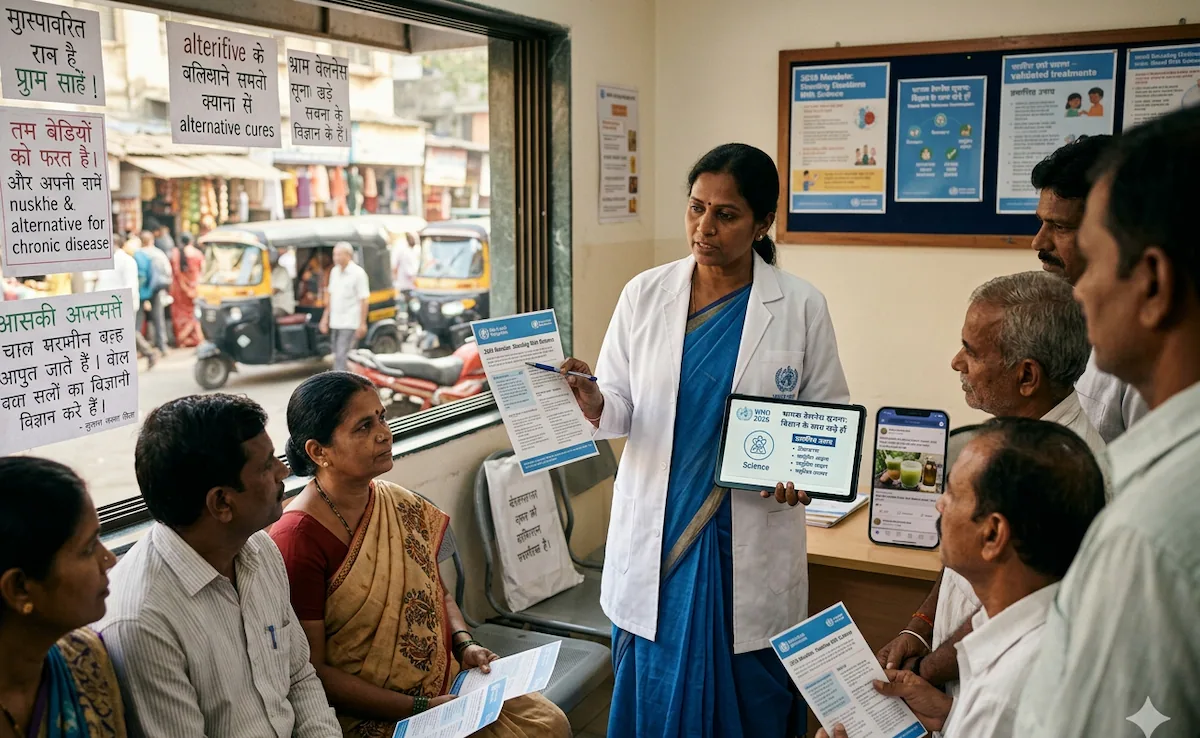
In an era where your Instagram feed is more likely to give you medical advice than your family doctor, the definition of “wellness” has become dangerously blurry. People have moved from simple home remedies to a world where “biohacking”, “adrenal fatigue”, and “parasite cleanses” are tossed around with the authority of a medical degree. But as the noise reaches a fever pitch, the World Health Organization (WHO) has stepped in with a definitive line in the sand. To mark World Health Day 2026, the WHO has launched its most urgent campaign yet: “Together for Health, Stand for Science.” It isn’t just a catchy slogan; it’s a global survival strategy. As people navigate a landscape saturated with infoxication, which is a term used to describe the paralysing volume of both true and false information, standing with science isn’t just an academic choice; it’s the only way to safeguard the collective future.
The Infodemic: When ‘Personal Truth’ Outpaces Peer Review
You have all seen it. A social media influencer with millions of followers claims a specific “alkaline diet” cured their chronic inflammation. Within hours, the search volume for “alkaline water” spikes. This is what researchers call Overgeneralised Health Messaging (OHM).
A 2025 study published in Health Promotion International highlights a terrifying trend: both blatant misinformation and factually “correct” but overgeneralised personal anecdotes lead to equally detrimental health outcomes. When an influencer shares a personal health journey, it feels authentic and trustworthy. However, human health is not a “one-size-fits-all” equation. What worked for a 22-year-old fitness guru in California could be medically catastrophic for a 50-year-old with underlying kidney issues in New Delhi.
The WHO’s 2026 mandate targets this head-on. By strengthening the discipline of infodemiology, the organisation is deploying AI-supported social listening tools like EARS (Early AI-supported Response and Social Listening) to identify information voids, those dark corners of the internet where misinformation thrives because credible science hasn’t arrived yet.
Also Read: Gastroenterologist Recommends Eating Fennel Seeds After Every Meal, Know Why
The ‘One Health’ Approach: Why Science Is The Only Map
The 2026 mandate isn’t just about debunking social media myths. It’s about a massive, integrated shift called the One Health approach. At the International One Health Summit in Lyon this week, the WHO made it clear: human health cannot be separated from the health of animals, plants, and our environment.
Why does this matter to you? Because the next pandemic won’t start in a vacuum. It will emerge from the intersection of climate change, habitat loss, and the food systems. “Standing with science” means supporting policies that look at the big picture.
“Science is not abstract; it shapes the everyday choices that safeguard you, your family, and your community,” says WHO Director-General Dr Tedros Adhanom Ghebreyesus.
From the vaccines that have saved over 154 million lives in the last 50 years to the simple germ theory that dictates why people should wash their hands, science is the invisible scaffolding of human survival.
Also Read: AIIMS-Trained Doctor Flags 3 Common Drinks To Reduce Fatty Liver Risk
Rebuilding Trust In A Sceptical World
The most difficult part of the WHO’s 2026 mandate isn’t the data; it’s the trust. People are living through a “polarisation loop” where scientific facts are often treated as matters of opinion.
A 2025 study on the mechanisms of influencer influence found that “parasocial interaction”-the feeling of closeness people have with the creators they follow-makes them more likely to believe their health advice over a faceless institution. To combat this, the WHO is mobilising its network of Collaborating Centres (including institutions like AIIMS New Delhi) to become “ambassadors of science”. The goal is to make science accessible, transparent, and, most importantly, human.
How To ‘Stand With Science’ Today
So, how do you navigate your next health decision? The WHO 2026 campaign offers a simple framework for the public:
Before starting a new supplement or diet, ask, “Where is the peer-reviewed evidence?” Check and use tools like the WHO’s AI infodemic observatory to see if a claim has been debunked.Only share health tips from verified medical professionals and scientific bodies.Your doctor knows your medical history; an algorithm does not.
The wellness industry is worth trillions, and much of that profit is built on the “information voids” that the WHO is now racing to fill. “Standing with science” isn’t about being cynical; it’s about being empowered. It’s about realising that while an influencer can give you inspiration, only science can give you a solution.
As people look toward the rest of 2026, let’s choose evidence over anecdotes. Let’s choose facts over filters. Because in the end, science isn’t just a subject in a textbook; it is the only reliable way to ensure that people and their planet don’t just survive but thrive.
Disclaimer: This content, including advice, provides generic information only. It is in no way a substitute for a qualified medical opinion. Always consult a specialist or your own doctor for more information. NDTV does not claim responsibility for this information.