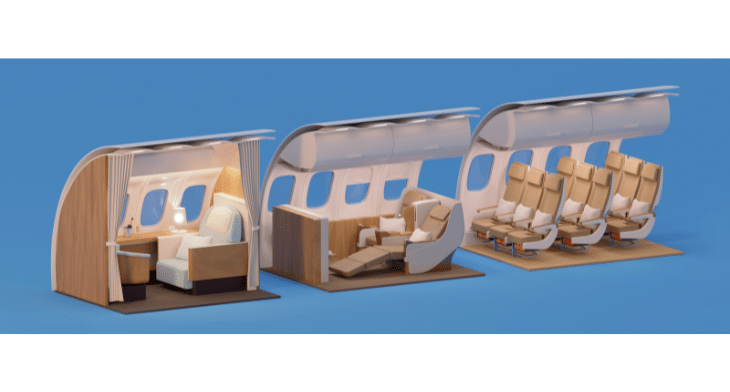
In this guest article, Vassilios Georgakopoulos, Aviation Customer Experience Consultant, explores passenger wellbeing in airline economy cabins.
We have achieved something genuinely remarkable in aviation. We have placed human beings inside a metal tube, cruising at altitude above oceans and continents, and made it for many, entirely unremarkable. The miracle of flight has been so thoroughly normalised that we now debate the thread count of Business Class bedding while politely ignoring a rather more fundamental question.
What are we doing about the wellbeing of the passenger sitting in 46E?
Onboard wellness has become a credible, well-funded conversation in premium cabins. Flat beds, carefully curated menus, sleep programmes, lighting systems calibrated to circadian rhythms; the thinking is serious, the investment considerable, and the results, at their best, genuinely impressive. But wellness should not begin at the curtain. It applies to every human being on the aircraft, and the conditions in which most passengers spend long-haul flights remain, fundamentally unchanged for decades.
The physics are not kind. Restricted movement, pressurised air, disrupted sleep, meals served according to equipment rotation rather than human biology, these are not trivial inconveniences. Their cumulative effect on physical and mental wellbeing over a 12 or 16 hour night flight is something the industry understands privately far better than it acknowledges publicly.
There are, however, genuine reasons for optimism, and the solutions are closer than the silence around this subject might suggest.
Qantas has demonstrated with Project Sunrise that thoughtful, evidence-based intervention is possible within existing constraints: revised meal timing, considered lighting design, dedicated refreshment and movement zones. These are intelligent interventions. The question worth asking is why these principles are not yet standard practice across long-haul operations globally, and what it would take to make them so.
The distinction between day and night flying is perhaps the most immediately actionable insight available to airlines right now. A daytime long-haul flight and a night departure are different human experiences requiring different service philosophies. Designing them identically, because the equipment rotation demands it, is a choice, not an inevitability. Passengers on night flights deserve a service concept built around rest, darkness, and minimal disruption and no chicken curries at 3am. Passengers on day flights deserve something closer to genuine pampering, unhurried, generous, a second aperitif, and mindful of time.
These interventions require will more than budget.
The longer horizon is more ambitious, and more interesting. Current Economy cabin architecture was not designed around human wellness. It was designed around unit economics, certification requirements, and fleet commonality. These are legitimate constraints. They are not, however, immovable ones. The conversation about what a genuinely wellness-led Economy cabin could look like, in layout, in materiality, in the relationship between seat, space, service, cabin crew complement and human body, is long overdue.
If there is a manufacturer or an airline willing to ask the question sincerely, not as a marketing exercise, but as a genuine rethinking of what long-haul Economy can and should feel like?
The passengers are waiting. Quietly, in row 46, as they always have been.
This topic will be explored further in a session at the Passenger Experience Conference (PEC) at the Hamburg Messe on Monday 13th April 2026. PEC takes place ahead of Aircraft Interiors Expo (AIX) on 14-16th April. For more information and tickets visit: www.passengerexperienceconference.com.