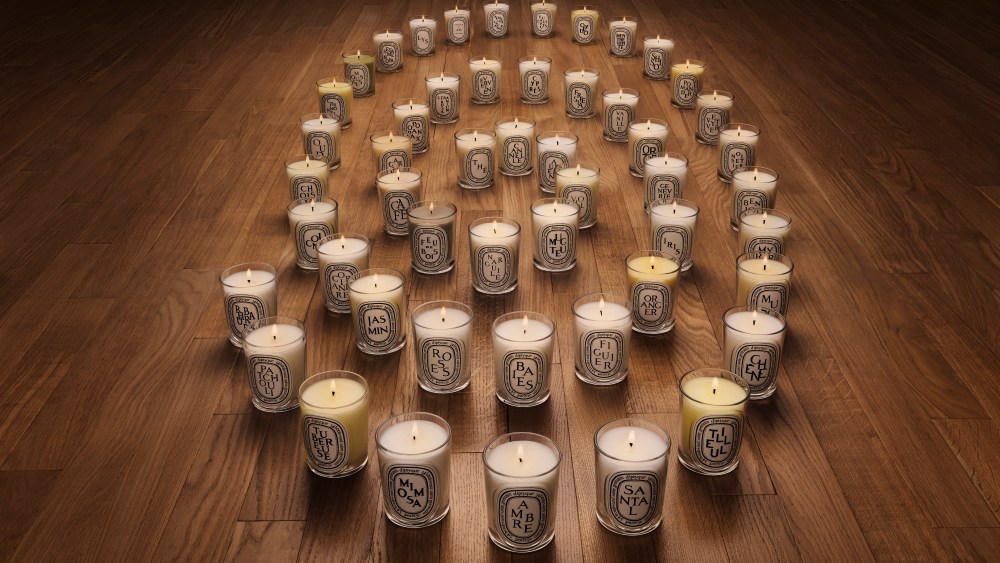
Diptyque’s iconic candle has been gently reworked for the first time since its launch in 1963.
“It’s a soft lifting of our iconic object,” said Laurence Semichon, chief executive officer of Diptyque. “This is quite an important gesture for us, because it was the first product ever created at Diptyque, and we have never changed it.”
She explained the goal is “to keep the spirit of the product and at the same time put it at the right level of luxury.”
Slight changes were made to the niche French brand’s candle vessel and label. Diptyque is also introducing refills, plus five new candles in what is referred to as its “herbarium of scents,” now coming in about 50 varieties.
The brand’s first candle — featuring a transparent glass vessel, white wax, and black-and-white oval label with “dancing letters” — was launched two years after the brand’s debut and its first flagship opened at 34 Boulevard Saint-Germain in Paris. Diptyque was founded by artists Desmond Knox-Leet, Christiane Montadre-Gautrot and Yves Coueslant.
The brand more recently signed on Franco-Swiss designer Julie Richoz to update Diptyque’s glass vessel. That now has an oval-shaped ridge of glass surrounding the candle’s label, which was given a subtly embossed texture. The typeface on the candle label, crafted by Knox-Leet in India ink, remains the same.
The newly designed classic candles, as well as five new ones, will be introduced on April 16. Those join Diptyque’s extensive candle collection developed to express natural elements in an imaginary garden.
Each of the new candles represents a specific ingredient and were created by IFF perfumer Alexandra Carlin and independent perfumer Olivia Giacobetti, who have long worked with Diptyque.
Café has an aroma of freshly ground coffee beans. Ortie comes with the scent of green nettle. Sésame Noir wafts a roasted sesame seed odor. Rhubarbe emits a fruity fragrance, while Shiso is reminiscent of fresh leaves.

Diptyque’s Sésame Noir candle.
Courtesy of Diptyque
“We wanted to have, of course, elements from nature, but we wanted to explore new ideas,” Semichon said.
Diptyque’s evolution has other facets. In September, 10 of its top-selling candles — Baies, Roses, Ambre, Mimosa, Figuier, Tubéreuse, Feu de Bois, Santal, Narguilé and Freesia — will be refillable.
“This follows our strong CSR commitments,” Semichon said, explaining Diptyque’s refills already represent a big share of the brand’s fragrance business. It has refills, too, for hand products, solid perfumes and La Droguerie multisurface cleaner and dishwashing liquid.
“This is something we want to push, and we hadn’t done it for our most iconic product,” she said.
It took more than three years to design the refillable vessels, which are 10 percent lighter than the originals, translating into an 18 percent carbon footprint reduction.
The refill candles are sold in a casing made of “paperfoam,” a bio-sourced, recyclable material. That the candle vessels are saved allows for their carbon footprint to be reduced by around 24 percent. The first refill purchase of the classic candle reduces the carbon footprint by 30 percent.
Diptyque’s coasted candle holder was revisited and a new oval tray of biscuit porcelain created. Three matchboxes featuring the house’s archival designs are being launched, as is a limited-edition giant matchbox. Other accessories include a pyramid lid and stand for the classic candle.
The classic 190-g. candle will now be priced at $90, with the medium 300-g. candle at $130 and the scented candle refill at $70.
Home fragrances historically generated up to 75 percent of Diptyque’s business and today make up about 50 percent of the total. The category has registered consistent midsingle-digit sales growth over the past few years worldwide.
The brand sells more than 15 candles a minute. Almost 25 percent of Diptyque clients repurchase candles, with about half returning to the same scent and trying out new ones. Most of the candle sales take place in-store.
Diptyque candles are produced in factories in France. One is in Provence and the other in the Paris region.
Today, the brand has 103 directly operated stores, more than one-third of which are in the Americas. Altogether it is in 139 doors. The brand counts 12 e-commerce platforms spanning 30 countries. By 2030, the directly operated retail network is expected to number 250.
Geographically, the United States is Diptyque’s first market, followed by the United Kingdom, China and France.
Private equity firm Manzanita Capital has owned the brand since 2005.