How do you know what you truly like? In a sea of algorithmic recommendations, ‘cool girl’ shopping guides and tips for dressing like Carolyn Bessette Kennedy, this question cuts to the heart of conversations about taste. And it grows even more pertinent when you ask, how do you know what you truly like enough to tattoo it on your body forever?
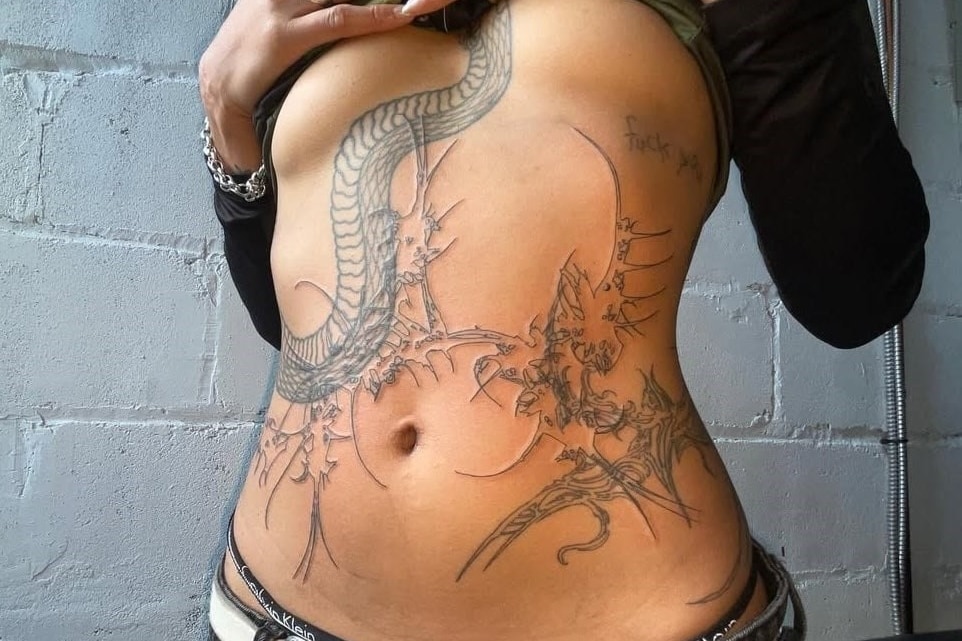
Not all tattoos carry deep, personal meanings, but getting inked inevitably reflects an element of your taste, history, relationships and obsessions. Tattoos can represent what you truly like, which is why a first tattoo can take a lot of deliberation. But when you are not an artist yourself, translating the idea you have in your head is sometimes tricky. AI promises to smooth out the tattoo process, streamlining the ideation stage and reducing the number of back-and-forth conversations needed with an artist. If AI platforms can generate images of Studio Ghibli characters or action figures that superficially incorporate our interests, it makes sense that this same model can also be used to suggest tattoo ideas.
For Jenna, 30, Gemini’s image generation tool helped brainstorm tattoo ideas after she struggled to find a suitable reference image on Google. “I kept trying different word strings until I got something near what I wanted and then I sent it to my artist,” she explains. “AI’s good at exploring themes or combining ideas you wouldn’t normally think of, especially early in the process.” Jenna took the AI design to an artist who then translated it into their own style. “It felt pretty impersonal until I translated it with an actual artist,” Jenna admits. “The meaningful part came from refining it, not generating it.”
Brighton-based tattoo artist Hannah Reynolds has noticed a sharp increase in the number of clients coming to her with AI-generated ideas. She finds this frustrating, although she understands where the impulse comes from. “Sometimes it can be tricky to convey specific ideas over message,” she says, “so having something visual to show your artist can help, and AI allows you to give them something very specific rather than describing it with words. Using AI feels like a lazy option, but I also don’t expect clients to research drawing in the way that I need to research for the drawing of my flash.”
Hannah says she would never tattoo an exact copy of an AI design, but she will use it as a starting point, combining it with elements of her own style as well as references from books and photos. The main problem, she notes, is that AI does not understand the technical side of tattooing the way that a professional artist does. Tattoos that it designs often include too much detail, the wrong proportions or spelling errors, so bringing an AI-generated design as a starting point is not always more efficient.
“Generating an AI tattoo design often leaves you with a piece that is technically bad as a tattoo that won’t heal well when it comes to real skin,” adds London-based tattoo artist Klaudia Kempa, who has also had clients come to her with AI-generated ideas. “If people are unsure, they should speak to a tattoo artist with experience who has knowledge of how things heal, how they age and what looks good in a general sense.”
While AI images often have an uncanny quality that makes them feel slightly off, whether it’s an extra finger or malformed text, they are improving all the time. In the tattoo space, BlackInk.AI was founded by Eric Mills in 2022 in response to the shortcomings of generic image generation tools that didn’t understand the nuances of human skin texture in relation to tattoo art. “AI helps the client feel more confident by presenting designs closer to their vision, and it allows artists to save time and earn money because the process with the client is much faster,” says Eric.
Each tattoo on the website is 100 per cent AI-generated and, Mills claims, entirely unique, but when AI can only pull from existing imagery, it raises questions about originality and ownership. Klaudia has had her own designs stolen before and believes that AI is only worsening the problem of plagiarism in the tattoo industry. It means that artists may be stealing other artists’ work without even being aware of it. “I would never tattoo an AI image for many reasons, one being I would never copy a design from an artist line for line unless in very specific situations,” Klaudia says. “AI isn’t an artist, which makes me question where it is pulling its ideas from.”
Deciding what to get for your next tattoo is not supposed to be a chore, but coming up with an idea can take time – not to mention badly drawn sketches, Sharpie drawings on your skin, chaotic saved Instagram folders and lists in your journal and notes app. Even silly, spontaneous tattoos are steeped in experience and memory. Ideas come from scattered sources: research, experience, conversations, and dreams. AI can provide speed and convenience, but what is lost when we outsource the initial stages of tattoo ideation?
For Billie, 25, coming up with tattoo ideas is one of the most enjoyable parts of the whole process. She planned her first tattoo for three years before getting it – a large Medusa design inspired by her teenage obsession with Greek mythology and feminism – and each of her tattoos holds a memory, whether they were inspired by “finding a painting in a book in a hidden corner of CSM’s library during my masters, admiring a corner of architecture in a new city or having my most regular artist immortalise my dog after he passed. All of my tattoos hold the same weight as they all represent the fact that at one point in my life, I felt inspired by a moment enough to get it sunk into my skin forever, and I think that’s class.”
When it comes to designing tattoos that respond to profound life experiences, such as grief or illness, an AI image generator can never understand that experience on an empathetic, human level. The back and forth between artist and a client when creating such a custom design is often deeply personal and collaborative. Paris-based tattoo artist Aleksandra has created several custom designs related to the loss of someone and finds this process “very intimate.” She usually asks the client to come in for a drawing session prior to the main tattooing session so that they can discuss the meaning of the tattoo and what’s important to them. The design is then inspired by these “experiences and emotions.”
Just as AI cannot comprehend grief, it also has no understanding of what it’s like to get a tattoo. It has no idea what it means to feel pain, to take a risk, to love something so much that you want it on your skin forever. But as AI is increasingly folded into daily decisions, such as what to eat for dinner or how to deal with a relationship issue, it is eroding our trust in our own ideas and taste. Relying on AI can provide reassurance, but tattoo regret is always a risk, no matter how long you spend trying to prompt the ‘perfect’ idea.
Tattoos last forever – barring painful and expensive removals and cover-ups – so it’s worth taking the time to research for yourself. It’s worth figuring out what you truly like. “If people are afraid of tattoo regret, the last thing to do is speak to AI,” concludes Klaudia. “Instead, do lots of research and see what speaks to you. If nothing does, don’t force it. It has to be something that calls to you and you absolutely love.”