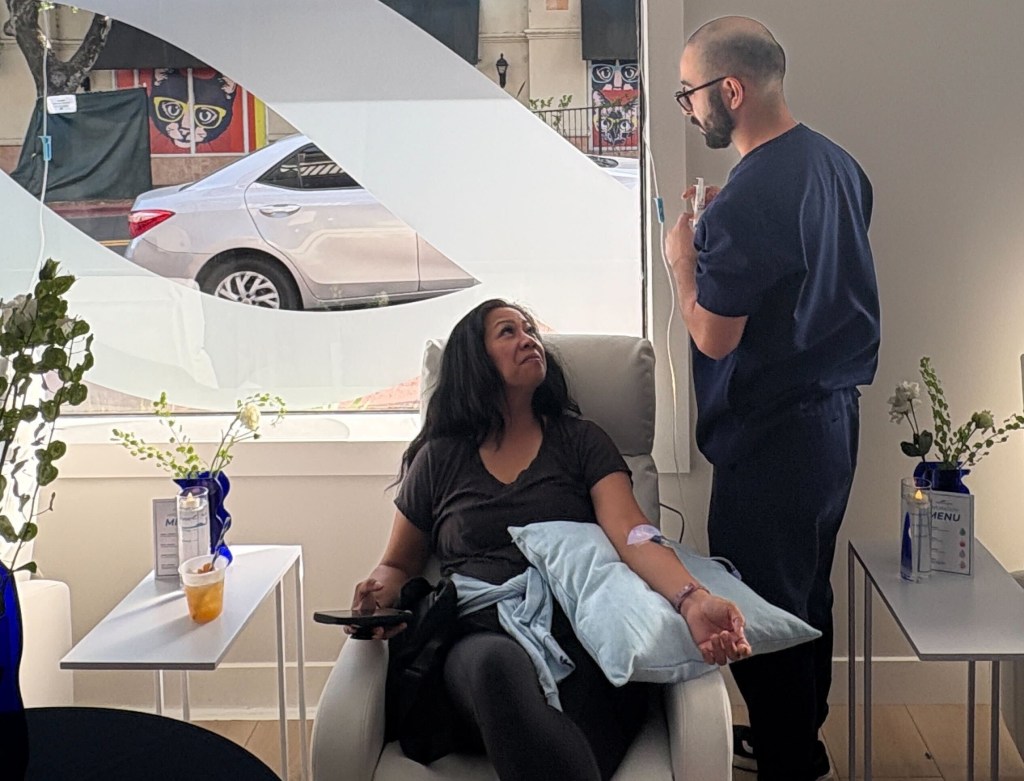
A new wellness clinic opened last month near downtown Los Gatos, offering intravenous cocktails and injections for those looking to beat the common cold, boost their metabolism and even try some of the newest drugs on the market, like GLP-1 and NAD+.
Hydration Room is a wellness clinic that offers targeted IV and injection therapies that claim to support immunity, energy, mood, metabolism and more. However, a doctor who has studied aging argues that these clinics do not do much for people’s overall health.
There are over 57 clinics across California, according to founder and chief medical officer Dr. Brett Florie. Hydration Room saw a major expansion in Northern California in late 2025. CEO Michelle Mendoza said that when they were looking to expand in the area, Los Gatos stood out for its demographics. The town boasts a predominantly white population with a sizable Asian minority. Women make up almost 51% of the town’s population, and the median household income in 2024 was over $216,500.
“We’re super excited to be part of this community and really embed into it,” Mendoza said. “We’re about a month young and really hope to become a regular for regulars in Los Gatos.”
Florie has both doctor of osteopathic medicine and doctor of medicine degrees and a master’s degree in biomedical sciences. He went to the University of Southern California and completed his anesthesiology residency there as well. He practices as an anesthesiologist and pain specialist in Orange County.
He conceived of Hydration Room when his wife was experiencing debilitating headaches as a college athlete while they were still dating in 2007 or 2008. Florie said she was taking Western oral medications, but they were ineffective and had side effects. He theorized that he could integrate Western and Eastern medicine to come up with a formula that would be delivered intravenously to cure her headaches. With a pharmacist’s help, Florie combined some vitamins, antioxidants and Western anti-inflammatory medication and administered it to his wife intravenously.
“It changed her quality of life,” Florie said of the successful treatment.
He replicated this process on a friend who had an autoimmune disease that caused malabsorption in the GI tract and achieved similar results. Since then, he has been putting together IV formulas to target a variety of ailments, like protecting against cold or flu season, recovering from jet lag or hangovers, managing chronic pain, aiding in weight loss or recovering from athletic activity.
Florie’s synergistic approach relies on the expansive testing offered by Western medicine while taking patients’ qualitative symptoms into account. Hydration Room is staffed with registered nurses. Patients can be referred to the clinic by their doctors. After a consultation to go over the patient’s diagnosis, medical history and lab results, the Hydration Room team puts together a treatment to help support the patient’s symptoms and goals.
“It’s super exciting to see the magnitude of what you can do when you deliver medicine, vitamins, to the bloodstream directly versus taking an oral vitamin,” Florie said.
Many of their patients are undergoing chemotherapy or radiation treatment or dealing with some kind of autoimmune condition, as well as athletes, Florie said. Hydration Room also offers GLP-1 injections to aid in weight loss and NAD+ therapies, which claim to enhance brain function, support cellular health and promote long-term vitality and health.
Mendoza said their clinics are designed to “look and feel like a med spa,” but are crafted in a way to ensure patient safety and cleanliness. Each location is a lounge with between five and eight chairs. They try to offer a calming presence, and a cup of tea is offered with every injection. An IV treatment takes around 30 to 45 minutes to complete, allowing patients to rest and rejuvenate during the procedure.
Mendoza added that about 60% of their clinics also have a private room to ensure clients’ privacy for certain procedures, such as injections sites other than the client’s arm.
Some in the medical community challenge the efficacy of treatments offered by Hydration Room and similar clinics. In an interview with the Bay Area News Group, Dr. Eric Verdin, president and CEO of the Buck Institute for Research on Aging, said, “There’s no rhyme or reason why these clinics should exist.”
Verdin holds a bachelor’s degree in medical sciences and a doctorate of medicine from the University of Liege in Belgium. He said that there’s no scientific evidence that administering a vitamin intravenously is better than taking it by mouth. He also said that this applies to NAD+, because it is not a molecule that exists in blood or plasma.
“As far as I’m concerned, all of these clinics are gimmicks,” Verdin said. “They’re ways to prey on gullible, uneducated customers who think they’re getting something special whereas they’re not.”
Verdin said he is concerned that some of the benefits people claim to get from IV therapies may just be the result of a placebo effect because “there’s something very emotional about getting something intravenously.”
He acknowledged that there are a lot of people who are doing good work in the field of longevity and will be changing how medicine is practiced in the future. In fact, the Buck Institute essentially coined the geroscience hypothesis, which is the idea that aging is the major driver for a whole series of diseases that occur during the aging process, like heart attacks, stroke, many types of cancer, Type 2 diabetes, Alzheimer’s and Parkinson’s diseases, macular degeneration and osteoarthritis.
Verdin points to Instagram influencers, supplement companies and the entire longevity industry as “essentially capitalizing on the promise of these interesting new data to make money without any regard as to whether what they’re offering is actually demonstrated to have any efficacy.
“If one of these clinics wants to provide some scientific evidence why the product that they’re offering is really helpful, I’m all for it.”