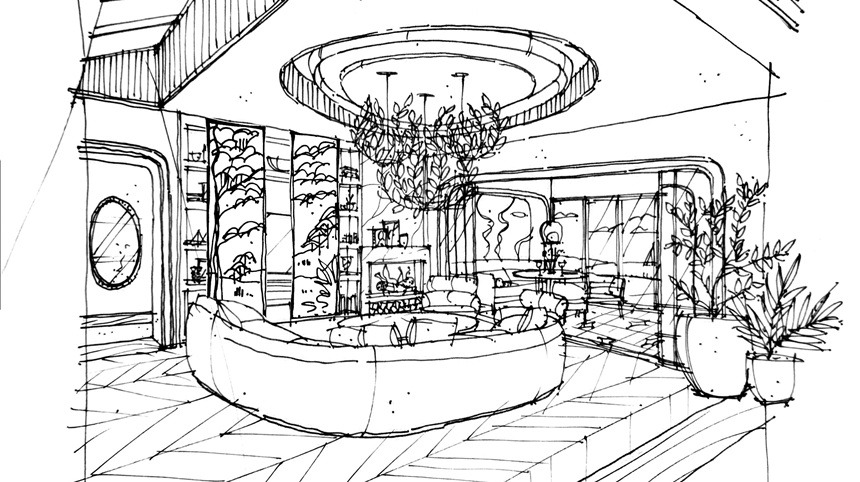
The big reveal for a virtual showhouse featuring neuroaesthetic and biophilic design and created by five interior designers will be part of the Science in Design keynote presentation at High Point Market.
HIGH POINT — The intersection of home, health, wellness and design has gone mainstream.
As economic and geopolitical uncertainties continue to disrupt business as usual, consumers across nearly all demographics are expressing interest in improving their quality of life through purposeful design that supports home’s vital role in well-being.
Although once more of an academic talking point, the concept of health and wellness as a crucial component of product development and design has evolved from highbrow conversations to science-based studies that underscore the supposition, and many consumers have taken note. Consequently, the home furnishings industry — now juggling macro challenges for what some say is the sixth year in a row — hasn’t often had the luxury of time to develop best practices and strategies supporting concepts like neuroaesthetics and biophilic design, but Science in Design‘s Mike Peterson is spearheading a project that can help.
See also:
At the upcoming High Point Market, Peterson and a team of certified designers will discuss how to apply science-backed, health-promoting design strategies. In “Creating Health-Based Design: Beauty, Neuroaesthetics, and Biophilia,” designers Angela Harris, Kat Blue, Marie Cloud, Michelle George, Gabrielle Kozuh-Joo, and Erica McLain will explore how color, light, texture, and spatial flow affect brain health and how to use evidence-based strategies in interior design.
During the keynote, the designers also will walk through a virtual showhouse they created that demonstrates how research-backed concepts in neuroaesthetics and biophilic design can be applied in resident interiors.
In an exclusive interview with Furniture Today, Peterson and the designers spoke about the virtual showhouse as well as how they are using wellness-based design in their own businesses.
“The movement behind neuroaesthetics and biophilic design is no longer niche,” said Peterson. “It’s becoming an everyday framework for how we think about space, product and experience.
“At its core, neuroaesthetics studies how beauty, nature and intentional design impact the brain and body,” he continued. “Advances in neuroscience and behavioral science now confirm what people have intuitively felt all along: Our surroundings directly influence mood, focus, stress levels and overall health. In parallel, biophilic design reinforces the idea that humans are biologically wired to respond positively to nature and natural forms.”
Peterson added that what was once considered artistic or luxury-driven thinking is now widely recognized as practical and performance-driven, and that the principles have gained traction because they help reduce stress and burnout, improve cognitive performance, enhance emotional well-being and create environments that people want to return to repeatedly.
“This shift is visible far beyond boutique design circles. Major corporations are embedding these ideas into large-scale environments,” said Peterson, pointing to specific initiatives at Amazon, Microsoft and Apple.
Additionally, he noted that academia and the broader design community are validating the shift with universities now offering courses connecting neuroscience and design, and designers and product teams increasingly referencing neuroaesthetic research to support decisions that go beyond appearance.
“Design is no longer viewed as ‘just aesthetic,’” said Peterson. “It is understood as a biological intervention, one that shapes how we think, perform, and live. That’s the clearest sign the movement has moved beyond niche; it’s no longer a style preference. It’s becoming common sense.”
For the virtual showhouse, each designer created a space using principles of neuroaesthetics and biophilic design as the basis for design. As they moved through the creation of their specific rooms, the designers drew upon experience, education and intuition for their final plans, a process they will explore in detail at the keynote event.
The rooms and designs
“I am designing a bedroom suite for a neurodivergent eight-year-old boy,” said McClain. “He is mildly autistic, highly auditory sensitive, and he also struggles with allergies. My top goal is to create a private haven that supports regulation and growth through adolescence, a room that can hold him on hard sensory days, while still encouraging independence, confidence and healthy stimulation.”
 A bathroom design for a mildly autistic boy is part of the virtual showhouse.
Kozhukh-Joo is designing the kitchen, prep kitchen and dining area of the home. The family profile includes parents with two children, one neurodivergent, a factor that influenced Kozhukh-Joo’s design goal of creating a space that is “grounded, calming, restorative and low in sensory stress.”
“These are the spaces where daily rituals and family connection happen, so my goal is to show that highly functional rooms can also be deeply supportive of health and well-being,” said Kozhukh-Joo. “The overall palette is earthy and mineral-based, intentionally soothing rather than sharp or overstimulating. I am incorporating natural light, mindful materials, healthy and lower-tox finishes, curved architectural gestures, and layered lighting to reduce glare and support daily rhythms.
Cloud is designing the entire second floor of the home as a wellness oasis and a restorative teen space, describing the level as “dedicated to reflection, restoration and emotional well-being within the context of everyday living.”
“My goal is to demonstrate that wellness-centered design does not need to feel clinical or minimal to be effective. It can be expressive, layered, and deeply residential while still applying principles rooted in science,” said Cloud. “The space explores how environmental cues can help the body transition from the stimulation of the day into a more restorative state.
“Neuroaesthetic strategies include layered lighting that supports circadian rhythm, spatial cocooning moments that create a sense of psychological safety, and sensory balance through texture, color and materiality. Biophilic principles are woven throughout the design through natural materials, views to the surrounding landscape, organic forms, and subtle references to patterns found in nature.”
 Cloud is incorporating Kohler’s full wellness shower experience through the Anthem+ system, including the Ice Shower feature, a hydrotherapy element that introduces cold-water stimulation designed to increase circulation and invigorate the body. Curved furnishings and arched architectural openings are also used throughout the upper level to echo forms found in nature and soften spatial transitions.
“The goal is to demonstrate how these principles can exist within a real home as part of everyday living,” said Cloud.
For the great room, Blue is creating a design space “where family gathers, guests are welcomed and everyday life unfolds,” and she added that the goal is to create a space that is both uplifting and restorative by using Science in Design principles.
“We incorporated Prospect-Refuge Theory by providing filtered views to the outdoors while also creating moments of enclosure and comfort,” Blue said. “Decorative screens in the dormer windows filter natural light and create dappled lighting patterns, which the brain associates with sunlight filtering through trees.
“Biophilia is expressed through open views to the natural landscape, integrated live plants and a hand-painted mural that evokes expansive natural scenery, giving the mind a moment of visual respite. We also layered fractal patterns into the floor design, millwork and trim details to subtly mirror the complexity found in nature. Finally, the space is grounded in natural materials — wood, stone, plaster, and metal — chosen not only for beauty, but (also) for the way they influence how we perceive and emotionally experience a room.”
Harris is designing the primary suite including both the bedroom and bathroom for the virtual showhouse with a goal of creating a “deeply restorative retreat.”
“Because sleep, recovery and quiet reflection are essential to overall health, the primary suite is an ideal place to showcase how science-informed design can shape everyday experience,” said Harris. “From a neuroaesthetic perspective, the space will emphasize visual clarity, balanced contrast and layered sensory cues that help the brain settle and relax.
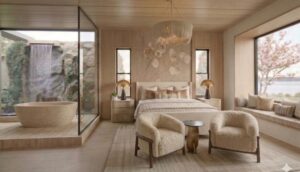 Angela Harris is creating the primary suite design for the virtual showhouse.
“Biophilic principles will play an equally important role,” she continued. “Natural materials, tactile textures and subtle references to nature — such as curvilinear forms and fractal-inspired patterns — create a sense of grounding and connection. Lighting will be layered and dynamic to mimic natural rhythms, supporting circadian health and the transition from day to evening.
“Together, these elements demonstrate how science and design can work hand-in-hand to create a space that feels intuitive, restorative and deeply human.”
Design to dollars
Peterson hopes that, along with designers, more manufacturers and retailers will begin to better understand the potential competitive advantages that health and wellness product and space designs offer in a challenging marketplace.
“Incorporating biophilic design and neuroaesthetics into home furnishings development offers both strategic business advantages and measurable consumer benefits,” he said. “As homeowners increasingly prioritize wellness, sustainability and emotional comfort, these approaches can create strong differentiation in a crowded market.
“Manufacturer benefits include stronger product differentiation, premium pricing power, alignment with wellness and sustainability trends, and increased customer satisfaction and loyalty. Design is no longer an aesthetic. It is a biological intervention.”
“Creating Health-Based Design: Beauty, Neuroaesthetics and Biophilia,” is scheduled for 3-4 p.m., Sunday, April 26, at the High Point Theatre. Hosted by Mike Peterson, the program will feature keynote speakers Kat Blue, Marie Cloud, Michelle George, Angela Harris, Gabrielle Kozuh-Joo and Erica McLain.