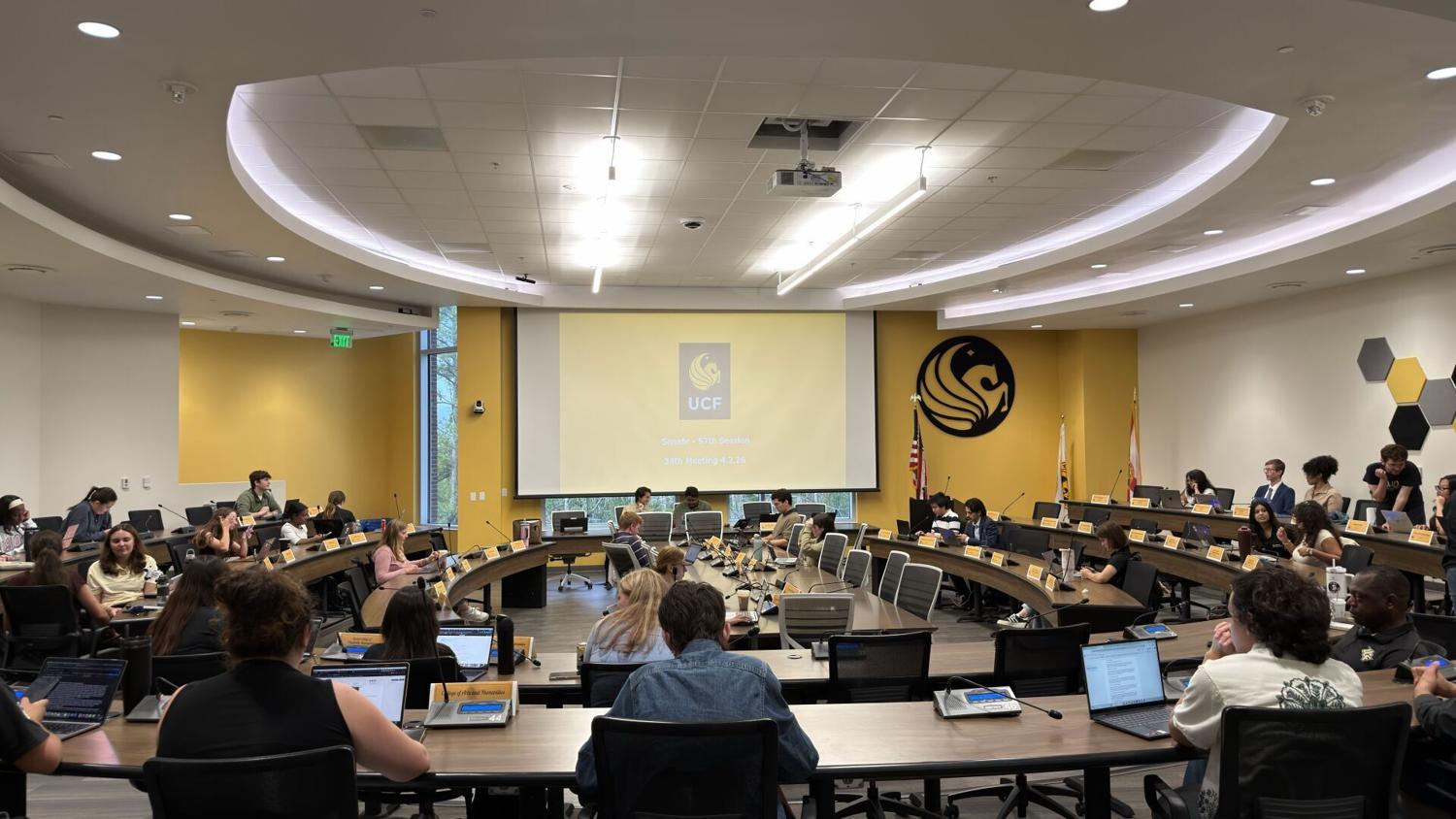
UCF Student Government established a new caucus that focuses on health and wellness Thursday night during a Senate meeting to create a more “human” approach to student well-being.
The measure, brought by Jordan Lipner, a senator of the College of Undergraduate Studies, and Caleb Berrios, senator-elect for the College of Sciences, secured the votes needed to pass on the Senate floor after two failed proposals.
The caucus is designed to represent students whose ability to succeed in university life is shaped by mental and physical health challenges. It also aims to break down stigma and make conversations around mental health more accessible.
A primary focus is creating a student-led space where individuals can connect, speak openly and feel supported.
“Students don’t always need another office to do paperwork. Sometimes they just need a room where they can speak,” said Lipner, senior environmental studies and political science double major.
While Lipner formally introduced the resolution, Berrios said the idea originated from his time in the Student Government Leadership Council, where he began developing the concept before collaborating with Lipner to draft the legislation.
“This caucus is not just another organization. It is an acknowledgment that student well-being matters, that their voices matter, that they matter,” said Berrios, freshman biology major.
The narrow 18-15-0 vote established the Health and Wellness Caucus through Resolution 57-20. The resolution ultimately passed on its third reading after senators gained a clearer understanding of the caucus’s purpose and potential impact, Berrios said.
“I think it was important that senators saw the real purpose behind the caucus and the benefit it can bring to students,” Berrios said. “Having senators speak out, along with presenting data and sharing our intent more clearly, made a difference.”
He also credited Lipner, the caucus leadership committee chair, with helping push the resolution forward, who Berrios said was “the propellant behind its passing.”
However, not all senators agreed that a new caucus was necessary.
“Issues like student well-being are something that Student Body Advocacy takes very seriously,” said Mila Teodorescu, College of Sciences senator and Student Body Advocacy chair.
Teodorescu, sophomore psychology major, added that there was no “lack of representation” requiring the creation of a new legislative body.
Lipner said the caucus will focus on improving awareness and accessibility of existing campus resources, which he said are often underutilized.
Berrios added that the caucus also aims to serve as a bridge between students and university administration, particularly for those who may feel overwhelmed navigating support systems.
It plans to coordinate with nearly 50 health-related registered student organizations and multiple university departments, including Counseling and Psychological Services, Student Health Services and Recreation and Wellness.
Berrios said he plans to begin outreach efforts ahead of the caucus’s launch to establish those relationships and support future initiatives.
The caucus will operate starting in the summer B semester, serving as a trial period before seeking permanent inclusion in Student Government statutes.
Students will be able to get involved by attending meetings, participating in events and sharing concerns through their college senators.
“What we are missing is not just services, but also connection,” Berrios said. “It is community.”