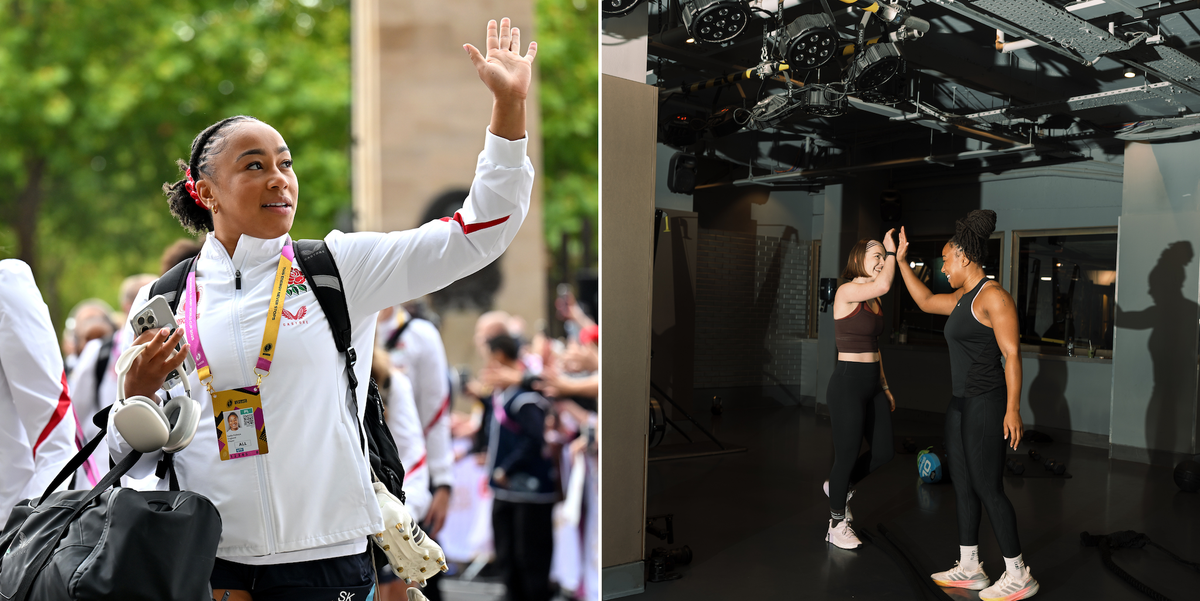
Despite still only being 24, England and Loughborough Lightning player Sadia Kabeya has already made a notable impact on the international rugby stage – from her impressive, dynamic performances on the pitch to her advocacy work off it.
Ahead of the 2026 Six Nations, which kicks off on Saturday, Women’s Health joined Sadia in the gym to hear about the prep that goes into massive tournaments like this, her rugby journey so far, and the impact her satin scrum cap is having on keeping girls and women in sport.
Discovering rugby by chance
A child with ‘too much energy’, Sadia says she did any sport that she was offered, mostly focusing on gymnastics before trying rugby by chance at secondary school. ‘One day in year 7 or 8, my teacher came to my science lesson and was like, “we’ve got a rugby team, we don’t have enough people, do you want to come?” And I was like, yeah, sure, let me get out of this lesson,’ says Sadia. ‘Since then, I haven’t looked back.’
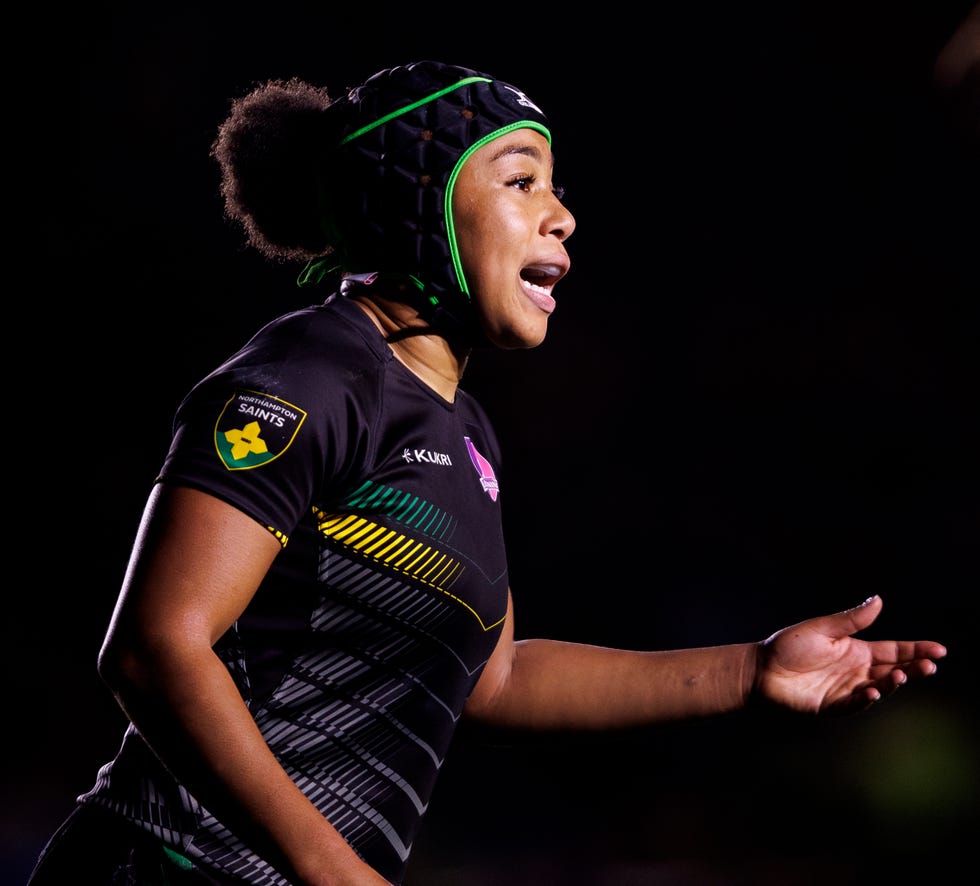 Bob Bradford – CameraSport
Sadia plays for Premiership Women’s Rugby side Loughborough Lightning
A decade on, has young girls’ access to rugby improved? ‘It’s definitely changing but I still think there’s a long way to go,’ says Sadia. ‘I think it should be at least an option on all curriculums [because] the main thing is having the opportunity, it doesn’t mean that you need to play rugby – but you don’t know if you can’t try.’ That’s key, she adds, to continuing the momentum that women’s rugby has garnered in recent years (in part thanks to England’s dominant force on the international scene). ‘I think there’s a lot of girls out there who have picked up the ball later on in life who wish they had that chance to do it in school.’
Balancing rugby with studying
Alongside being an elite athlete, Sadia studies sport and exercise science at Loughborough University part-time, which she admits can be a tough balancing act, but that she’s ‘a strong believer in having a degree and being able to have another option, even though [rugby] is my career now.’ While it can be difficult to squeeze in uni work during the hours off in camp, Sadia says she thrives on structure and routine.
Training like a Red Rose
Luckily, there’s a lot of that when it comes to preparing for a huge tournament like Six Nations. A typical week of training, explains Sadia, involves four training days and one match day. ‘We start at 1pm and finish at 8pm, and it consists of a skill session, a big gym session and then a main training session in the evening.’ In camp, everything ramps up. ‘It’s seven days a week – when you’ve got a big tournament coming up, you need to be able to lock in.’
‘I really don’t enjoy running,’ says Sadia when quizzed on her favourite workouts – which is quite unfortunate for an athlete who has to run a fair bit. Thankfully, she adds, the team wouldn’t typically go out and run a 5k – everything is rugby-specific. ‘We might do a 5k pitch session that includes changes of direction and down-up stuff that would be transferable to a rugby pitch.’ Her favourite exercises? Anything lower body. ‘I love a squat – exercises where I can feel like they’re working immediately.’
‘I really don’t enjoy running’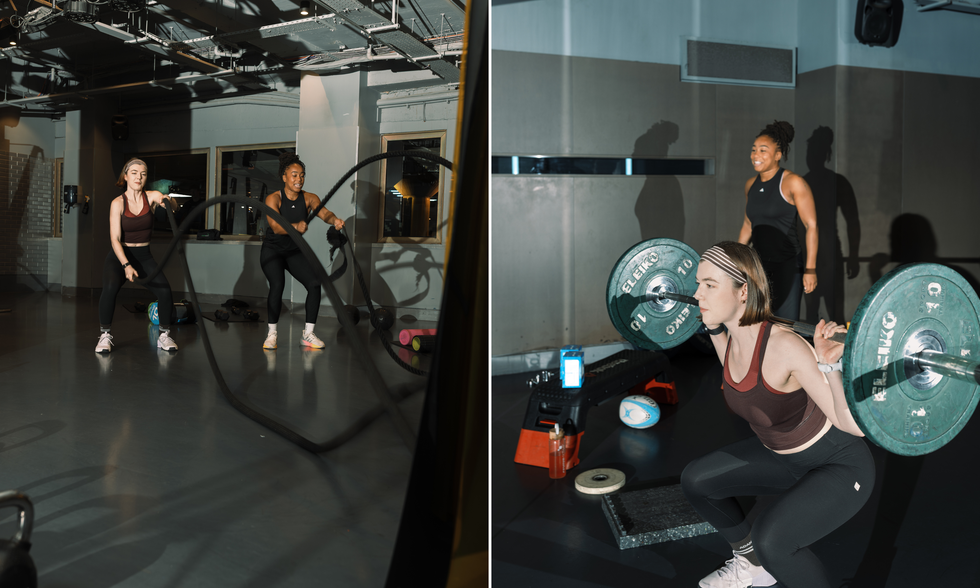 Revive Active
WH senior health and fitness writer Hannah getting a taste of Sadia’s Six Nations training
Protecting against impact
A key aspect of training is helping to protect players against impact. In light of the increasing research and awareness around concussion – four years ago, World Rugby made a commitment that any research they did on the men’s game, they would also do on the women’s game – ‘a lot of our workouts are done as prevention – a lot of stuff around neck and shoulder strength to be able to limit those impacts,’ says Sadia. ‘If you were to see me doing a session in the gym, you might think it looks a bit weird because I’ve got a rubber band around my head or I’m pushing my head into a wall or something, but a lot of it is done to strengthen those muscles you can’t see.’
As World Rugby’s Science and Medical manager Dr Lindsay Starling told WH last year, according its research, women appear to be more susceptible to concussion than their male counterparts (they found that for every contact event, a woman is more likely to get injured than their male counterpart). There’s multiple theories being studied as to why this is the case, but one is indeed linked to neck strength. ‘The circumference of our neck is smaller and the strength of our muscles is reduced in comparison to male counterparts. So, it’s possible that women have reduced strength and stabilisation from their neck, which could then make them more susceptible,’ explained Dr Starling. This research is informing approaches to training – including those unconventional exercises you might catch Sadia doing in the gym.
Fuelling and recovery
Sadia says she’s learnt a lot about fuelling and recovery over the years. When she first started playing rugby, she wouldn’t eat much after a game, ‘but then the next day, I would be absolutely knackered because I didn’t have any fuel in my body’. Now, though, she says players have access to detailed nutrition plans – including guidance on supplements – and other recovery protocols such as ice baths and sports massages.
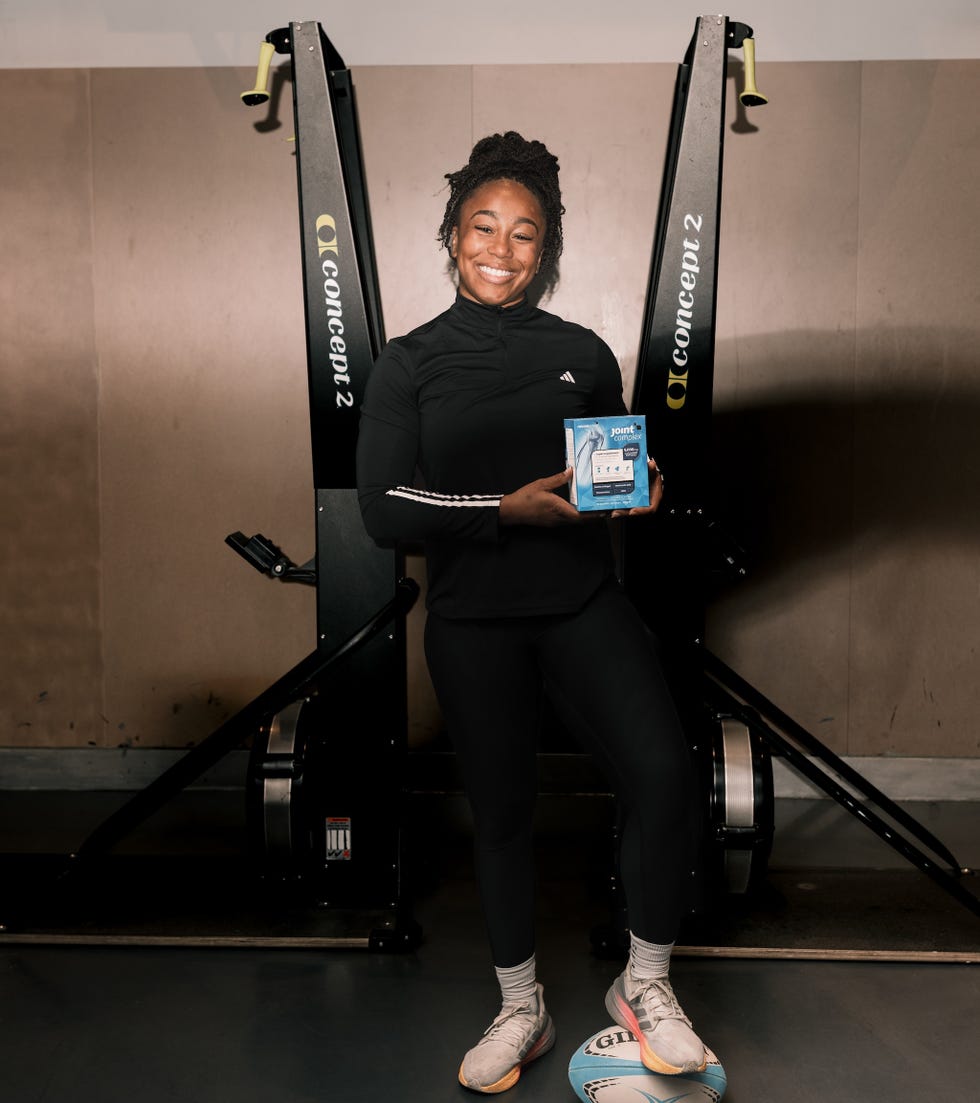 Revive ActiveSadia – who is an ambassador for Revive Active – says vitamin D and iron are two of the most important supplements for rugby playersDowntime
Having some downtime amidst all the training and planning is also crucial. ‘I think with a high-performance sport, you try to do the most low-energy things in your spare time,’ says Sadia. ‘With rugby, it’s all about going for coffee,’ she adds – or a matcha, in Sadia’s case. ‘Finding the best coffee places and bringing the cards out while you’re there.’
But she’s also someone who needs her own space, especially during camp. ‘Once the day’s done, I need to be able to just regenerate by lying flat in my bed or going for a walk,’ says Sadia. ‘Having that mental headspace is important.’
The satin scrum cap
And on top of all the training, competition and studying, Sadia has still had time to make a difference off the pitch, too, particularly with the satin scrum cap she designed with Gilbert to help protect players’ hair. ‘I came into rugby from a very non-traditional background,’ she says. ‘And as a woman of colour, looking after my hair and that being a thing for me was always huge.’ But as Sadia quickly discovered, scrum caps weren’t really designed to ‘make your hair look neat’. ‘It’s very common within curly hair communities to wear a silk bonnet or headscarf to bed,’ she adds, ‘and I thought, why can’t I combine those two things by adding a satin layer into the scrum cap?’
It might seem like a small thing and it ‘could have been done ages ago’, says Sadia, but she’s glad it’s happening now and is ‘very, very proud’ of the impact the scrum cap has had. ‘These things can be barriers – as a girl from south London, I know how big it is to upkeep your looks, and having something like this can just take away a small barrier to keeping girls in sport, keeping girls in rugby.’
You can watch as England take on Ireland in their first Six Nations game on Saturday, April 11 at 14:25 on BBC One and iPlayer.
Related Stories
Hannah Bradfield is a Senior Health and Fitness Writer for Women’s Health UK. An NCTJ-accredited journalist, Hannah graduated from Loughborough University with a BA in English and Sport Science and an MA in Media and Cultural Analysis. She has been covering sports, health and fitness for the last five years and has created content for outlets including BBC Sport, BBC Sounds, Runner’s World and Stylist. She especially enjoys interviewing those working within the community to improve access to sport, exercise and wellness. Hannah is a 2024 John Schofield Trust Fellow and was also named a 2022 Rising Star in Journalism by The Printing Charity. A keen runner, Hannah was firmly a sprinter growing up (also dabbling in long jump) but has since transitioned to longer-distance running. While 10K is her favoured race distance, she loves running or volunteering at parkrun every Saturday, followed, of course, by pastries. She’s always looking for fun new runs and races to do and brunch spots to try.