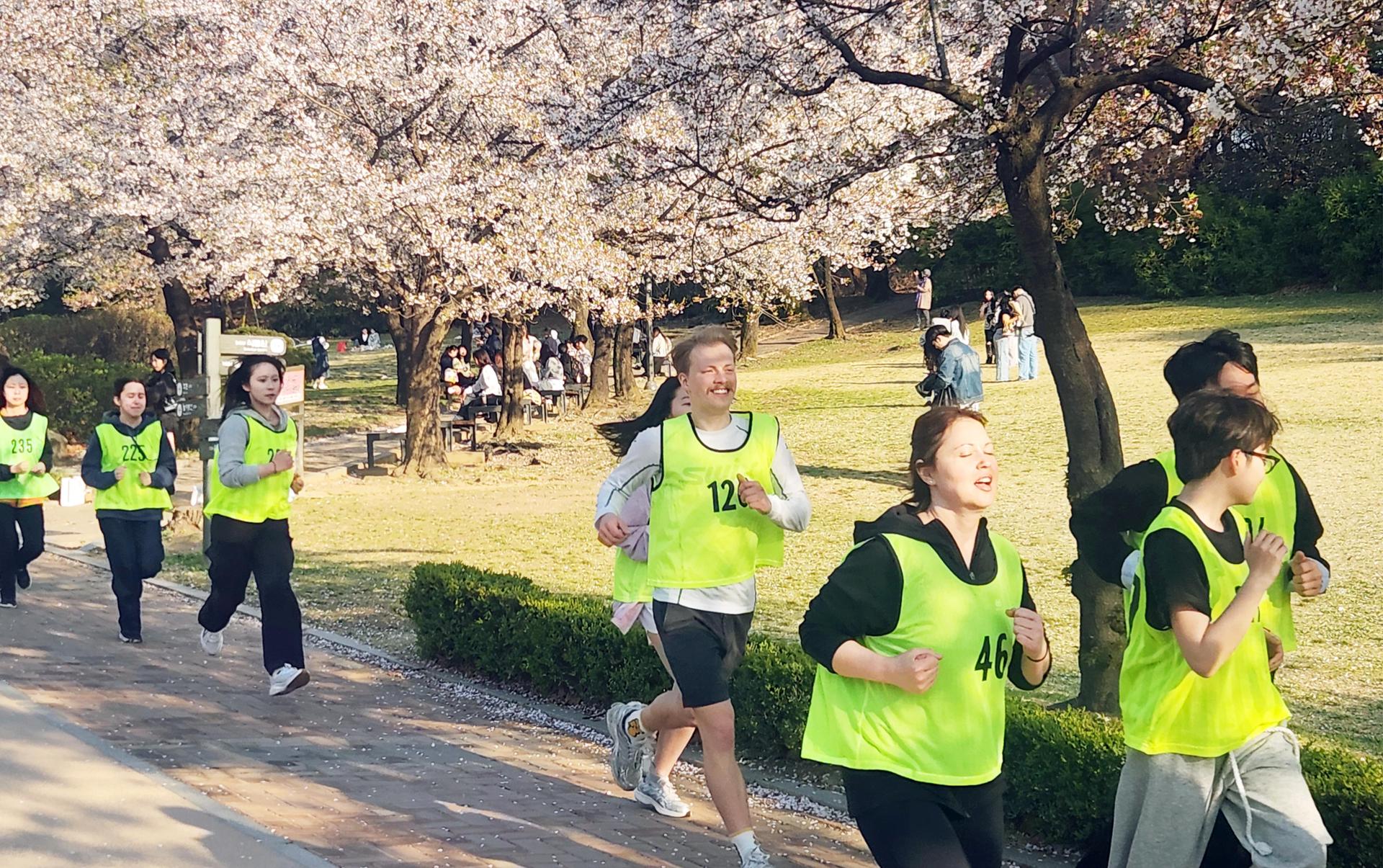
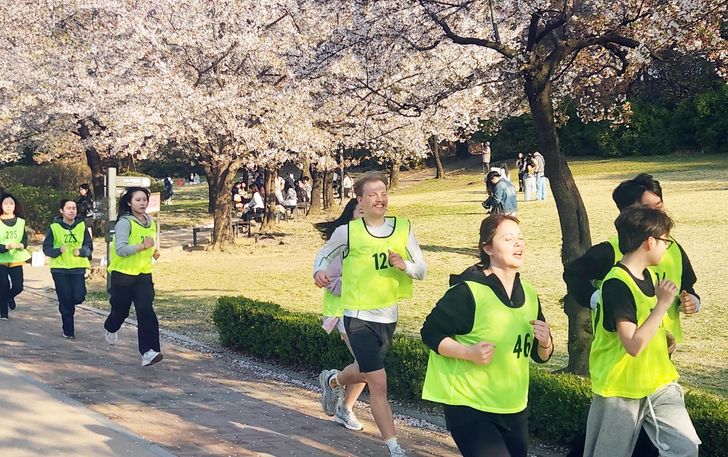
Sejong University students run at Seoul Children’s Grand Park in Gwangjin District, Seoul. Courtesy of Sejong University
Sejong University’s Daeyang Global College is offering a hands-on course for international undergraduate and exchange students during the first semester of the 2026 academic year, blending physical activities with learning Korean culture.
The course, titled “Running & Korean Culture,” is designed to combine physical activity with firsthand exposure to everyday Korean life and urban environments, with the aim of improving students’ physical fitness and deepening their understanding of and adaptation to Korean society.
Classes are held at Seoul Children’s Grand Park in Gwangjin District, directly across from the Sejong University campus.
Students run and engage in outdoor activities amid a green urban setting, allowing them to encounter Korean leisure and lifestyle culture naturally.
Last week, the sessions took place amid cherry blossoms in full bloom, with activities including running, the “Red Light, Green Light”— a traditional Korean children’s tag game famous for featuring on Netflix show “Squid Game” — and a police-and-thief chase game, giving participants a chance to enjoy Seoul’s spring season.
The university said it conducted advance analysis of foot traffic and timing to minimize inconvenience to park visitors and established a framework for university-community cooperation in the use of public facilities through coordination with the Seoul Facilities Corporation and Seoul Children’s Grand Park management.
A Seoul Children’s Grand Park official said the program represents a meaningful collaboration between a university and a public facility to create educational value while maintaining order for ordinary visitors, and noted that the course provides a natural channel for international students to connect with the local community.
Sejong University President Eom Jong-hwa said international student education must be redesigned to move beyond basic orientation support, offering students genuine connections to Korean society and culture, and added that the university is continuing to develop new educational models that treat the city and the broader community as an extended learning space.
The university said it plans to continue expanding experiential curricula linked to public spaces as a model for international student education.