
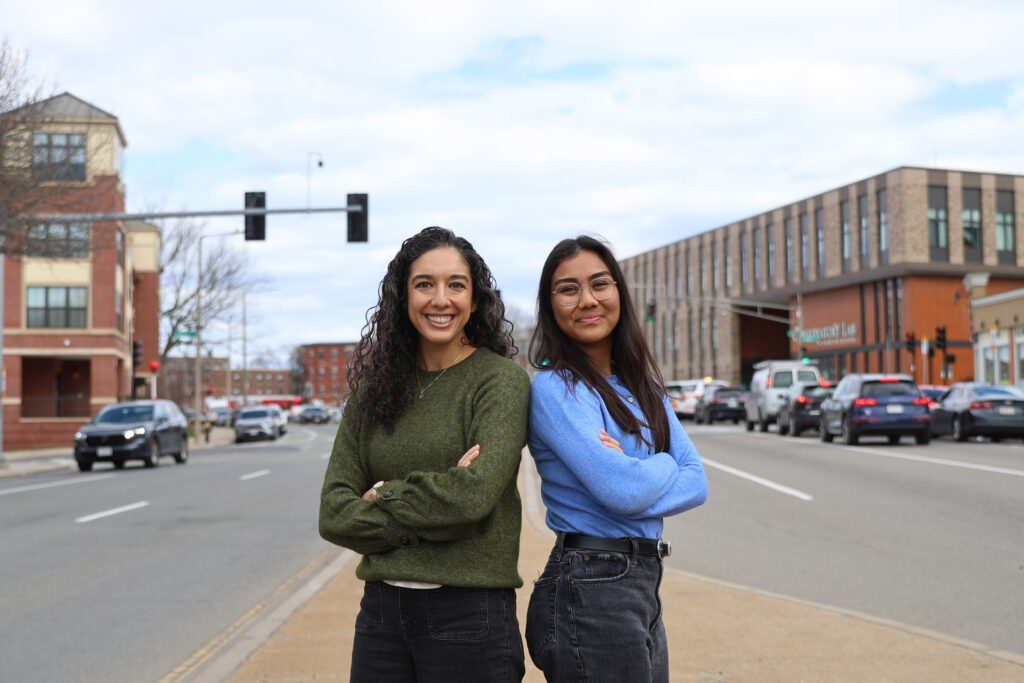
Maggie Carmona (left) and Annesta Batuwangala, MPH alums, outside their office in Dorchester. Photo: Mike Saunders
All News
Maggie Carmona and Annesta Batuwangala, MPH alums and colleagues in the Boston Public Schools Office of Health and Wellness, discuss their unique paths to public health, their shared passion for health communications, and their collaborative efforts to engage student leaders.
After only discovering public health once they were well into their 20s, Maggie Carmona (SSW‘19, SPH‘20) and Annesta Batuwangala (SPH‘23) are determined to introduce the next generation to the field a lot earlier.
As employees of Boston Public Schools’ (BPS) Office of Health and Wellness, Carmona and Batuwangala lead a Youth Advisory Board that offers BPS students a crash course in public health and the opportunity to make a difference in their communities while they are still in high school.
Both Carmona and Batuwangala came to public health after studying psychology during undergrad; Carmona at Stonehill College and Batuwangala at Stony Brook University. When they each concluded that clinical practice was not the right fit, they both pursued Master of Public Health (MPH) degrees at the School of Public Health. Carmona, who also earned her Master of Social Work (MSW) degree at BU, started working at BPS during a field placement for her MSW coursework and never left. When she was promoted from health promotion coordinator to her current position as wellness council support manager, she hired Batuwangala to fill the role and the two have worked together closely over past three years.
“[Batuwangala] keeps me grounded,” says Carmona. “She says, ‘Okay, let’s talk about logistics. Let’s talk about the structure.’”
Batuwangala, who sits two cubicles away, appreciates that both herself and Carmona are inclined to talk their ideas through out loud and she credits Carmona with often connecting the dots.
“She does a really great job of thinking about the big picture and how can we make sure that we’re connecting all of these people and making sure that [the] youth voice is heard,” says Batuwangala. The entire Office of Health and Wellness has a collaborative culture, she says. “Everyone in our office really cares about improving the health and wellbeing of students. I think that makes it easier for all of us to be aligned on the same overarching goals.”
According to the BPS Office of Health and Wellness website, Carmona, Batuwangala, and their colleagues are guided by two comprehensive goals: “to actively promote the social, emotional, and physical wellness of all students to support their healthy development and readiness to learn” and “to create safe, healthy, and sustaining school environments where the healthy choice is the easy choice.”
To meet these goals, the office is organized into five teams: health education; physical education, physical activity; social-emotional learning and instruction; and wellness policy, promotion, and data evaluation. Carmona and Batuwangala sit on the wellness policy, promotion, and data evaluation team. Carmona is responsible for collecting and communicating data and other resources to support the work of wellness councils at each of the districts’ schools and Batuwangala creates health-promotion materials for different health challenges and student populations. Batuwangala also oversees BPS’s condom accessibility program, which provides sexual health counseling and supplies to high school students. Together, they run the Youth Advisory Board.
While working for a big system like BPS comes with challenges, Batuwangala says she really enjoys the opportunities she has to exercise creativity in executing her team’s shared goals. They learn a lot from each other, Carmona adds. “[BPS] attracts a lot of people who are mission-driven, deeply care, and have values that align with my values,” she says. “There’s always an opportunity to learn something new and think more deeply about something.”
SPH chatted with Carmona and Batuwangala about discovering a passion for health communication at SPH and their efforts to promote student health and elevate student voices at BPS.
Q&AWith Maggie Carmona (SSW‘19, SPH‘20) and Annesta Batuwangala (SPH‘23)
SPH: Are there particular skills you learned while students at SPH that you find yourselves using in your jobs?
Batuwangala: Everything—my skills got me the job! I took Jacey Greece‘s course, [Designing Strategic Interventions and Communications to Advance Public Health], and that really set me up for success in my career. The class gave me all the skills that I needed to do the health promotion work that I do now. A big part of that is creating a strategic communication plan and really thinking about who the target audience is and the different ways that we can [spread] information. I try to take some of what I learned and put it into our Youth Advisory Board lessons. Also, Craig Andrade‘s [Strategies for Public Health Advocacy] course. That has also helped me develop the Youth Advisory Board lessons and just helps me think about how our students can better advocate for the things that they feel passionate about.
Carmona: I think the course that surprised me most was the [From Data to Dashboards: Building Excel Skills to Support Health Program Decisions] course I took my last semester at SPH. I was just intrigued by it, and now, I absolutely love getting into Google Sheets and putting together a dashboard so we can communicate information.
SPH: In your roles in the Boston Public Schools’ Office of Health and Wellness, you collaborate to lead the district’s student-led advisory group. Can you talk about what that entails?
Batuwangala: Yes, a rundown of Youth Advisory Board—we reach out to different [high] schools to invite students to apply to the program. We interview them, and then once students join, we give them a five-lesson crash course in public health. We teach them intro to public health, health equity, health communication, health data, and health advocacy. I was trying to combine two years—a whole MPH—into five lessons. Then, they pick a topic that they’re passionate about. We want them to look at the problems that they see in their school, in their community. We try to help them figure out how they can address that problem. Then, they get into groups based on their interests, and they decide on a project. We created a workbook for them to use throughout the year to guide them through the creation of a communication deliverable and an advocacy deliverable, and we’re working to try to incorporate student voices into various BPS initiatives.
Carmona: We started it in the school year 2020-2021. It started in that school year fully remote and now, we’re fully in person, which I think has really made a difference in the sense of community that gets built. Our office operates on a lot of different grant funding [and] one of our major grants is from the CDC. We call it, ETTH, our Empowering Teens Through Health Grant. What that grant really focuses on is increasing access and quality of health education for middle school and high school students, specifically mental health services and sexual health services, and then creating safe and supportive school environments for all students, but primarily for our LGBTQ students. So, we have these three strong lenses that we try to do a lot of the work through. It’s growing every year. We have about 17 to 20 consistent students this year, and we allow students who’ve been part of it [before] to return, and we try to find leadership opportunities for them, whether that’s helping interview new students [or] lead the public health lessons.
SPH: Could you give a few examples of student projects that have come out of the Youth Advisory Board in the past?
Batuwangala: There were so many good projects. Last year, we had a group advocate for health education in our district. They started to lead introductory health education lessons in some of the elementary schools. They were received well, and they had a lot of fun doing it. Then, we have another group that is doing a mental health podcast. They’ve interviewed professionals in the area—social workers, but also public health professionals—to get their opinion on adolescent mental health. They’ve also interviewed their peers to talk about the stigma that’s associated with it. We’ve had a group create a biking advocating for biking in the city. They talked about the different rules of the road and how to get access to biking resources in the city. We had another student write a fourth-grade children’s book for students with disabilities. She got to go to the schools and read aloud to the elementary school students.
SPH: What does it mean to you to work with BPS students?
Carmona: This is such a cool opportunity that we wish we would have had because we didn’t know about public health until later in our lives. It’s just really fun, energizing work. The students take it seriously. They know it’s meaningful and impactful, and they’re not just doing something for their resume or their own growth, but they [say], “No, we really want to make change across the district and make healthier communities.”
We’ve had students who are 1776509198 11th graders who started in seventh grade, and it’s amazing to see the way they approach public health in the BPS system and all the things that they think about having just experienced the Youth Advisory Board. One student I’m thinking of, even his parents [said], “This gave him so much confidence.”
Batuwangala: The Youth Advisory Board is probably one of my favorite parts of the job just because seeing the amount of growth that [the students] have, even just in one year. It takes a while to crack their little hard outer shells, but as they get to know us more and as they get to know each other more, we just see them open up and start to connect the dots. Things that I have never once considered until grad school, they’re connecting in high school. It’s great to know that those students are going to be carrying on the legacy of public health.
Related
Explore Related Topics: