
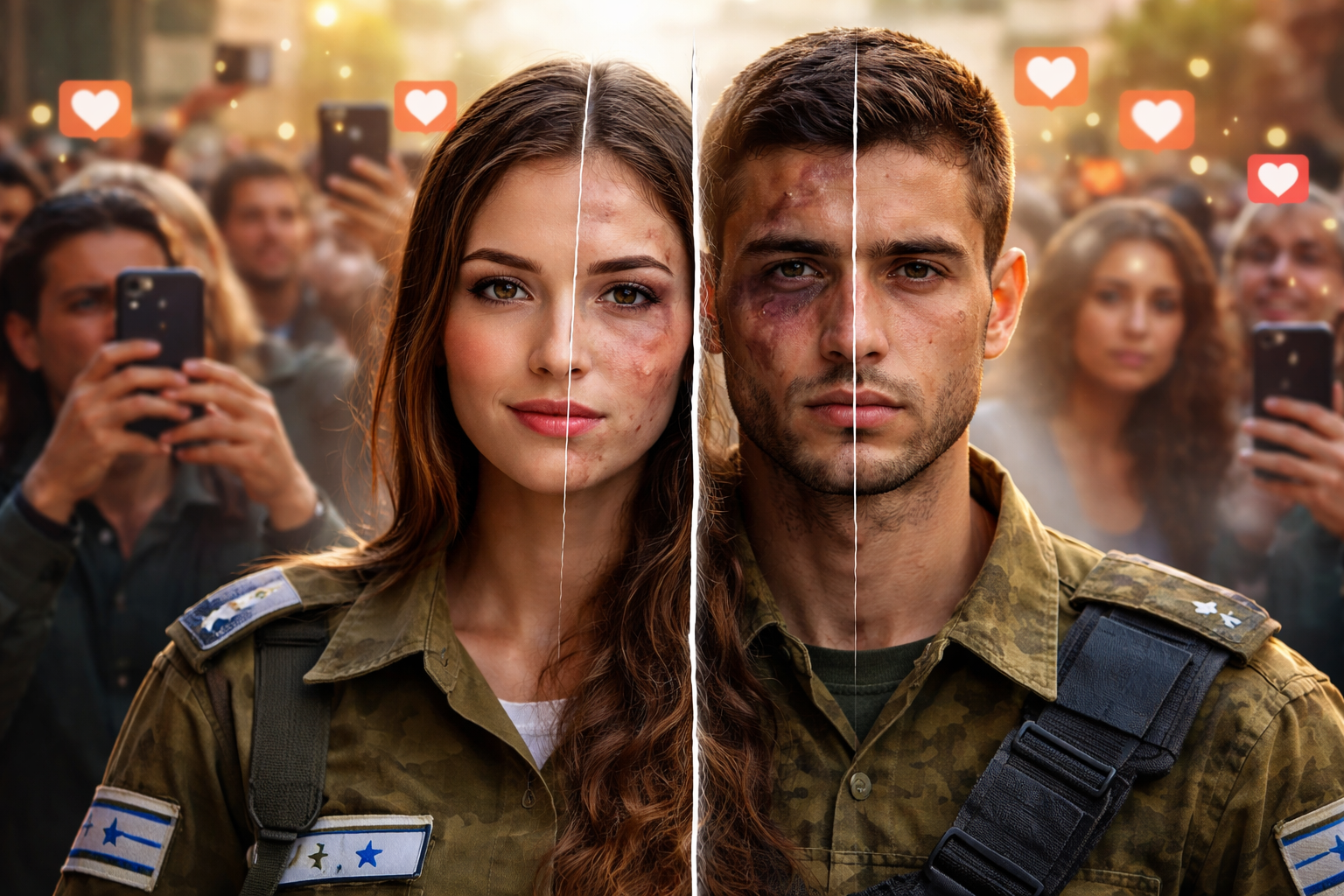
Imagine being a young woman in Israel who looks completely ordinary. Your hair is a bit thin, your teeth are not perfectly straight, maybe your nose feels too small or your ears too big. Perhaps you have a pimple that refuses to go away or a birthmark that draws attention in ways you never asked for. You do not match the polished, filtered version of beauty that fills screens and headlines. Yet your life is full of meaning. You serve in the army. You support your friends when they are struggling. You help your grandmother with her groceries because she cannot walk alone. You study, you think deeply, you contribute. You are kind. You matter.
Now imagine a young man serving beside you. He might be strong and determined. Maybe he is considered attractive, maybe not. It does not really matter because people tend to accept that men come in all forms. His value is rarely reduced to how he looks. He is judged by his actions, his courage, his character.
These are just two ordinary people. Real human beings with depth, effort, and dignity. But then something shifts. A photograph appears online. A woman, not even necessarily representative of the average soldier, is captured through a carefully crafted lens. The lighting is perfect. The pose is deliberate. There is just enough allure to trigger attention. Suddenly the narrative changes. Praise floods in, focused almost entirely on beauty. Words like beautiful and brave are thrown together as if they are naturally linked.
What happens to the people described earlier in that moment. The ones who serve, who care, who carry emotional and physical weight every day without recognition. It must be painful to see how quickly substance is overshadowed by appearance. To realize that no matter how much you give, it can feel invisible if you do not fit a certain visual ideal.
This obsession with beauty feels deeply out of place when compared to the values many associate with resilience, community, and purpose. It feels shallow. It feels empty. And yet it is not limited to one place. It reflects a broader pattern that has spread across societies, heavily influenced by a culture where appearance and status often outweigh character and contribution.
Recently, there have been moments where even very young individuals are pushed into the spotlight primarily because of how they look. Media attention amplifies this, turning a person into an image before they have the chance to simply exist as themselves. What might seem like a compliment on the surface can carry a deeper cost. It shapes expectations, invites objectification, and reinforces a narrow definition of worth.
At the same time, countless people who are beautiful in their actions, in their kindness, in their integrity, remain unseen. They are the ones who hold communities together. They are the ones who show up when it matters. Yet their recognition is limited because it cannot be captured in a single striking image.
This raises a difficult question about what kind of society we are building. When attention is given so easily to surface level traits, what message does that send to everyone else. What does it teach young people about what they should strive for.
A world that places less emphasis on appearance and more on moral strength, empathy, and achievement would feel very different. It would allow people to be valued for who they are rather than how closely they match an ideal. It would create space for dignity that is not dependent on approval or comparison.
Every time we elevate one person purely for their looks, especially in public spaces, we risk diminishing the value of others who contribute in quieter but far more meaningful ways. Recognition should not be a competition based on appearance. It should reflect the richness of human character.
There is still an opportunity to do better. To notice more. To appreciate what is not immediately visible. To build a culture where being kind, thoughtful, and strong in spirit is just as worthy of attention as any outward form of beauty.
Time To Stand Up for Israel
Time To Stand Up for Israel is an independent foundation dedicated to fighting misinformation, countering antisemitism, and providing clear, fact-based education about Israel. We do not engage in internal Israeli politics. We stand on two core principles: Israel has the right to exist. Israel has the duty to defend itself.
Support our work: Donate and/or subscribe at: www.timetostandupforisrael.com

CEO of Time to Stand Up for Israel, a nonprofit organization with a powerful mission: to support Israel and amplify its voice around the world. With over 200,000 followers across various social media platforms, our community is united by a shared love for Israel and a deep commitment to her future.
My journey as an advocate for Israel began early. When I was 11 years old, my father was deployed to the Middle East through his work with UNTSO. I had the unique experience of living in both Syria and Israel, and from a young age, I witnessed firsthand the contrast in cultures and realities. That experience shaped me profoundly.
Returning to the Netherlands, I quickly became aware of the growing wave of anti-Israel sentiment — and I knew I had to speak out. Ever since, I’ve been a fierce and unapologetic supporter of Israel. I’m not religious, but my belief is clear and unwavering: Israel has the right to exist, and Israel has the duty to defend herself.
My passion is rooted in truth, love, and justice. I’m a true Zionist at heart.
From my first breath to my last, I will stand up for Israel.