
The global tilapia sector is entering a new phase of complexity, where traditional strengths such as hardiness and adaptability are no longer sufficient to guarantee profitability. This was the central message of Tilapia Talk 2026, a webinar hosted by Lachance Group on April 8, which brought together leading experts from academia and industry to discuss the future of tilapia farming.
Featuring Professor Chang-Wen Huang from the Department of Aquaculture, National Taiwan Ocean University; Dr. Wei Zhang, Lachance Aquaculture Technical Manager; Dr. Zhihua (Andy) Pei, Founder and President, Spring Edge Nutrition LLC; and Professor Abdel-Fattah M. El-Sayed of Alexandria University, the session explored how genetics, nutrition, and functional feed strategies must evolve together to address mounting challenges.
Current status of the tilapia industry
Despite its reputation as one of the most resilient aquaculture species, tilapia is no longer considered an “easy fish” to farm. According to Andy Pei, global production exceeded 7 million tons in 2025, with China, Indonesia, and Egypt leading output. Yet, behind this growth lies a more difficult reality: declining profit margins and increasing operational pressures.
Tilapia farming is being squeezed by four major forces: trade disruptions, disease challenges, stricter regulations, and rising feed costs. Shifting global trade dynamics, particularly tensions between major markets such as China and the United States, have reshaped export flows and pricing structures. As a result, regional specialization is emerging, with Latin America focusing on fresh fillets, Africa driving demand for whole fish, and Southeast Asia relying more on domestic consumption.
At the same time, disease risks remain persistent. Bacterial infections such as streptococcosis and viral threats like tilapia lake virus (TiLV) continue to undermine productivity, particularly in intensive farming systems. Environmental stress, including poor water quality, further weakens fish immunity, leading to reduced survival rates and slower growth.
Regulatory pressures are also increasing. Export markets now demand not only product quality but full compliance with environmental, labor, and traceability standards. This has raised operational costs and forced producers to upgrade their systems.
However, the most significant cost driver remains feed, which accounts for up to 50–60% of total production costs. Even small inefficiencies in feed conversion ratio (FCR) can significantly erode margins. As Andy emphasized, feed is no longer just a nutritional issue; it is a financial one.
In response, the industry must shift from volume-driven growth to efficiency-driven production. This requires a coordinated upgrade across four pillars: genetics, feed, management, and marketing. Genetics sets the biological potential, feed controls costs, management ensures performance, and marketing captures value. The future of tilapia farming, therefore, lies in integration rather than isolated improvements.
Functional feeds
As tilapia farming becomes more intensive, functional feeds are emerging as a critical tool to maintain fish health and performance under stress. Chang-Wen Huang highlighted how nutrition is increasingly being integrated with advanced breeding strategies to create a more precise and resilient production system.
Tilapia remains an attractive species due to its fast growth, adaptability, and relatively low environmental impact. However, traditional farming methods are no longer sufficient to meet modern challenges such as climate change, disease outbreaks, and resource limitations. This has driven the shift toward integrated aquaculture systems, where water quality, feed, and fish health are managed together.
Functional feeds play a key role in this transition. These feeds incorporate specific additives, such as plant-based compounds, probiotics, or bioactive substances, that go beyond basic nutrition to enhance immunity, gut health, and metabolic efficiency. Huang’s research demonstrated how such feeds can improve survival and growth, particularly under stress conditions like salinity changes.
One example discussed was the use of Bidens pilosa, a medicinal plant, as a feed additive. In controlled trials, tilapia fed diets supplemented with this plant showed improved survival rates when exposed to increasing salinity levels. The additive also influenced gene expression related to osmoregulation, indicating a deeper physiological adaptation.
Functional feeds also reshape the gut microbiome, increasing beneficial bacteria while reducing harmful ones. This contributes to better nutrient absorption and overall health. By integrating data from genomics, metabolomics, and microbiome studies, researchers are gaining a more comprehensive understanding of how diet influences fish performance.
El-Sayed further emphasized that feed additives must be used strategically. They can be classified into several categories, including nutritional, technological, sensory, and zootechnical additives, each serving specific functions such as improving digestion, enhancing immunity, or stabilizing feed quality. However, their effectiveness depends on multiple factors, including species, life stage, dosage, and farming system.
Importantly, there is no universal solution. The same additive may produce different results under different conditions, and incorrect usage can even lead to negative effects. Therefore, precision and context-specific application are essential when implementing functional feeds.
Overall, the integration of functional nutrition with genetic improvement represents a shift toward “precision aquaculture,” where feeding strategies are tailored to the specific needs of the fish, environment, and production goals.
The specific case of bile acids
Among the various functional feed additives discussed, bile acids stood out as a particularly promising solution for modern tilapia diets, especially in the context of high-fat feeding strategies.
Wei Zhang addressed what he described as a “high-fat diet paradox.” While increasing dietary fat can reduce feed costs and spare protein, it also introduces significant health risks, including fatty liver disease, impaired immunity, and reduced growth performance. This creates a dilemma for producers seeking to balance cost efficiency with animal health.
Bile acids offer a potential solution. Naturally produced in the liver from cholesterol, bile acids play a central role in fat digestion and metabolism. When added to feed, they act as emulsifiers, breaking down lipids and improving their absorption. But their benefits extend beyond digestion.
According to Zhang, bile acids serve four main functions: enhancing fat utilization, regulating metabolism, supporting gut health, and protecting liver function. They can also bind and remove toxins, further contributing to overall fish health.
Experimental results presented during the webinar showed the effectiveness of bile acid supplementation in Nile tilapia fed high-fat diets. Fish receiving an optimal dose of 150 grams per ton showed significant improvements in growth performance, including a nearly 15% increase in final body weight and better feed efficiency.
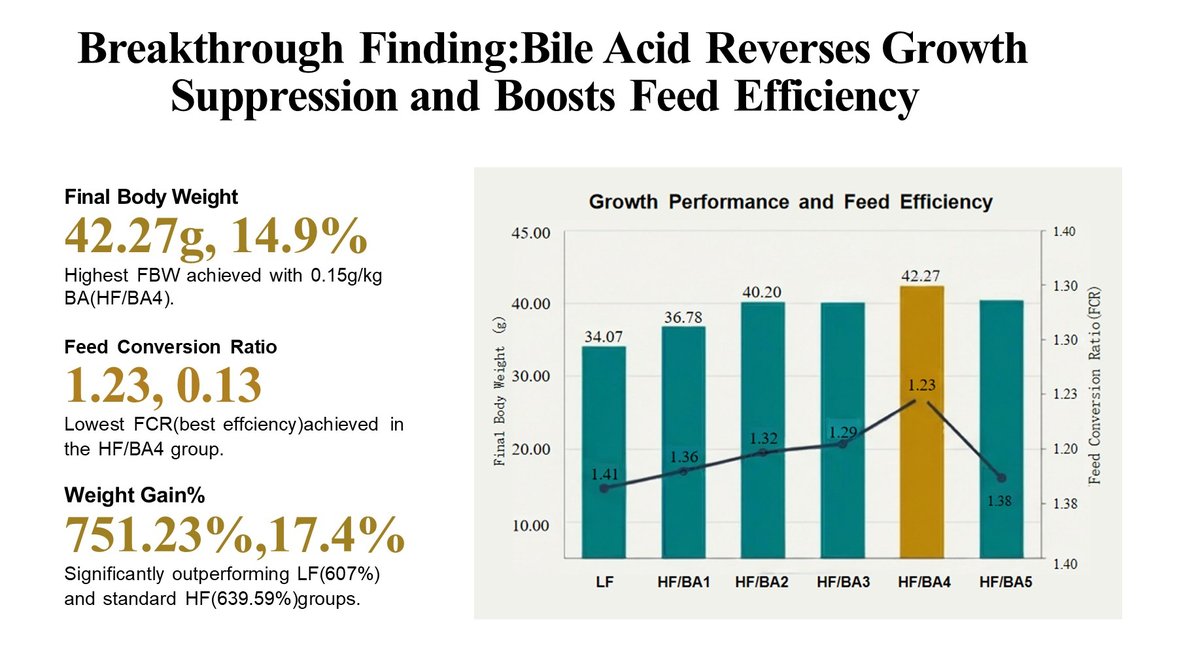
Results presented by Wei Zhang, Lachance Aquaculture Technical Manager, during the webinar. Credits: Lachance
At the physiological level, bile acids helped reverse fatty liver conditions by reducing lipid accumulation and restoring normal liver structure. They also repaired intestinal damage caused by high-fat diets, increasing the surface area for nutrient absorption and reducing inflammation.
Moreover, bile acids influenced key metabolic and hormonal pathways. They enhanced the activity of digestive enzymes, increased growth hormone levels, and reduced leptin, a hormone associated with appetite suppression, thereby improving feed intake and utilization.
Biochemical analyses further confirmed their benefits. Bile acid supplementation normalized blood indicators such as cholesterol, triglycerides, and glucose levels, and improved liver enzyme profiles. Additionally, they strengthened the antioxidative defense system by boosting enzymes like superoxide dismutase (SOD), catalase (CAT), and glutathione peroxidase (GPx), helping fish cope with oxidative stress.
Zhang concluded that bile acids are not merely a feed additive but an enabling technology that allows producers to fully exploit the economic advantages of high-fat diets without compromising fish health. By improving growth, enhancing welfare, and supporting sustainability, they represent a key innovation in modern aquafeed formulation.
Conclusion
Tilapia Talk 2026 underscored a fundamental shift in aquaculture: success is no longer defined by production volume alone, but by efficiency, resilience, and integration. Advances in genomic breeding, the strategic use of functional feeds, and innovations like bile acid supplementation are reshaping the industry.
As tilapia farming becomes more complex, the path forward lies in combining better genetics, smarter nutrition, and more precise management. In this new era, profitability will depend not on a single breakthrough, but on how well these elements work together.
Watch Tilapia Talk 2026 here.