
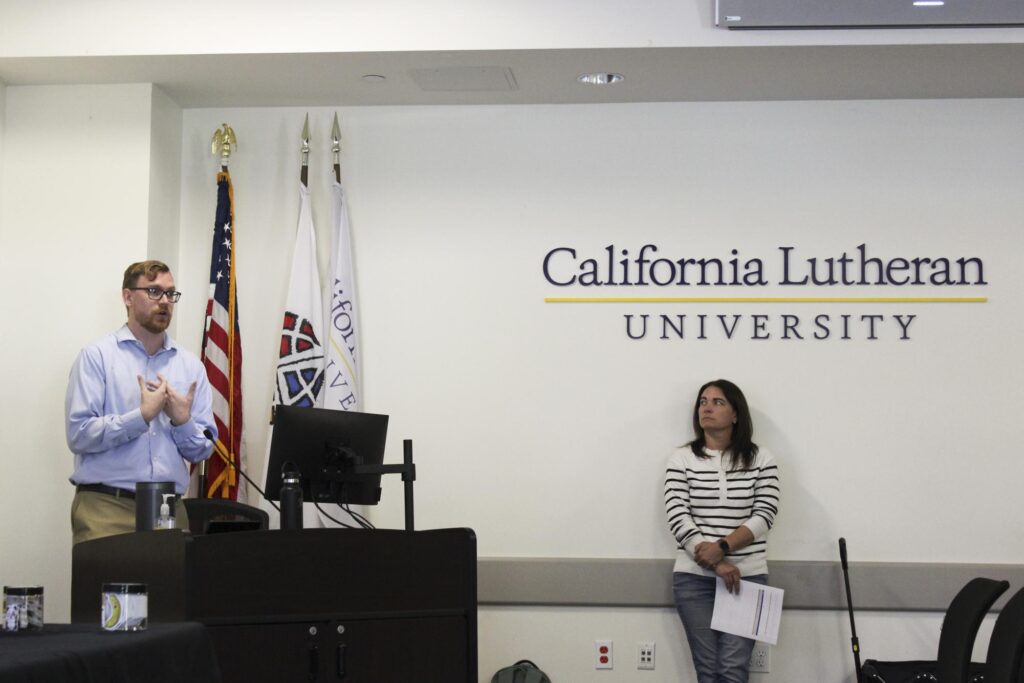
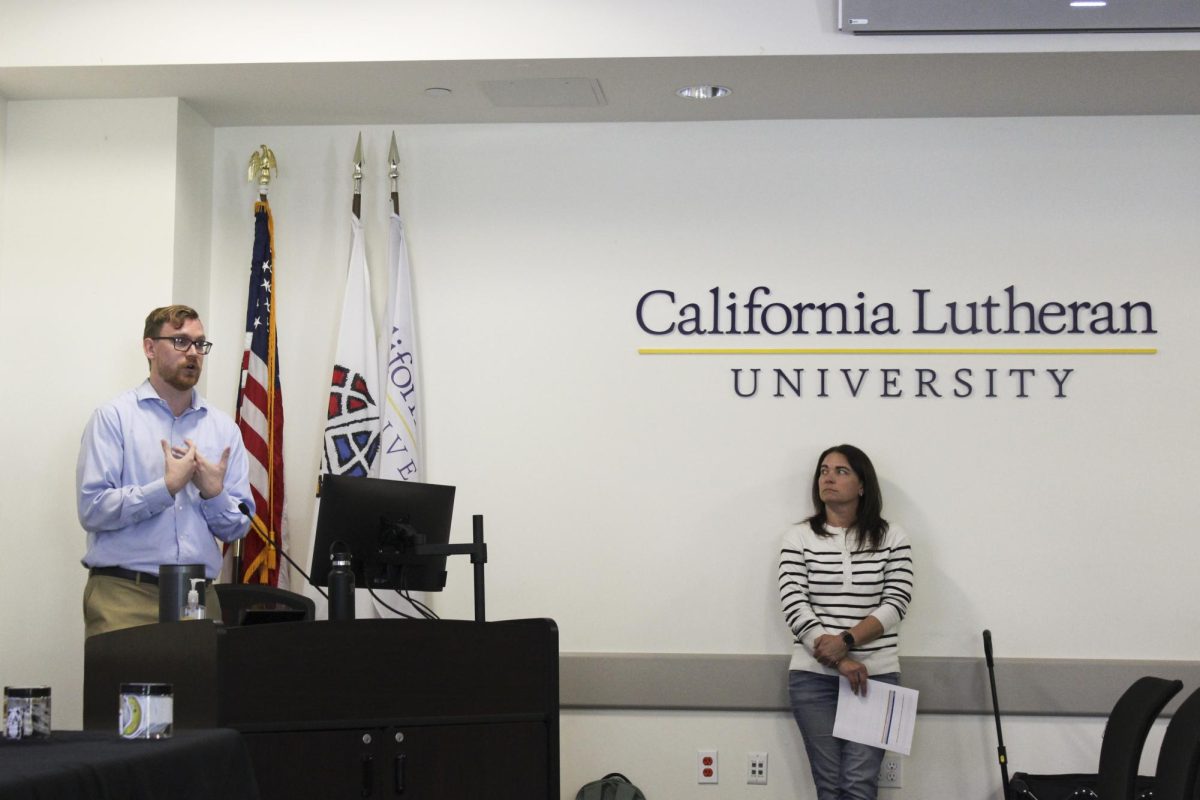
Ricardo Cornejo (left), a CAPS psychologist who holds a doctorate in clinical psychology and serves as the CAPS athletics liaison, presents a slideshow at the workshop alongside Christy Linder (right), a trainee clinician at CAPS.
California Lutheran University’s Counseling and Psychological Services’ “Identity as an Athlete” workshop on Wednesday, April 15 addressed the question of what happens when athletes’ sport are taken away from their identity, whether by injury, graduation or the passage of time.
The presentation was developed by Ricardo Cornejo, a Cal Lutheran CAPS psychologist and CAPS athletics liaison who holds a doctorate in clinical psychology, alongside Christy Linder, a trainee clinician at CAPS and former Michigan State University gymnast.
According to Director of CAPS Anna Guerin, who holds a doctorate in clinical psychology, the idea for the workshop grew directly from student and staff feedback.
“This was a topic that was deemed as important for the health and well-being of student athletes,” Guerin said in an email interview.
Cornejo said the end-of-year timing of the event was intentionally chosen to address the pressing needs of student-athletes.
“What we saw was a need for a lot of athletes, especially around this time, was assistance in figuring out how to adapt when either there’s injuries or they’re graduating and they’re maybe not going to be able to be athletes anymore,” Cornejo said.
The workshop was grounded in Acceptance and Commitment Therapy, or ACT, a psychological framework centered on values and committed action, Cornejo said. Rather than focusing on athletic goals alone, Cornejo said he encouraged attendees to examine what draws them to their sport in the first place.
“Trying to ask yourself why you like the sport you’re in, what about it is rewarding, and maybe see if you can find ways to engage with that outside of the sport,” Cornejo said.
Cornejo addressed the growing role of social media in athlete mental health, noting a “fear of results being posted online” and “feeling like there’s a lot of eyes and potential for criticism” as concerns he hears regularly. While those pressures may not be new, he suggested that social media has made them harder to ignore.
Senior Regals basketball center Deanna Broughton attended Wednesday’s event and said the presenters’ message resonated with her because she tore her ACL toward the end of her season.
“[Cornejo] called me out with the injuries a little bit because I felt like I resonated with that, with the non-acceptance or, like, pushing my limits too much,” Broughton said.
Despite her injury, Broughton said she found ways to stay connected to her team and her identity as an athlete.
“I still made sure I was, even though I wasn’t playing or practicing, that I was still, like, showing up to practice, and, like, I even suited up when I couldn’t even, when there was no chance for me to play,” Broughton said. “So that’s how I just try to find the good things due to the injury and not kind of dwell and try to focus on still being there for my team.”
Cal Lutheran’s relatively small campus, Cornejo said, offers an advantage to students when it comes to mental health support.
“When they’re looking for resources or support from the people around them, there are people that are available to them in a way that maybe is not the case at other universities,” Cornejo said.
Broughton said CAPS, the Hidden Opponent club, and the athletics mental health staff are signs the university is invested in athlete wellness beyond performance.
For graduating athletes especially, the transition away from the sport can feel disorienting. Cornejo said ACT’s concept of values, such as asking what is important to you in your life and the things that you draw meaning from, offers a powerful tool for navigating that shift.
“A lot of athletes are engaging with values already through their sport. They just might not realize it,” Cornejo said.
Cornejo encouraged athletes to ask themselves: “Why do I like the things that I like? What kind of person do I want to be and what are the behaviors that I can start engaging in and would be willing to engage in in order to make progress towards living alignment with those values?”
Broughton said this focus on values stood out to her the most in Wednesday’s discussion.
“I like how [the presentation] made us reflect on how we saw it in our athletic lives into, like, our academic or, like, professional lives,” Broughton said.
Guerin said CAPS held a workshop on performance anxiety last semester, and hopes to continue offering at least one workshop per semester in the coming academic year.
For any athlete feeling lost, whether between seasons, after an injury or heading into post-grad life, Cornejo said it can be helpful for them to engage with their values, admit when they need help and talk about their struggles with someone they trust.
“Make one step towards doing something different, even if it feels like it’s really small, because that builds momentum for us to be able to make other changes,” Cornejo said.