




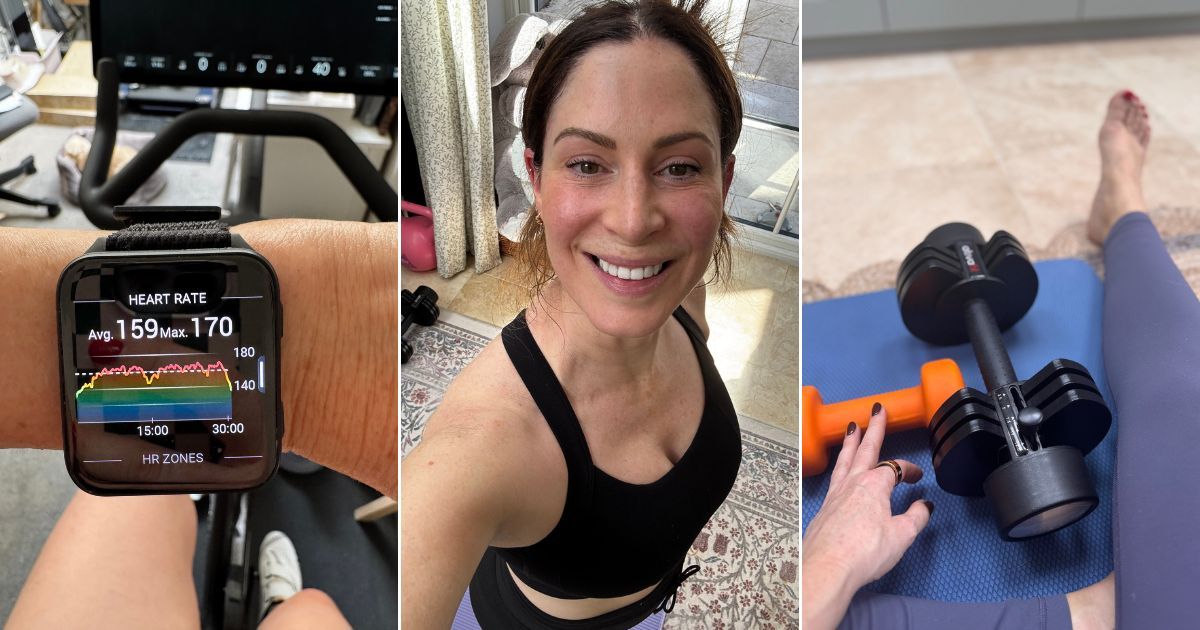
Ever been stuck in a workout rut? You know the kind: your routine feels stale, and you’re just not seeing the results you used to. If so, you’re not alone: plateauing is totally normal, even if it is super frustrating.
Sometimes, all you need is a rest, but if you’re not one to take a week (or more!) off, then – same – and the old adage rings true, here: a change is as good as a rest. Mixing things up not only benefits our minds, but also our muscles. too. In fact, recent research (published in the journal BMJ Medicine) shows that varying our workouts is associated with increased longevity – reason enough to give it a go.
So, it’ll come as no shock to you that when I was asked to try the trending Norwegian 4×4 workout for a month, I was all in. Touted by experts as being the ultimate longevity workout, the method has been gaining traction on socials for its heart health and cardio fitness benefits – specifically, an improved VO2 max score.
Article continues below
You may like
We’ll cover more on what this means exactly further down, but in essence, a good VO2 max score lowers our risk of all-cause mortality and cardiovascular disease (check out this study, published in the journal Translational Sports Medicine). No wonder, then, that the Norwegian 4×4 is making waves in the fitness world as a simple (but not exactly easy!) way to achieve a higher score.
Keep scrolling for all the details of my month’s trial, but in the meantime, take a look at our comprehensive guides to VO2 max for beginners, the Norwegian 4×4 workout, and the most effective cardio workouts, here.
The Norwegian 4×4 boosts VO2 max like nothing else – I tried it for a month What is the Norwegian 4×4 workout?
Never heard of it? Here’s the lowdown. Originally developed in 1990 by researchers Dr Jan Hoff and Dr Jan Helgerud at the Norwegian University of Science and Technology, the basic premise utilises heart rate zones to maximise intensity and efficiency across the workout.
“The Norwegian 4×4 method is simply another variation of high-intensity interval training (HIIT), a training style that has been proven to deliver results for decades,” explains Emily Schofield, certified personal trainer at Ultimate Performance.
Essentially, it is built on the principle of performing four minutes of high-intensity work, typically at around 85 to 95% of your maximum heart rate, followed by three minutes of active recovery. You repeat this sequence four times (so four ‘reps’, if you like) usually alongside a warm-up and cool-down, resulting in a session lasting about 30 to 40 minutes.”
So, four minutes, four times equals 4×4. Sounds simple, and brutal, all at the same time.
What are the benefits of the Norwegian 4×4 workout?
If you’re wondering why on earth anyone would do this, same, but there are so many benefits to this style of workout (sorry!)
What to read next
1. It’s efficient and effective
There’s no doubt that the Norwegian 4×4 method will require you to work hard (very, very hard!), but, added up, it’s a mere sixteen minutes of all-out work – very little in your day as a whole, right?!
“One of the major advantages of the Norwegian 4×4 workout is efficiency,” shares Schofield. “A well-structured HIIT session like this can deliver powerful results in a relatively short period of time. Even sessions lasting under 30 minutes can produce profound improvements in fitness and body composition, which makes it particularly appealing for women with busy schedules who need to make the most of what time they do have to dedicate to their fitness.”
2. It boosts cardiovascular health
While there are so many benefits to working out, if we strip it all back, one of the main benefits of any type of exercise is that it improves our cardiovascular health, building stronger hearts and lungs. And this, the 4×4 workout does, in spades.
“One of the main benefits of the Norwegian 4×4 workout is that you’re training your heart to become stronger and more powerful,” agrees personal trainer Monty Simmons. “You’re also improving the elasticity and function of your blood vessels, so your arteries and veins become more efficient at transporting blood. At the lung level, you’re improving oxygen uptake, and at the muscle level, you’re improving how that oxygen is delivered and used to produce energy; also, that whole transport and utilisation system becomes more efficient.”
“Much of the hype and popularity surrounding the Norwegian 4×4 method centres on the fact it can improve your VO₂ max,” notes Schofield. “In brief, VO₂ max refers to the maximum amount of oxygen your body can utilise during intense exercise and is one of the most widely regarded indicators of a person’s cardiovascular fitness.
“A higher VO₂ max reflects a more efficient heart, stronger lungs, and a greater capacity for delivering oxygen to working muscles. Or, to put it another way, it represents the size and power of your aerobic engine!
“Improving your VO₂ max has genuine benefits and should not be treated as just ‘another’ metric in the data-driven age we live in,” she continues. “Greater VO₂ max levels will enhance your endurance, support your overall health, and are strongly associated with increased longevity. This is why it has become such a focal point in both performance and health-focused training programmes.”
4. It builds stamina and functional fitness
“In terms of outcomes, your stamina will improve, both in everyday life and in training,” advises Simmons. “Things like walking up stairs, running for the bus, cycling, or hiking will feel easier. In the gym, you’ll recover better between sets and rounds, and you’ll be able to sustain effort for longer without feeling as exhausted. Recovery improves both during workouts and between sessions, because your aerobic system becomes more efficient.”
Why is the Norwegian 4×4 workout trending?
As far as fitness trends go, there’s not really any such thing as reinventing the wheel; most of what we learn is established principles executed in new ways – and the Norwegian 4×4 method is no different.
“In reality, I wouldn’t look at the Norwegian 4×4 method as something that is revolutionary or new, albeit it most certainly can be effective,” shares Schofield. “What you typically see is variations on the basic fundamentals of exercise being packaged as something new, and because most people are looking for the maximum results in the least amount of time possible, they’re drawn to these types of trends.
“The Norwegian 4×4 method is gaining a lot of traction and popularity in fitness circles at the moment because it is being presented as a cutting-edge, science-backed approach to improving your cardiovascular fitness, being a bit of a silver bullet for fat loss, and for boosting your VO₂ max levels.
“And, with buzz phrases such as ‘longevity’ and ‘improving the quality of your life’ being the zeitgeist of the day, anything that claims to improve your VO₂ max levels is naturally going to get a lot of attention.”
TLDR: it’s not a new approach, it is good for fitness and VO2 max, but there’s no such thing as a shortcut: when it comes to making meaningful changes to your cardiovascular fitness, it takes time, consistency and graft.
How to do the Norwegian 4×4 workout
One of the advantages of the protocol is that you can more or less tailor it to whatever form of exercise you enjoy, whether that’s running, strength training, cycling or something else entirely.
“Most commonly, people opt for four minutes of running or cycling or rowing because of the ease with which modern cardio machines allow you to increase and decrease your speeds (intervals),” says Schofield. “But any exercise you can perform intensely for four minutes would technically count.”
I tested the Norwegian 4×4 workout for a month to improve my VO2 max – here are my findingsWeeks one and two
I’ll be honest: I’m not a huge fan of HIIT workouts. Despite their undeniable benefits, I think I overdid them back in the noughties, and since I turned 40, I’ve veered away from them, preferring a gentler, more holistic approach to fitness. So, it’s with some trepidation that I select a HIIT-style strength training session for my first foray into a Norwegian 4×4.
I know it’s going to be tough – and, reader, it is – but what I wasn’t prepared for was how much I was actually going to enjoy my workout. That’s right: it was quite fun! Whether it was muscle memory from all those years of training in a similar style, or just the fact that I knew it was short-term pain for long-term gain, I was pleasantly surprised (not to mention relieved!) after my first workout.
I won’t lie: it was hard work. Four straight minutes of strength training with heavy weights isn’t for the faint-hearted, and I did drop my weights down around halfway through my session, having been slightly overly optimistic with my selection. I also broke up the four minutes, so I did one minute of each move (alternating between burpees – my personal nemesis, kettlebell swings, squat to clean and jumping jacks) so I didn’t get too bored, which definitely helped. I can’t imagine doing four minutes of straight burpees!
For my active recovery, I switched between weighted squats and lunges – full disclosure, I actually think that was too much, as my heart rate remained pretty high all the way through the workout.
In terms of measuring intensity, I’ll admit, I went old-school and did this on feel rather than wearing a heart rate monitor, partly because I was quite nervous to begin with, and sometimes tracking my metrics increases my anxiety.
I kept the rest of my week the same as usual: a barre-style workout, reformer and mat Pilates and a 7k run, as the experts advise that once a week is enough for the Norwegian 4×4. Phew!
At the start of week two, I decided to challenge myself on a run. I’ll admit: I’m one of those runners who will complain about never getting any better, but I’m reluctant to actually do the things that I know will help me improve (hill sprints, I’m talking about you). So, I’m intrigued to learn whether incorporating the 4×4 method will help, but I also know that a single workout isn’t going to make much (or indeed any!) difference in the big scheme of my running ability – this is more to test how easy the protocol is to follow as I run.
And I’m delighted to report that in terms of a method of run training, it’s super easy: my Garmin does the hard work for me, keeping track of time and my heart rate. This being said, the actual workout itself is far from easy. There’s only one word for it: brutal. Running at 85% capacity for four minutes feels endless, and I confess, by the third round, I was pretty much finished.
On the upside, I felt amazing when it was over, which I’ll take.
I won’t lie: it took monumental levels of self-motivation to tackle week three. After last week’s run, the memory of those intervals is still haunting me as I hop on the bike for a spin class – I know it’s going to be tough.
But we can do hard things, right? So I buckle up and face the music – and, as is so often the way, it’s not as painful as I’d feared. Note to self, though: attempting this immediately after lunch isn’t one of my all-time best ideas. I also notice that I struggle to get my heart rate in the right range, and I spend much of the workout checking and rechecking my Garmin – which is mildly annoying.
That being said, I feel invincible afterwards – if only we could bottle up that post-workout high! And it’s this that becomes my most important takeaway from the challenge: at the start, I’d got out of the habit of feeling uncomfortable in my workouts, preferring instead to stay in my comfort zone, despite knowing that this isn’t where the growth happens. But over the four weeks, I’ve proved to myself that I can still push my limits, even if only for four minutes (trust me when I say, four minutes can feel endless!)
The mental health wins are something Simmons advocates, too.
“As it becomes harder for you to get out of breath, and you become more comfortable working at higher intensities, it increases your physiological and psychological tolerance to hard work,” he notes.
All this, and I’m still only working out for around half an hour each session, so I’m done and dusted in no time at all, despite sweating for a while afterwards (I am a serious sweater!)
Before I know it, the month is almost up, and it’s time to assess my progress. Have I gained fitness? I think I have, based less on actual data and more on how exhausted I feel running up the hill to collect my son from school (I’m perennially late, so it’s pretty much a faily thing), but I’ll take it. I also notice that I’m spending more time in the amber zone of my Garmin heart rate, rather than red, which, according to Simmons, is a sign my fitness is on the up.
“As you get fitter, you’ll notice it takes more effort or speed to hit that 85% target, which is a good sign your cardiovascular system is improving,” he notes.
As for my VO2 max, I’ll be frank: it hasn’t moved, yet, but any significant uptick here is likely to take longer than four sessions, so I’m undeterred. Watch this space.
Shop MC UK’s go-to workout essentials now:

Fly-By 2-In-1 Shorts – Electric Tangerine/reflective
Let me tell you: running shorts are a game-changer in this weather. No more sweating through black lycra, these shorts are lighter, airier and more comfortable than their longer counterparts, but still benefit from inner cycling shorts to prevent the dreaded thigh chafe.

Adanola Seamless Racer Back Bra in Dusty Pink
Whatever your workout of choice, Adanola is a great option. We love their new seamless range, for comfort, style and substance.

Lululemon Align™ High-Rise Pant 25″
Still in the market for leggings? We love the lululemon Align range: it’s soft, comfortable, and perfect for low-impact days (or just wfh days!)
Is the Norwegian 4×4 workout really effective in boosting vo2 max?
“The Norwegian 4×4 method is undeniably effective, not because of the catchy name, but because it’s grounded in basic fitness principles and supported by research,” advises Schofield. “So, can it deliver meaningful improvements in cardiovascular fitness and VO₂ max when applied correctly? Yes!
“Do remember, however, that factors such as fitness level, training history, goals, and recovery capacity will all influence which style of interval training is most appropriate for you. Find what works for you, don’t slavishly copy what might work for someone else or is considered on trend, look instead at fundamental principles that have worked for decades.
“Methods may evolve and vary, but the fundamentals remain pretty constant! Long-term results in your overall fitness levels and your body fat levels are driven by consistency, effort, and sustained intensity while exercising. The Norwegian 4×4 method can be incredibly effective if integrated into a more holistic fitness programme that combines strength training and HIIT together, rather than a standalone solution.
“If you enjoy the 4×4 method, go for it! Just make sure you complement your programme with strength training, don’t overdo the HIIT, and eat, rest and recover properly.”