




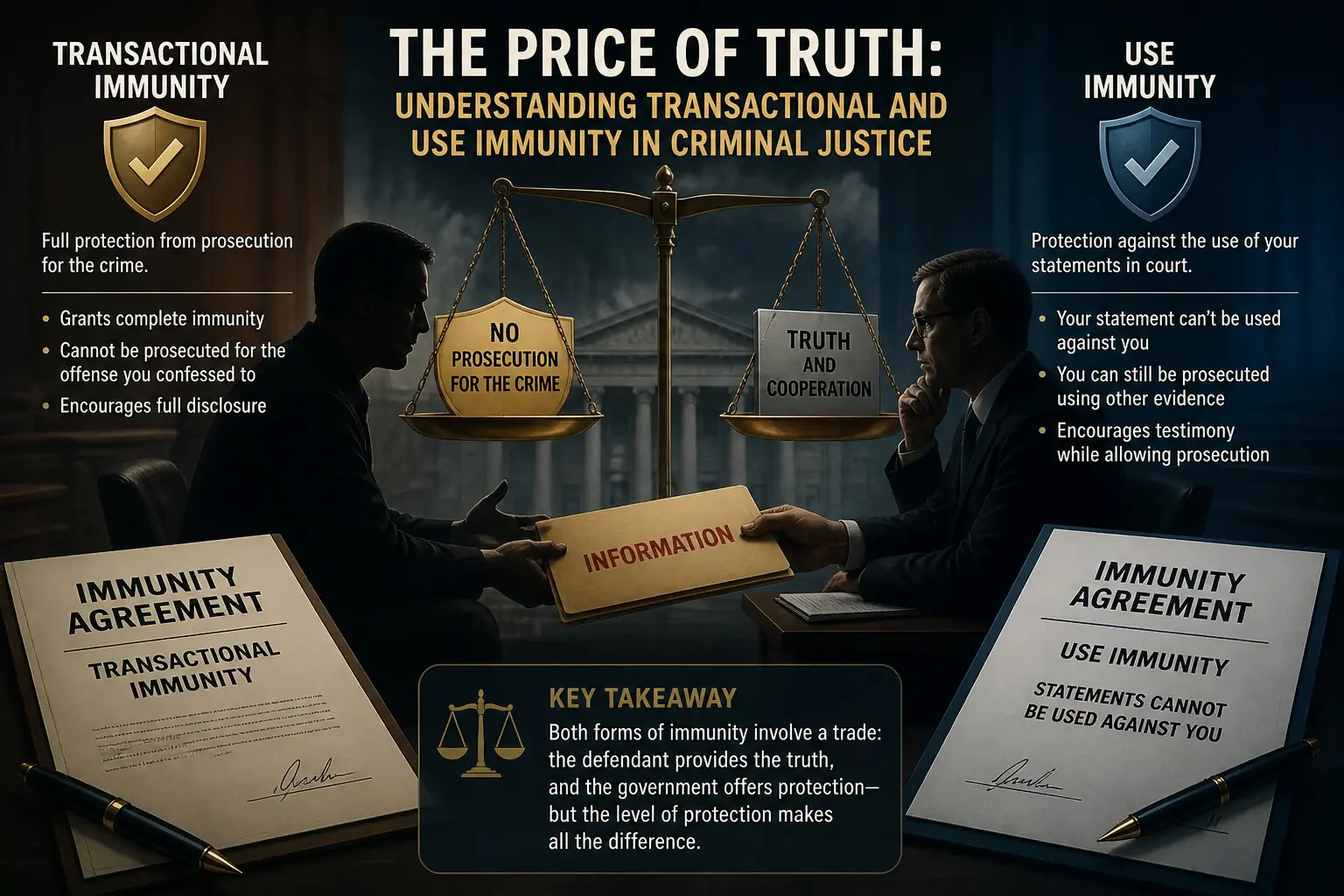
The tension between the state’s power to prosecute and an individual’s right to remain silent is one of the most profound conflicts in modern jurisprudence. To resolve this, legal systems—most notably that of the United States—have developed a mechanism known as immunity. At its core, immunity is a legal assurance by the state: in exchange for compelled testimony, the witness receives protection against the prosecutorial use of that testimony—sometimes extending even further. : the government waives its right to prosecute a witness in exchange for the witness waiving their right to remain silent.
However, not all promises of safety are created equal. In the legal “marketplace” of testimony, there are two primary currencies: transactional immunity and use (and derivative use) immunity. Understanding the distinction between these two is critical for any legal scholar, practitioner, or citizen interested in the mechanics of justice.
The Constitutional Conflict: Why Immunity Exists
The Fifth Amendment to the U.S. Constitution—and comparable protections in other constitutional systems, including Article 20(3) of the Indian Constitution (which protects an accused person from compelled self-incrimination)—reflect a shared principle against compelled self-incrimination. This creates a stalemate. If a witness has information vital to convicting a high-level criminal but that information also reveals their own minor crimes, they will “plead the Fifth” to avoid self-incrimination.
To break this stalemate, the government must provide a “protective shield” that is at least as broad as the protection offered by the right to remain silent. Only then can the court legally compel the witness to speak. If the witness still refuses after being granted immunity, they can be held in contempt and jailed.
Transactional Immunity: The “Blanket” Protection
Transactional Immunity is often referred to as “Total” or “Blanket” immunity. It is the most robust form of protection a witness can receive.
The Scope
When a witness is granted transactional immunity, they are shielded from prosecution for the entire transaction or offense they testify about. If a witness testifies about their role in a 2023 bank robbery, the state is forever barred from charging them for that robbery, regardless of what evidence they find later.
The Effect
Finality: It operates as a complete bar to prosecution for the specific transaction disclosed.
Irrelevance of Independent Evidence: Even if the police later find a DNA sample, a confession to a third party, or high-definition security footage clearly showing the witness committing the crime, they cannot be prosecuted. The “transaction” is off-limits.
Prosecutorial Risk: This is a high-risk tool for the state. If a prosecutor grants transactional immunity to a “small fish” who turns out to be the mastermind, the state has effectively immunized the most guilty party.
Use and Derivative Use Immunity: The “Filtered” Protection
Use and Derivative Use Immunity is a more surgical approach. It is the narrower of the two and represents the constitutional minimum required to compel testimony.
The Scope
This immunity operates on two levels:
Use Immunity: The government cannot use the witness’s specific words (their testimony) against them in a criminal trial.
Derivative Use Immunity: The government cannot use the testimony as a “lead” to find other evidence. For example, if a witness says, “I hid the stolen jewels in my basement,” the police cannot then go to the basement, find the jewels, and use them as evidence. The jewels are a “derivative” of the immunized testimony.
The Catch: The Independent Source Doctrine
Unlike transactional immunity, the witness can still be prosecuted for the crime they discussed. However, the burden of proof shifts dramatically to the state. The prosecution must demonstrate that all its evidence was derived from a source entirely independent of the compelled testimony. This was established in the landmark U.S. Supreme Court case Kastigar v. United States (1972).
A Comparative Analysis: The Shield vs. The Armor
Feature
Transactional Immunity
Use & Derivative Use Immunity
Common Name
Blanket Immunity
“Kastigar” Immunity
Legal Breadth
Protects the person from the crime.
Protects the person from their words.
Can you be charged?
No, for that specific transaction.
Yes, if evidence is 100% independent.
Burden of Proof
State is barred.
State must prove “Independent Source.”
Usage
Rare; usually reserved for key witnesses.
Standard; used in Grand Juries.
5. The “Independent Source” Hurdle
The main debate about Use Immunity is whether it’s truly possible to “un‑ring the bell.” Once a prosecutor hears a witness confess, that knowledge may unconsciously influence how they investigate the case, even if they insist it doesn’t.
During a Kastigar Hearing, the government must prove that its evidence is completely free from the influence of the immunized testimony — that it is “untainted.” To do this, prosecutors often separate their teams so that those handling the case have never seen or heard the protected statements. This process is sometimes called erecting a “Chinese wall” / ethical screen between prosecutors.
If the barrier between these teams is broken and any member is exposed to the immunized testimony, the protection fails. In such cases, the court usually rules that the prosecution’s evidence is compromised and cannot be used.
The Global Perspective: India and Beyond
While “Use vs. Transactional” is a distinctly American framework, the underlying principles resonate globally.
In India: The system relies on the Tender of Pardon (Section 343 BNSS). This is closer to Transactional Immunity but is conditional. The pardon is granted only if the accomplice makes a “full and true disclosure.” If they lie, the pardon is revoked, and they are prosecuted.
In the UK: In the UK, immunity exists in more limited and structured statutory forms, while investigative emphasis often falls on evidentiary safeguards and adverse-inference doctrines rather than broad compelled-testimony mechanisms seen in the United States.
The Ethical and Practical Implications
The use of immunity raises significant ethical questions. Is it “justice” to let a murderer go free (Transactional Immunity) to catch a serial killer?
From a practical standpoint, immunity is the engine of complex litigation. Without it, organized crime, corporate fraud, and deep-seated government corruption would be nearly impossible to prosecute. Many insiders will remain silent unless offered credible legal protection against self-incrimination.
Conclusion: The Delicate Balance
The choice between Transactional and Use immunity is a choice between certainty and possibility.
Transactional Immunity offers the witness total certainty, making it the most effective way to encourage a witness to talk, but it comes at the high price of potential impunity for the guilty.
Use Immunity preserves the possibility of justice for all parties, but it creates a procedural minefield that can lead to the collapse of high-profile cases if the prosecution is not meticulously careful.
Ultimately, both forms of immunity serve the same master: the “Search for Truth.” They acknowledge that in the pursuit of justice, the state must sometimes give up its right to punish the few in order to protect the many.
Summary Rule of Thumb:
If you have Transactional Immunity, you are safe from the case.
If you have Use Immunity, you are only safe from your own mouth.
Views: 27,720